Puzzle types

45 puzzle types: where they come from and how to play them

Every puzzle our generator makes, in short: who made it, when and where, the other names it goes by, and its rules on a page of their own with a real book page and its answer key.

Word Puzzles

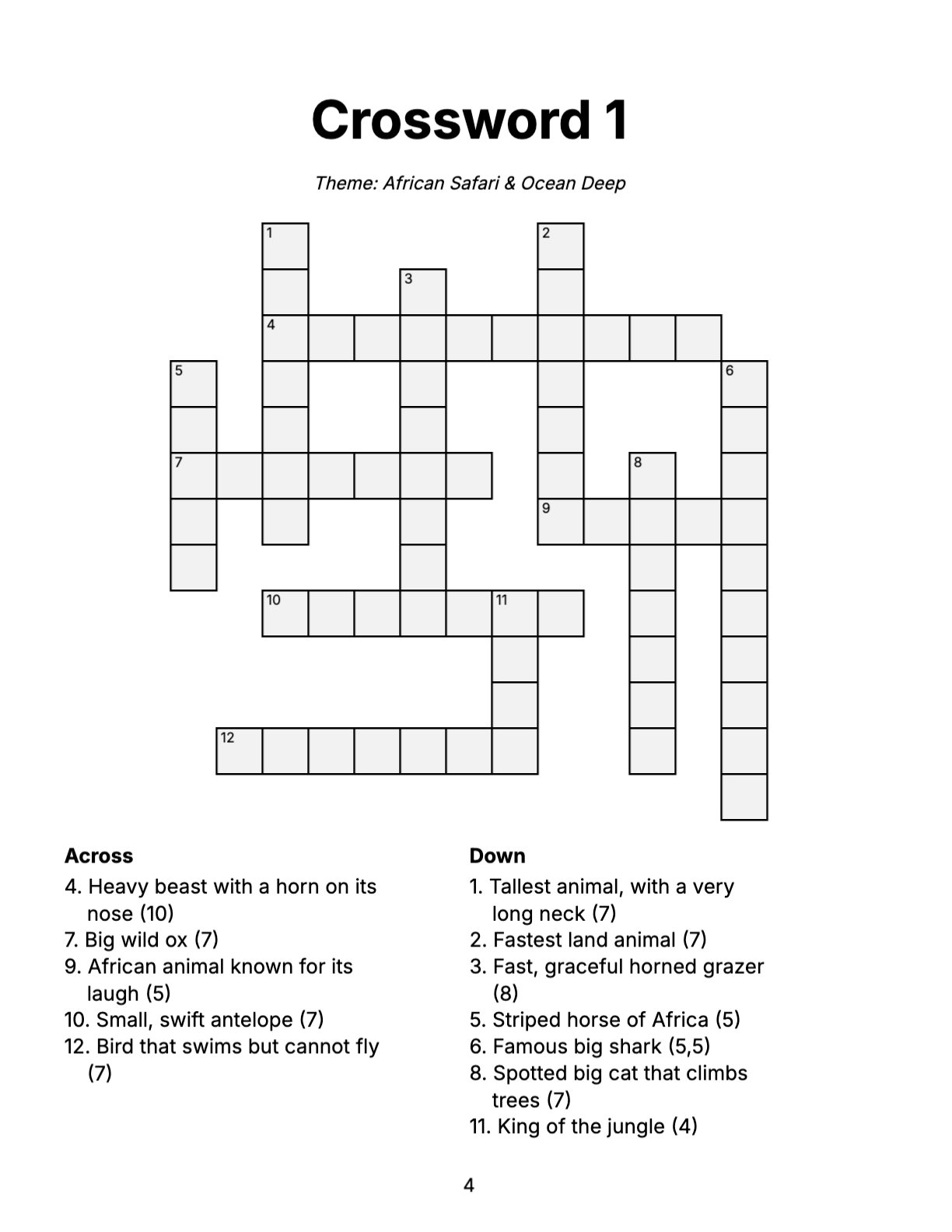
Crossword puzzle page from a Wisdom Effect book

Crossword

Answer the numbered clues and write the answers across and down in the grid.

When
21 December 1913
Where
New York, USA
Who
Arthur Wynne, a journalist from Liverpool

His "word-cross" ran in Fun, the Sunday puzzle supplement of the New York World, and crosswords became a craze in the 1920s.

Also known as freeform crossword and criss-cross crossword.
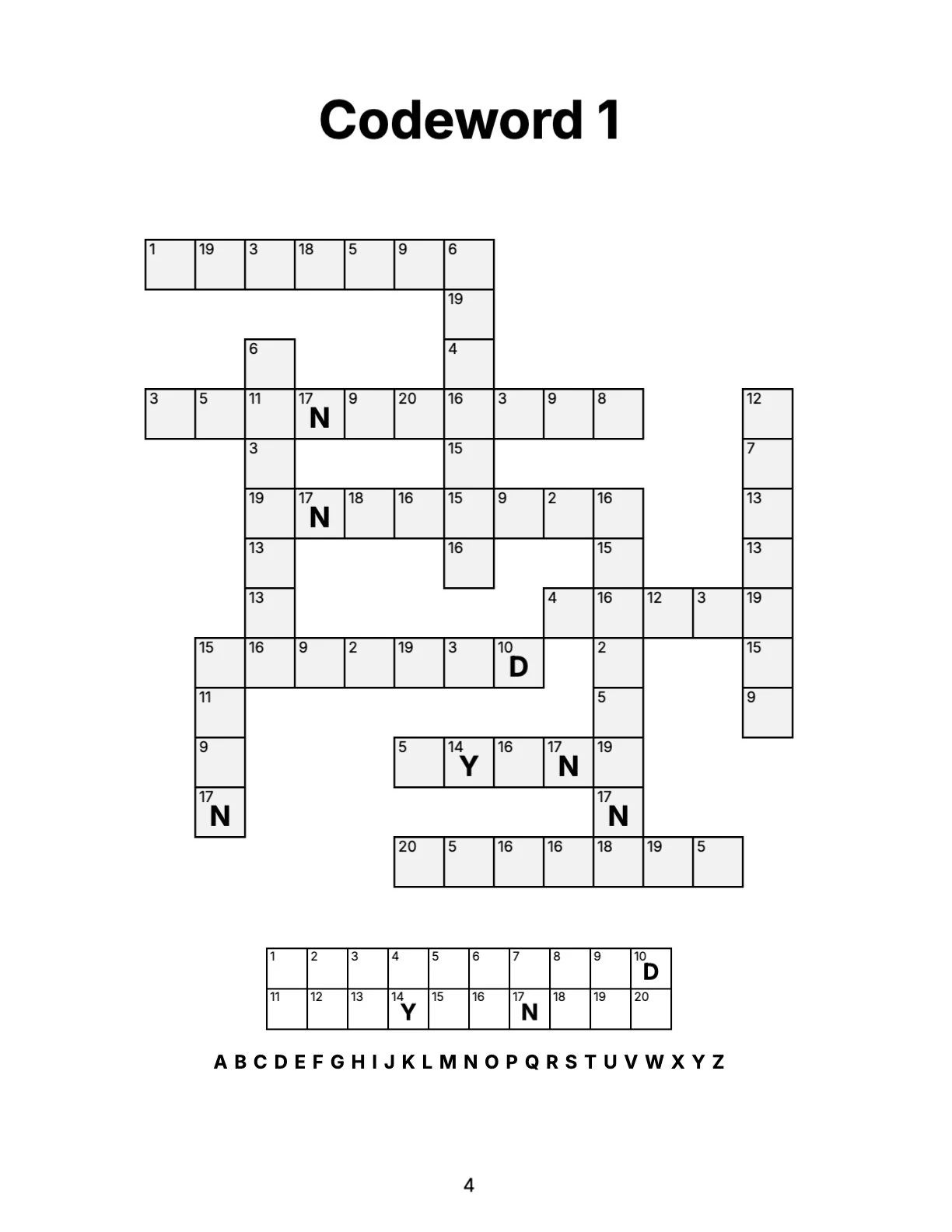
Codewords puzzle page from a Wisdom Effect book

Codewords

A crossword grid without clues where every letter hides behind a number.

When
Unknown
Where
Puzzle magazines
Who
Unknown

Codewords join the crossword grid with the letter code of the cryptogram. In Japan the puzzle is known as Kaidoku.

Also known as codebreakers, code crackers, Kaidoku and coded crossword.
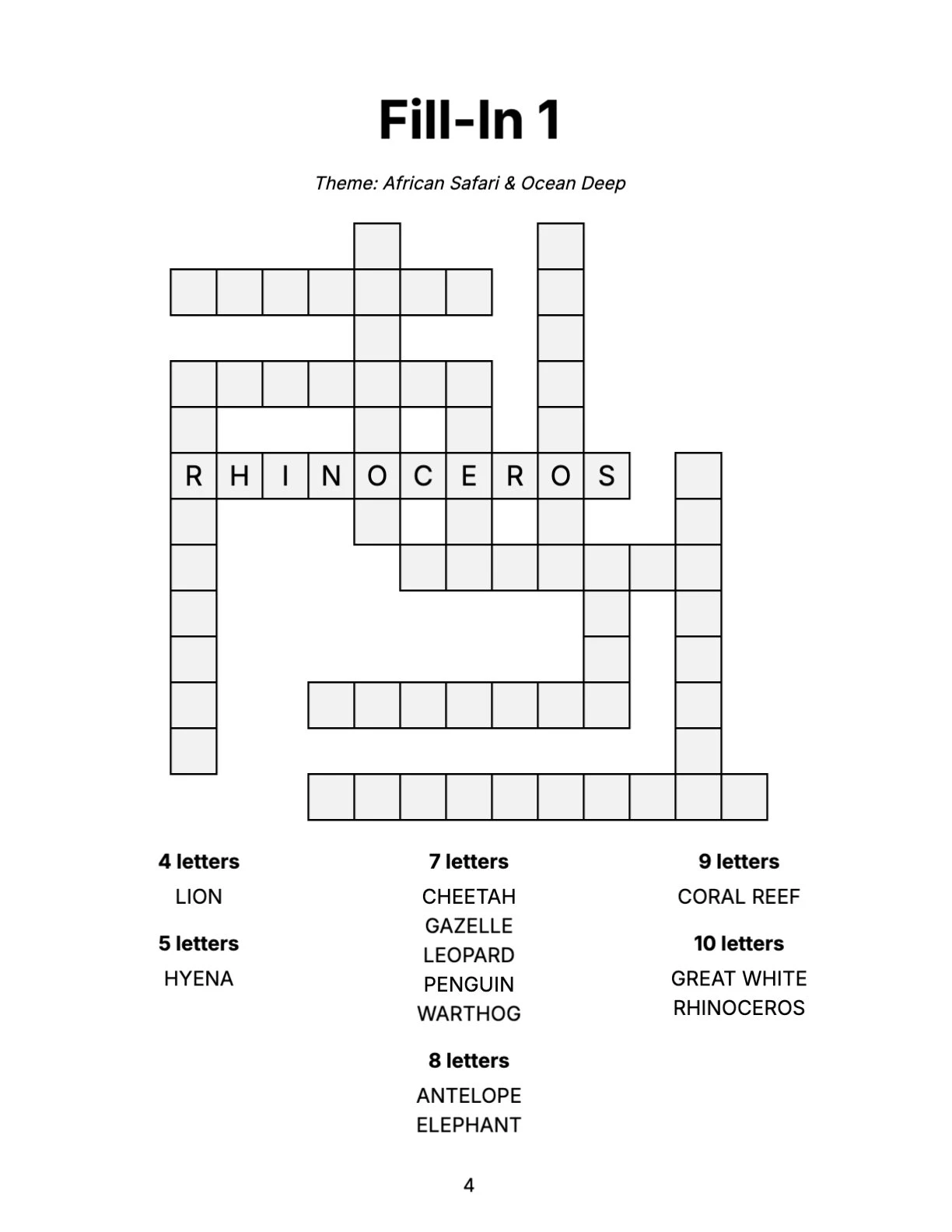
Fill-In puzzle page from a Wisdom Effect book

Fill-In

Fit every word of the list into the grid, like a crossword whose answers are given.

When
Unknown
Where
Puzzle magazines
Who
Unknown

A crossword without clues: you already have the answers and only need to find where each one goes.

Also known as kriss-kross, word fit and criss-cross.

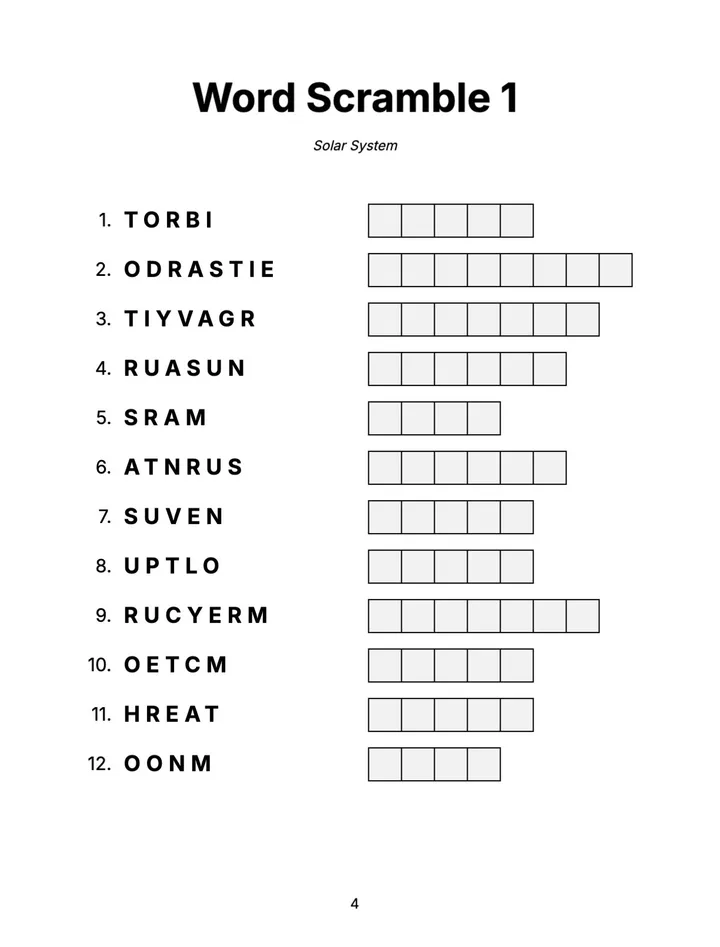
Word Scramble puzzle page from a Wisdom Effect book

Word Scramble

Put the mixed-up letters back in order to find the hidden words.

When
Unknown (in US newspapers since 1954)
Where
USA
Who
Unknown

Mixing up letters is as old as the anagram. A daily scrambled-word panel, Jumble®, has run in American newspapers since 1954. Jumble® is a registered trade mark of Tribune Content Agency; Wisdom Effect is not connected with Tribune.

Also known as scrambled words, jumbled words and unscramble the words.

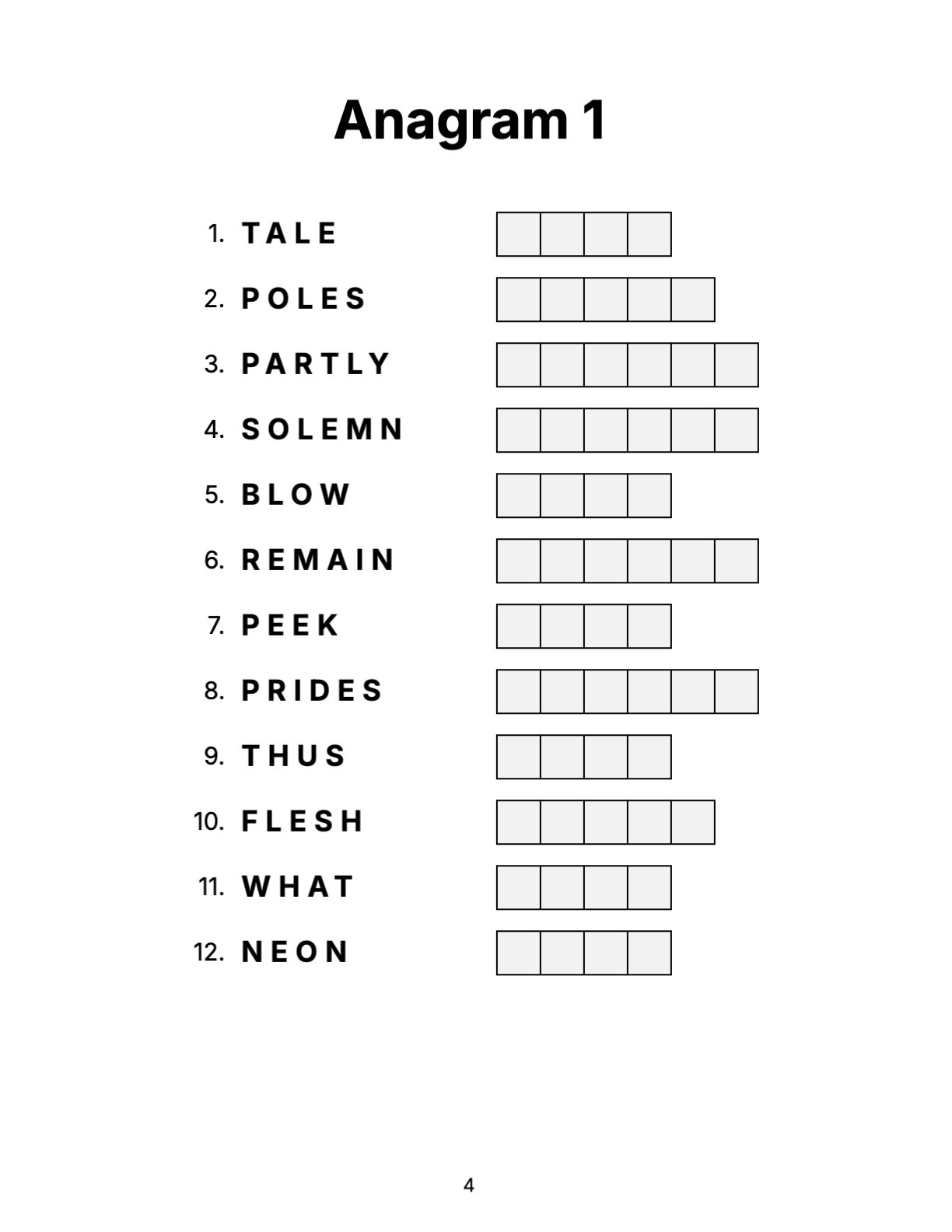
Anagram puzzle page from a Wisdom Effect book

Anagram

Turn each real word into another real word made of exactly the same letters.

When
3rd century BC
Where
Alexandria, Egypt
Who
The Greek poet Lycophron, the first known anagram maker

Lycophron turned royal names into flattering phrases. In 1676 the scientist Robert Hooke hid his law of springs in the anagram "ceiiinosssttuv".

Also known as word anagrams.

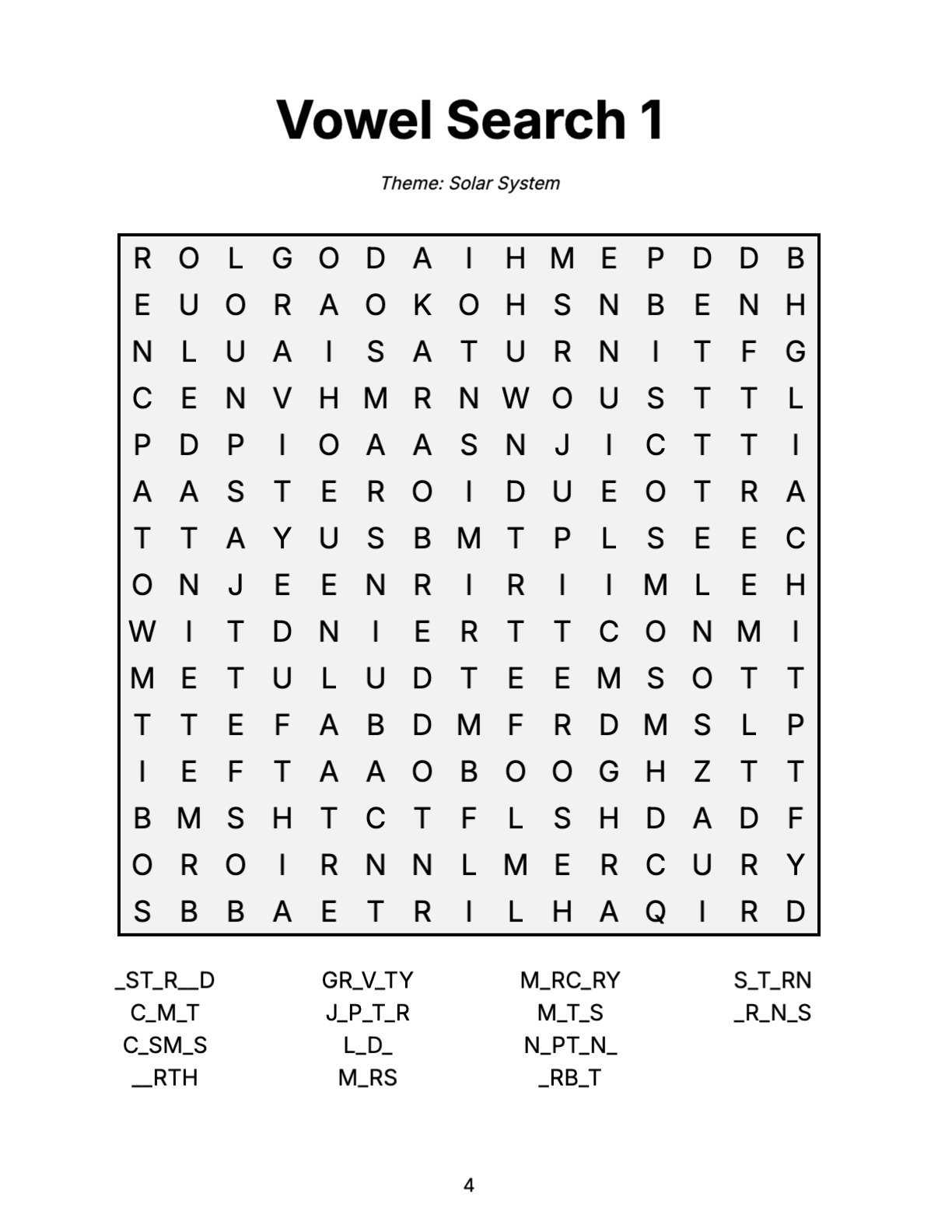
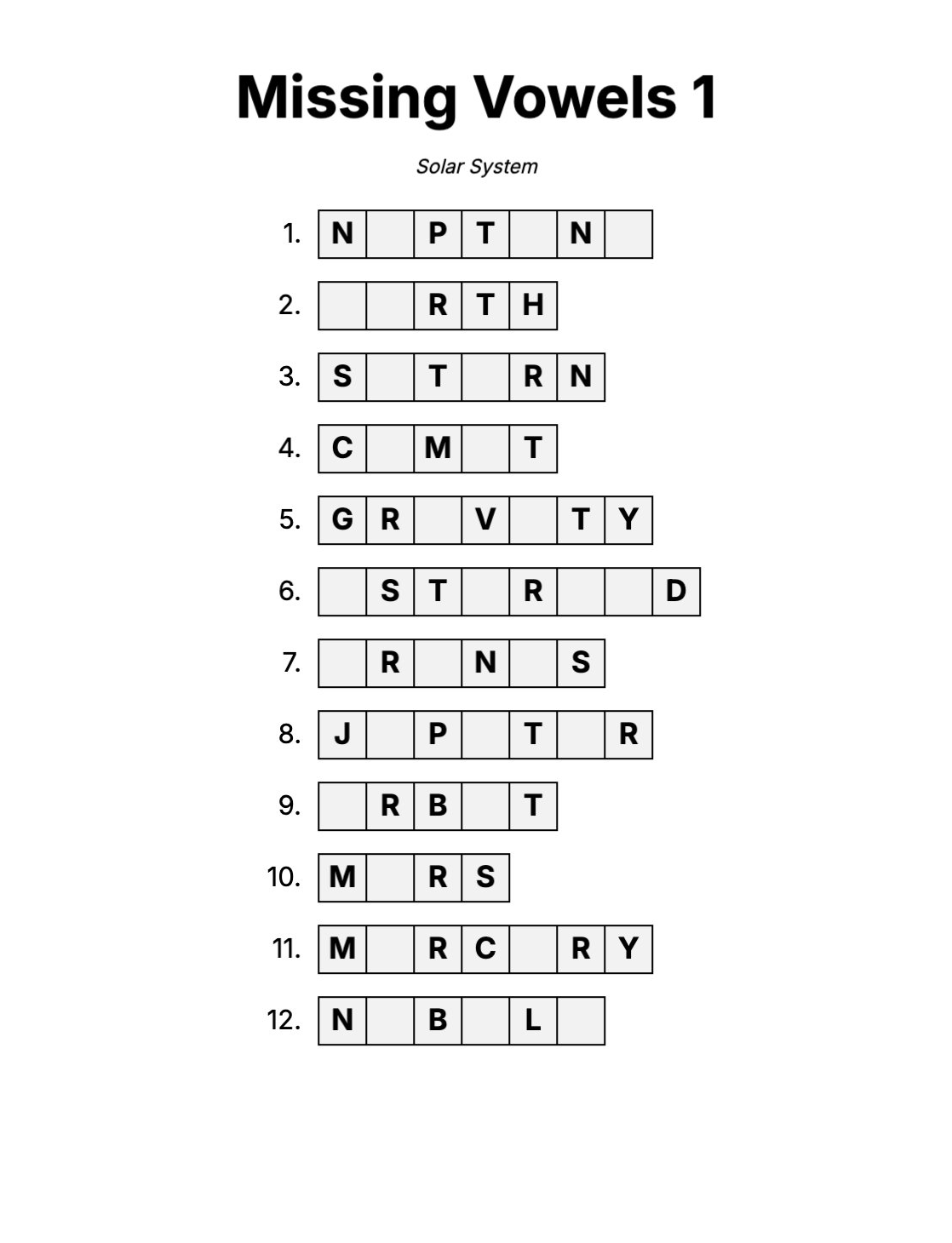
Missing Vowels puzzle page from a Wisdom Effect book

Missing Vowels

Put the missing vowels back into words printed with their consonants only.

When
Unknown
Where
Worldwide
Who
Unknown

Writing without vowels is ancient: the Phoenician alphabet wrote consonants only. As a game it became famous as the last round of the BBC quiz show Only Connect, from 2008.

Also known as words without vowels, disemvowelled words and consonant puzzles.

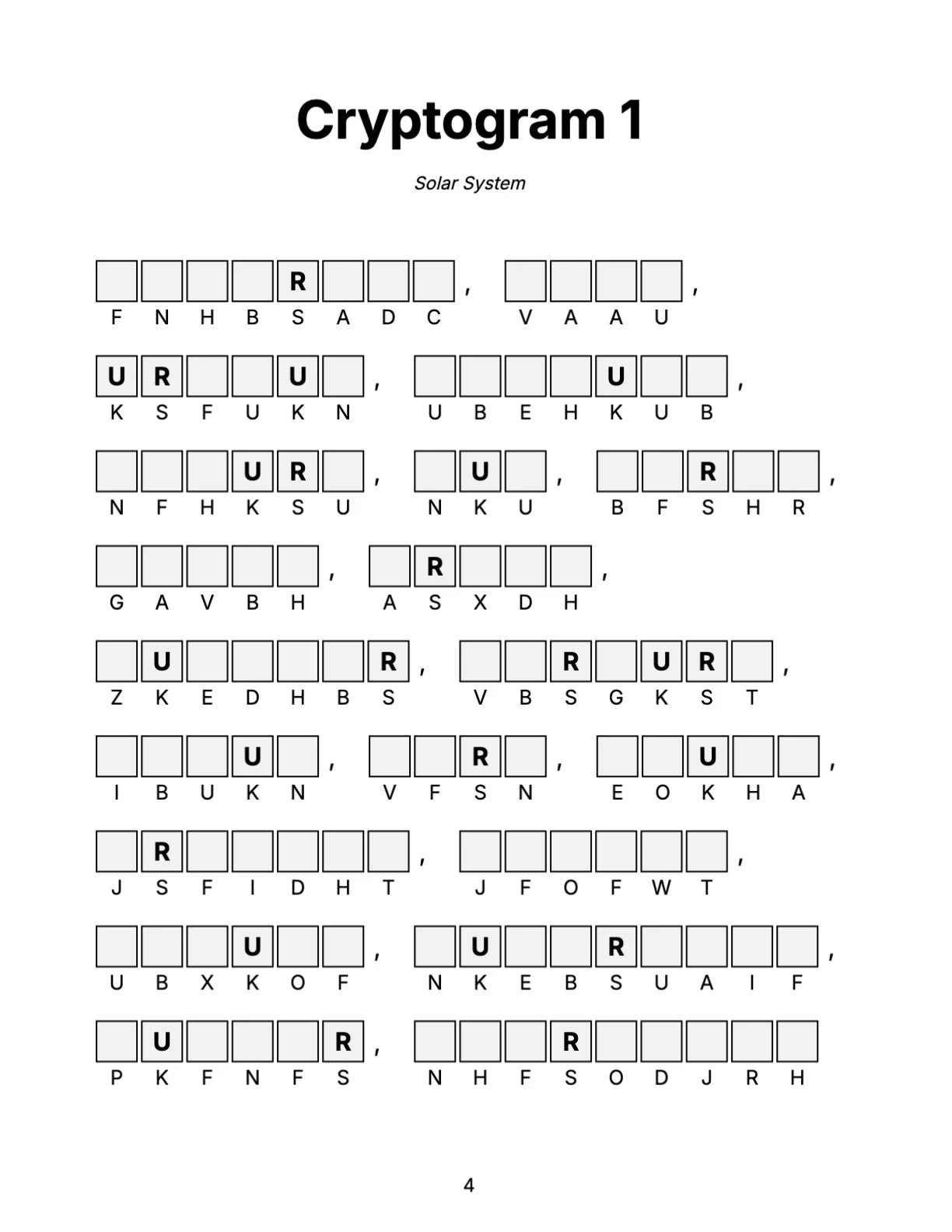
Cryptogram puzzle page from a Wisdom Effect book

Cryptogram

Crack a letter code to read a hidden quote or phrase.

When
1839 as a reader puzzle
Where
Philadelphia, USA
Who
Edgar Allan Poe made it popular

Julius Caesar already shifted letters to hide his messages. Poe challenged the readers of a Philadelphia weekly to send him ciphers and built his story The Gold-Bug (1843) around one.

Also known as cryptoquote, substitution cipher puzzle, aristocrat and patristocrat.

Number Logic

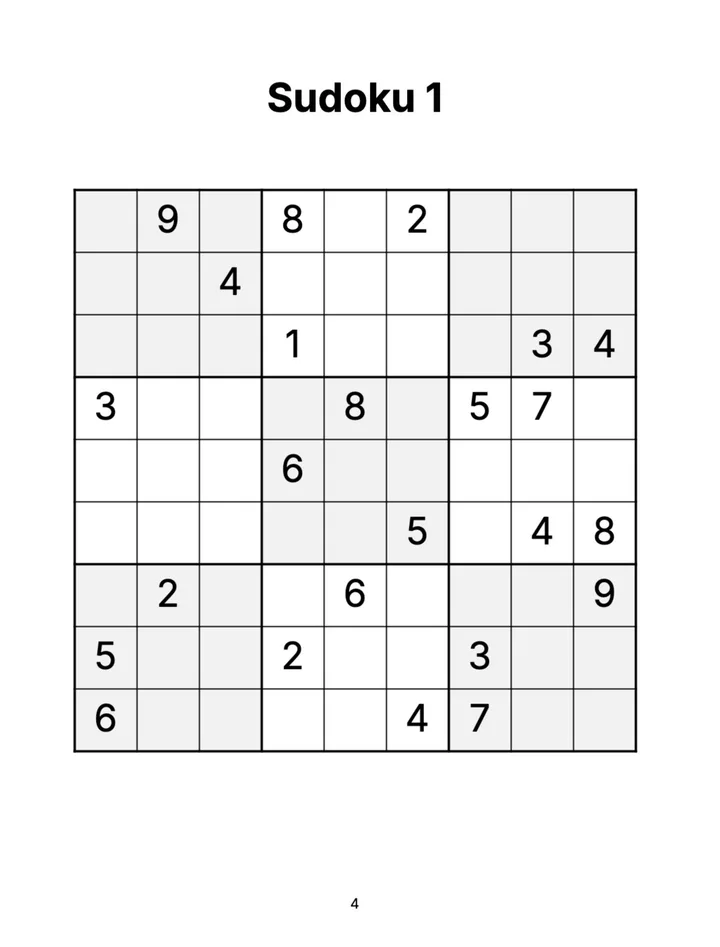
Sudoku puzzle page from a Wisdom Effect book

Sudoku

Fill the grid with digits so that no digit repeats in any row, column or box.

When
1979
Where
USA
Who
Howard Garns, a retired architect from Indiana

French newspapers printed similar number squares in the 1890s (Le Siècle in 1892, L'Echo de Paris from 1895). The modern puzzle ran in Dell magazines in 1979 as Number Place. In 1984 the Japanese publisher Nikoli printed it as "Sūji wa dokushin ni kagiru" ("the digits must stay single"), soon shortened to Sudoku, and The Times of London took it around the world in 2004. In Japan, Sudoku is a registered trade mark of Nikoli, so other Japanese publishers call the puzzle Number Place or Nanpure.

Also known as Number Place and Su Doku.

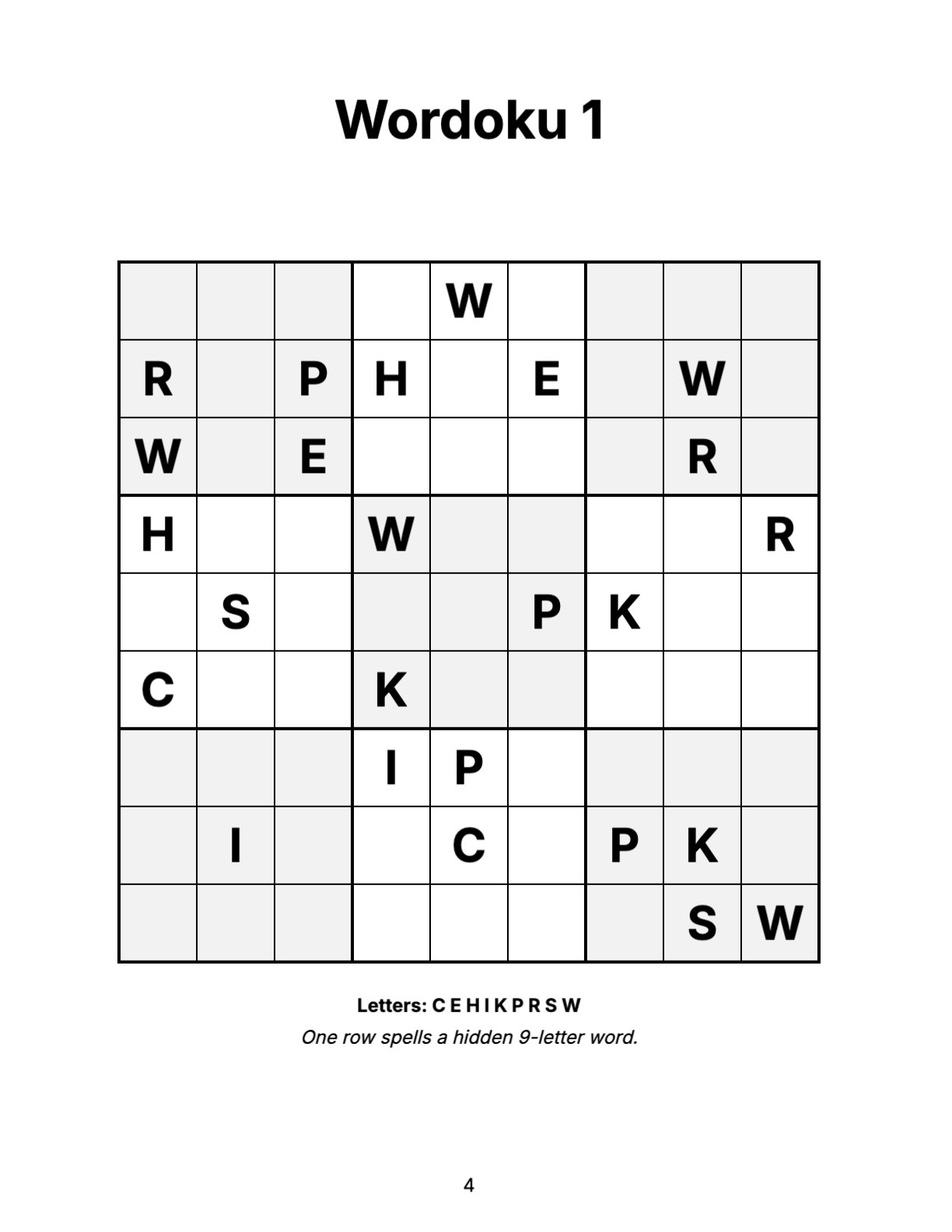
Wordoku puzzle page from a Wisdom Effect book

Wordoku

A sudoku with letters: fill the grid so that no letter repeats in any row, column or box.

When
Mid-2000s
Where
United Kingdom and USA
Who
Unknown

A sudoku needs nine different symbols, not numbers, so letter versions appeared during the sudoku boom of the mid-2000s, often built from the letters of one nine-letter word.
Also known as letter sudoku, word sudoku and alphabet sudoku.

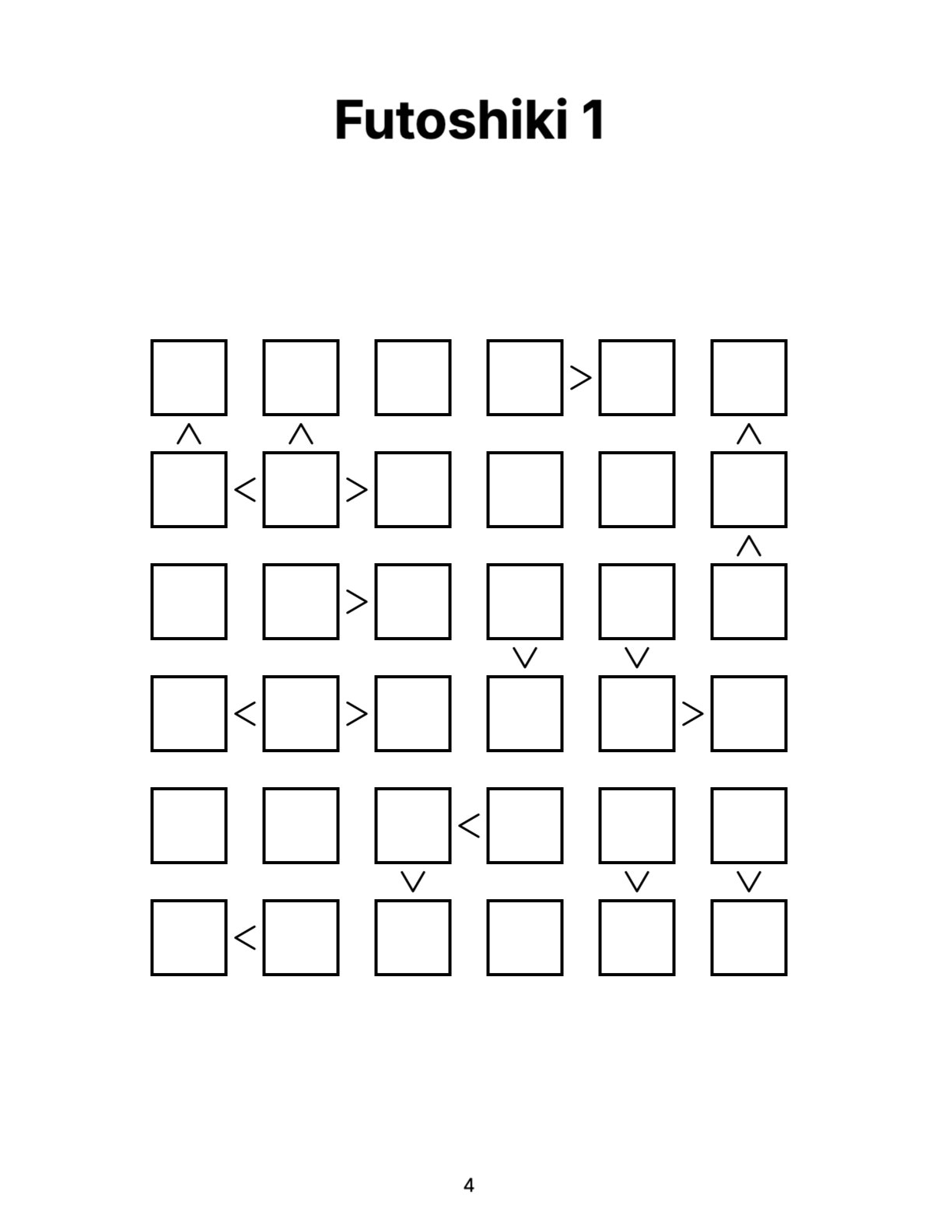
Futoshiki puzzle page from a Wisdom Effect book

Futoshiki

Fill a square grid with numbers that never repeat in a line and obey the signs between them.

When
2001
Where
Japan
Who
Tamaki Seto

Futoshiki is Japanese for "inequality", and a solved grid is a Latin square. British newspapers took it up after sudoku, around 2006; The Times, The Guardian and The Daily Telegraph print it today.

Also known as More or Less, Unequal, inequality puzzle, greater-than puzzle and hutosiki (another spelling).

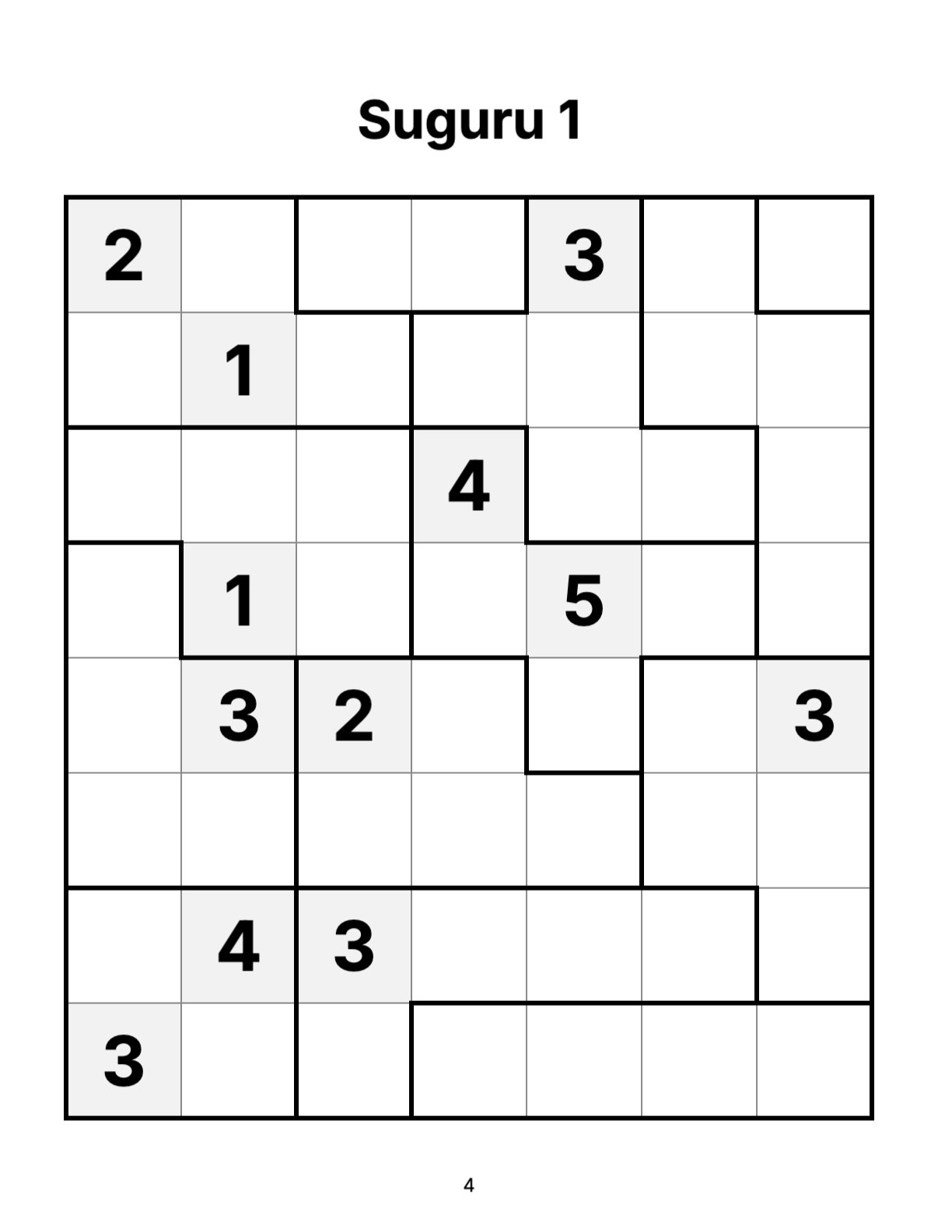
Suguru puzzle page from a Wisdom Effect book

Suguru

Fill outlined regions with the numbers 1 to the size of the region, so equal numbers never touch.

When
2001
Where
Japan
Who
Naoki Inaba, a Japanese puzzle designer from Nagoya

Naoki Inaba first called it Nanba Burokku, "number blocks". It became known as Suguru, and in the Netherlands it runs under the brand name Tectonic.

Also known as Tectonic, Number Blocks and Kemaru.

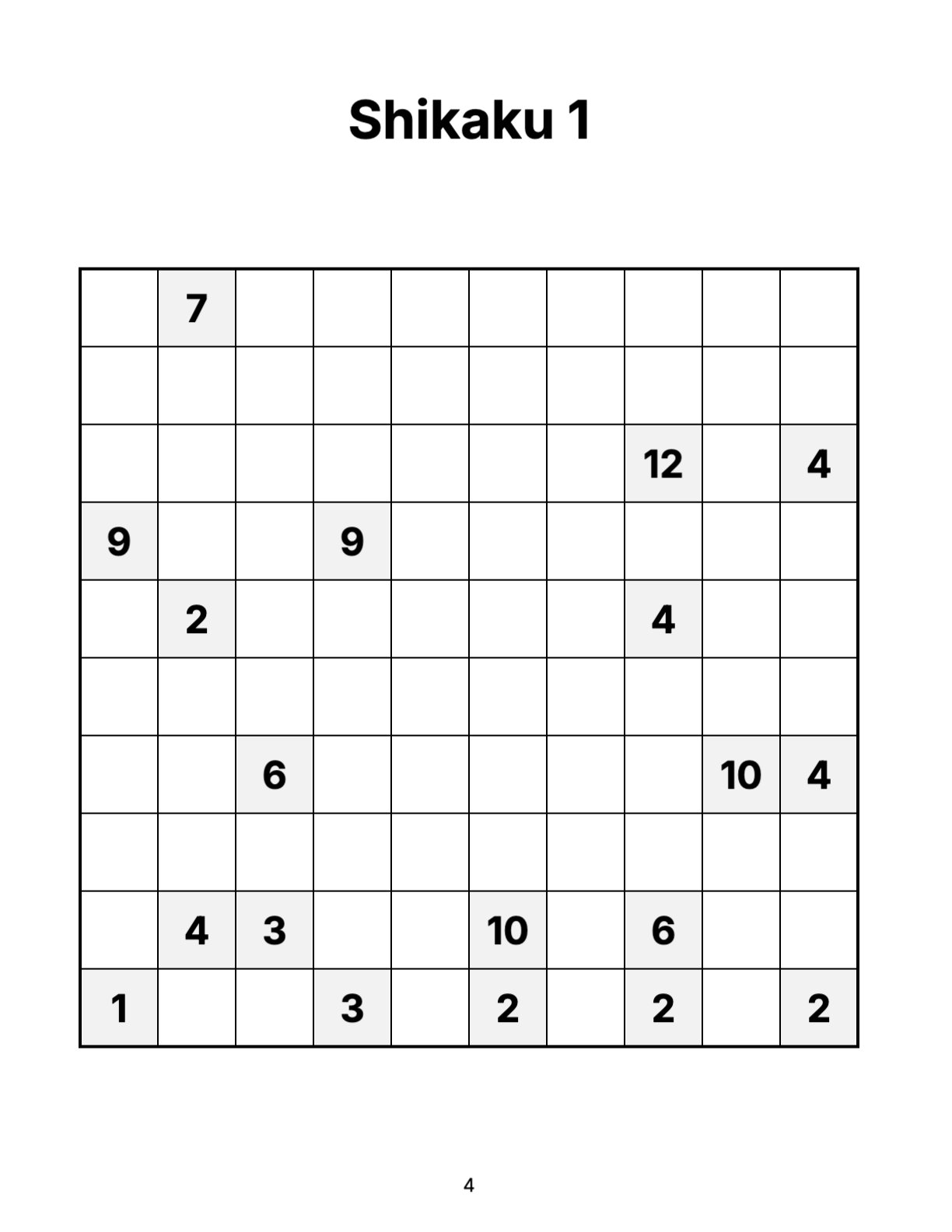
Shikaku puzzle page from a Wisdom Effect book

Shikaku

Divide the grid into rectangles, each holding one number that tells how many squares it covers.

When
September 1989
Where
Japan
Who
Yoshinao Anpuku, published by Nikoli

Yoshinao Anpuku, then a mathematics student at Kyoto University, sent the puzzle to the magazine Puzzle Communication Nikoli, which first printed it in volume 27. The Japanese name, Shikaku ni Kire, means "divide into rectangles"; Nikoli calls it Divide by Box in English, and other books print it as Rectangles or Divide by Squares.

Also known as Rectangles, Shikaku ni Kire, Divide by Box, Divide by Squares and Sikaku.

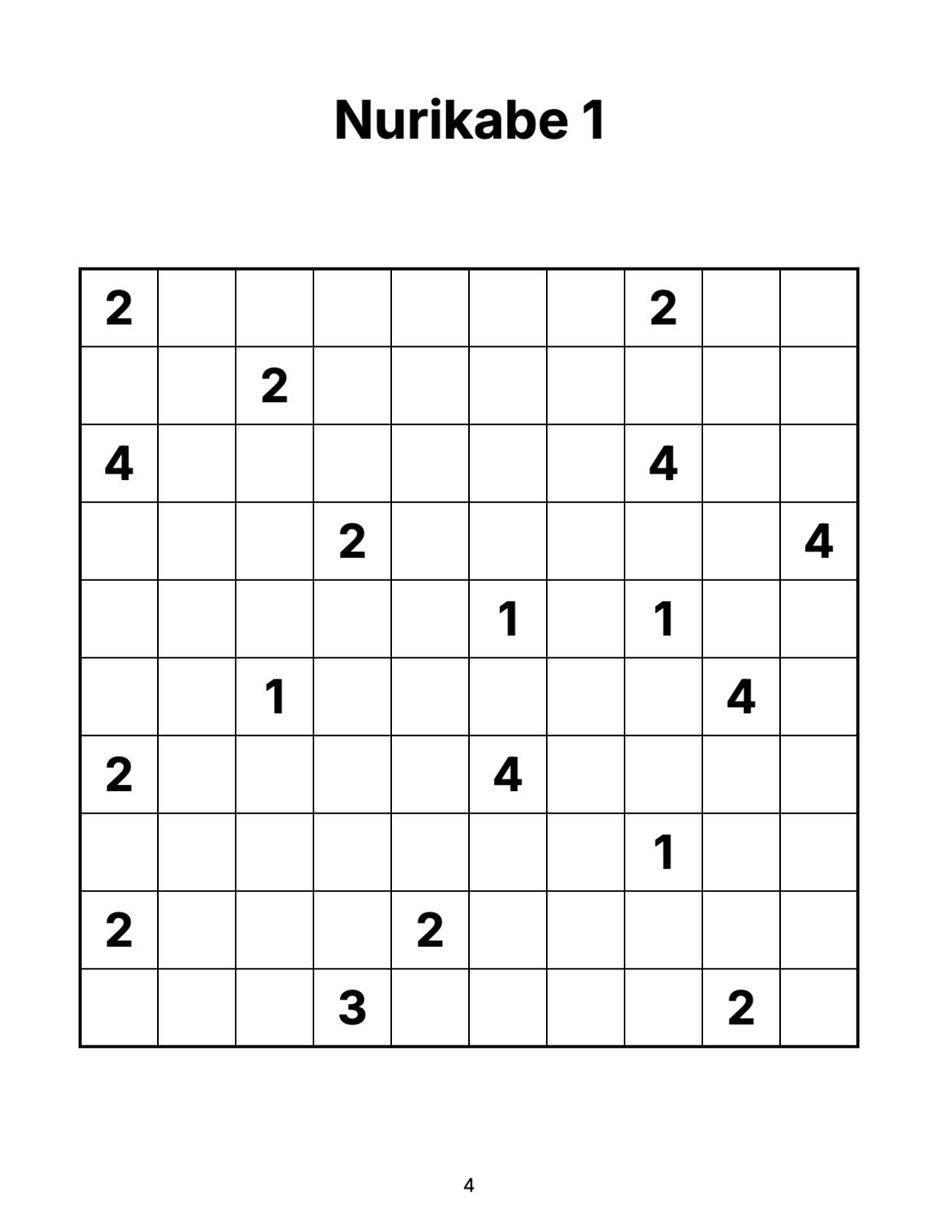
Nurikabe puzzle page from a Wisdom Effect book

Nurikabe

Shade squares to make one connected sea, so that each number lies in an island of exactly that many white squares.

When
March 1991
Where
Japan
Who
renin, published by Nikoli

A puzzle author known as renin sent the puzzle to the magazine Puzzle Communication Nikoli, which first printed it in issue 33 and has carried it in every issue since issue 38. It is named after the nurikabe (ぬりかべ), an invisible wall of Japanese folklore that blocks the way of travellers at night. English books sometimes call it Islands in the Stream or Cell Structure.

Also known as Islands in the Stream, Cell Structure and ぬりかべ.

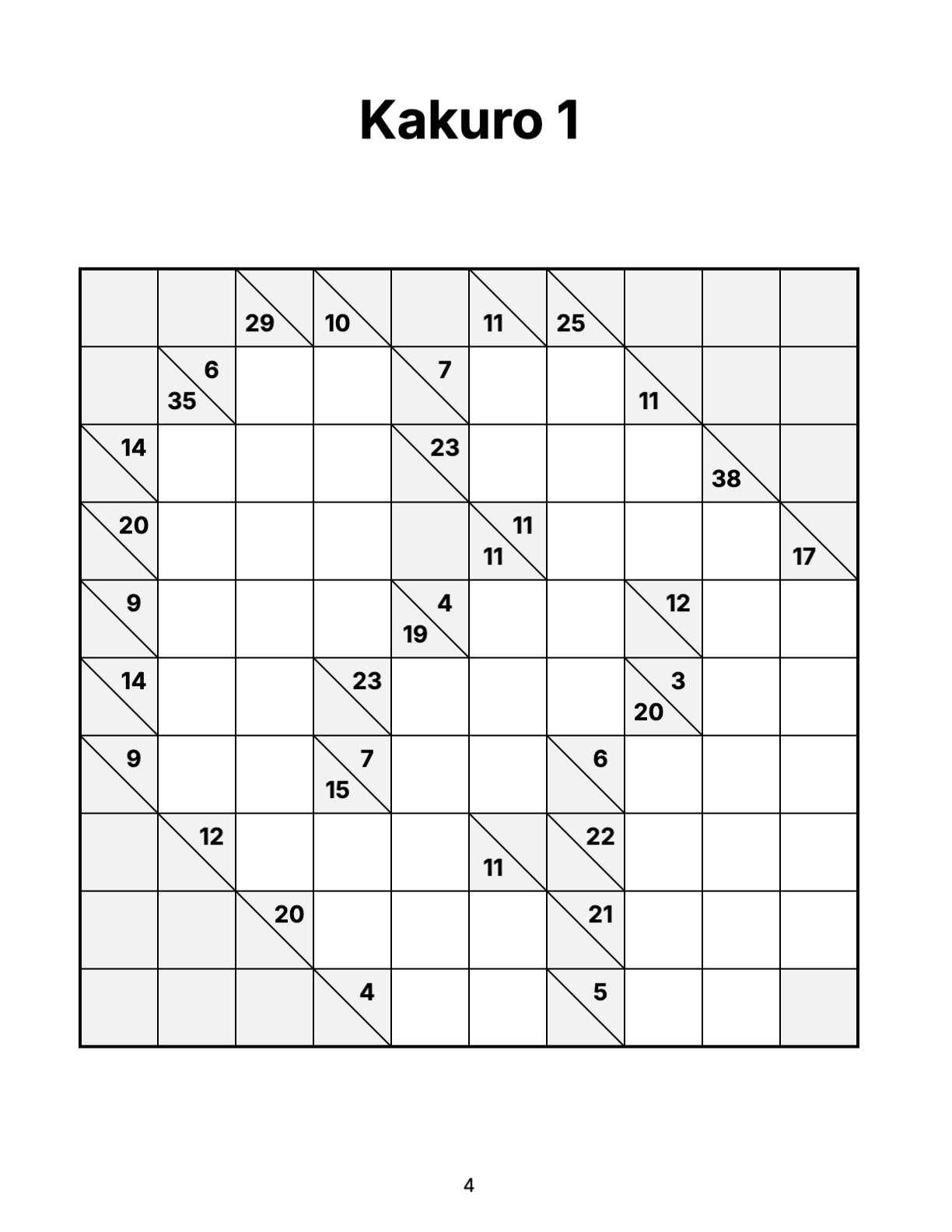
Kakuro puzzle page from a Wisdom Effect book

Kakuro

Write a digit from 1 to 9 in every white square, so that each run adds up to the sum before it and no digit repeats in a run.

When
By 1966
Where
USA
Who
Dell Magazines; Jacob E. Funk named it Cross Sums

The puzzle ran in Dell’s puzzle magazines in the United States as Cross Sums, a name given by Jacob E. Funk, a Canadian working for Dell; some books call it Cross Addition. Around 1980 Maki Kaji of the Japanese publisher Nikoli brought it to Japan as kasan kurosu ("addition cross"), shortened to Kakkuro, and in Japan it was the most popular logic puzzle in print until sudoku took over. In English it is known as Kakuro, the name puzzle books and generators use. Nikoli lists Kakkuro (KAKURO) as its registered trade mark in Japan, so Japanese Wisdom Effect books call the puzzle Cross Sum instead; Wisdom Effect is not connected with Nikoli.

Also known as Cross Sums, Cross Addition and Kakkuro.

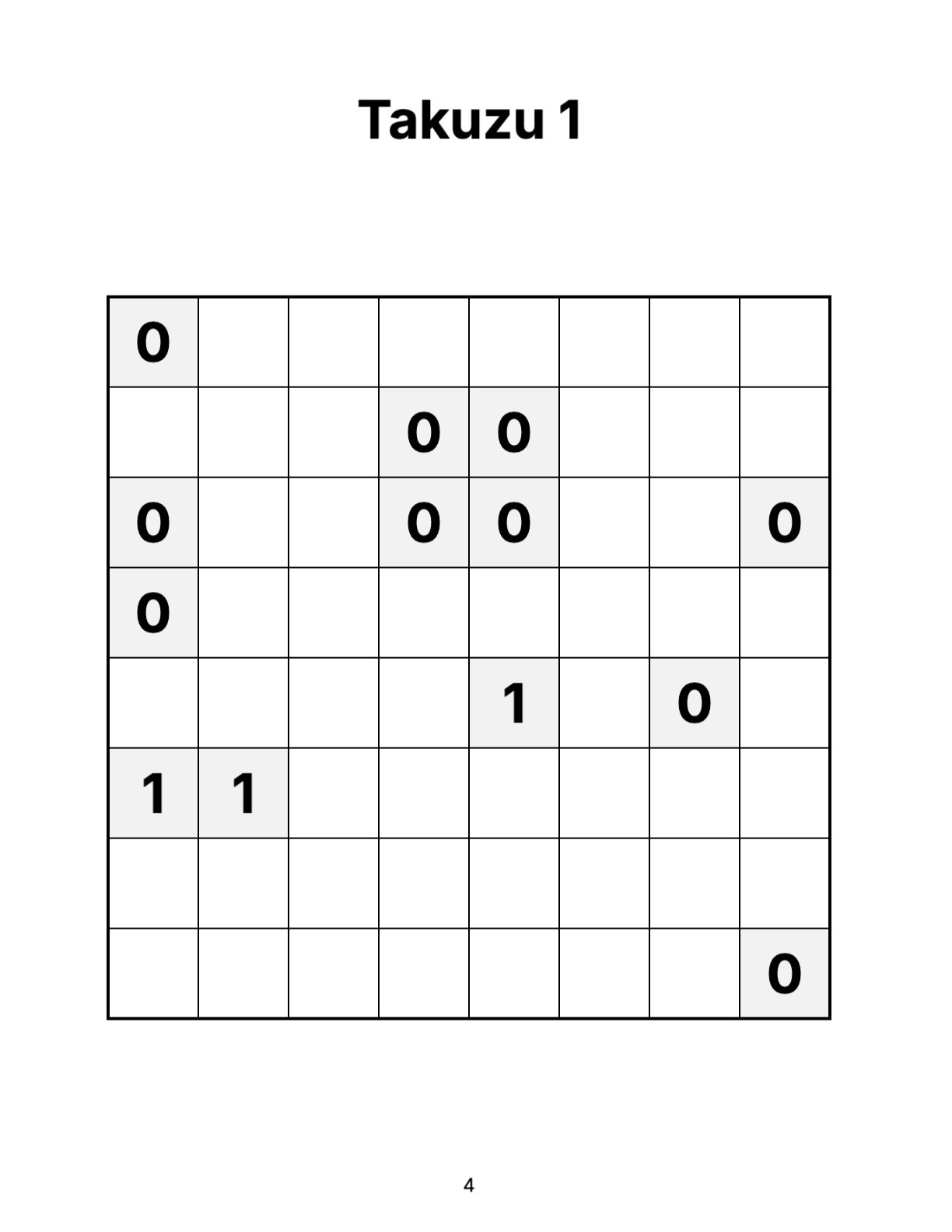
Takuzu puzzle page from a Wisdom Effect book

Takuzu

Fill the grid with 0 and 1 so that rows and columns balance and no three equal digits stand together.

When
2009
Where
Belgium and Italy
Who
Frank Coussement and Peter De Schepper; Adolfo Zanellati at about the same time

The two Belgian puzzle makers published it as Binairo® in 2009; at about the same time the Italian Adolfo Zanellati made the same puzzle as Tohu wa Vohu. With only two symbols it is also simply called the binary puzzle. Binairo® is a registered trade mark; Wisdom Effect is not connected with its Belgian inventors, Frank Coussement and Peter De Schepper.

Also known as binary puzzle, Tohu wa Vohu and Eins und Zwei.

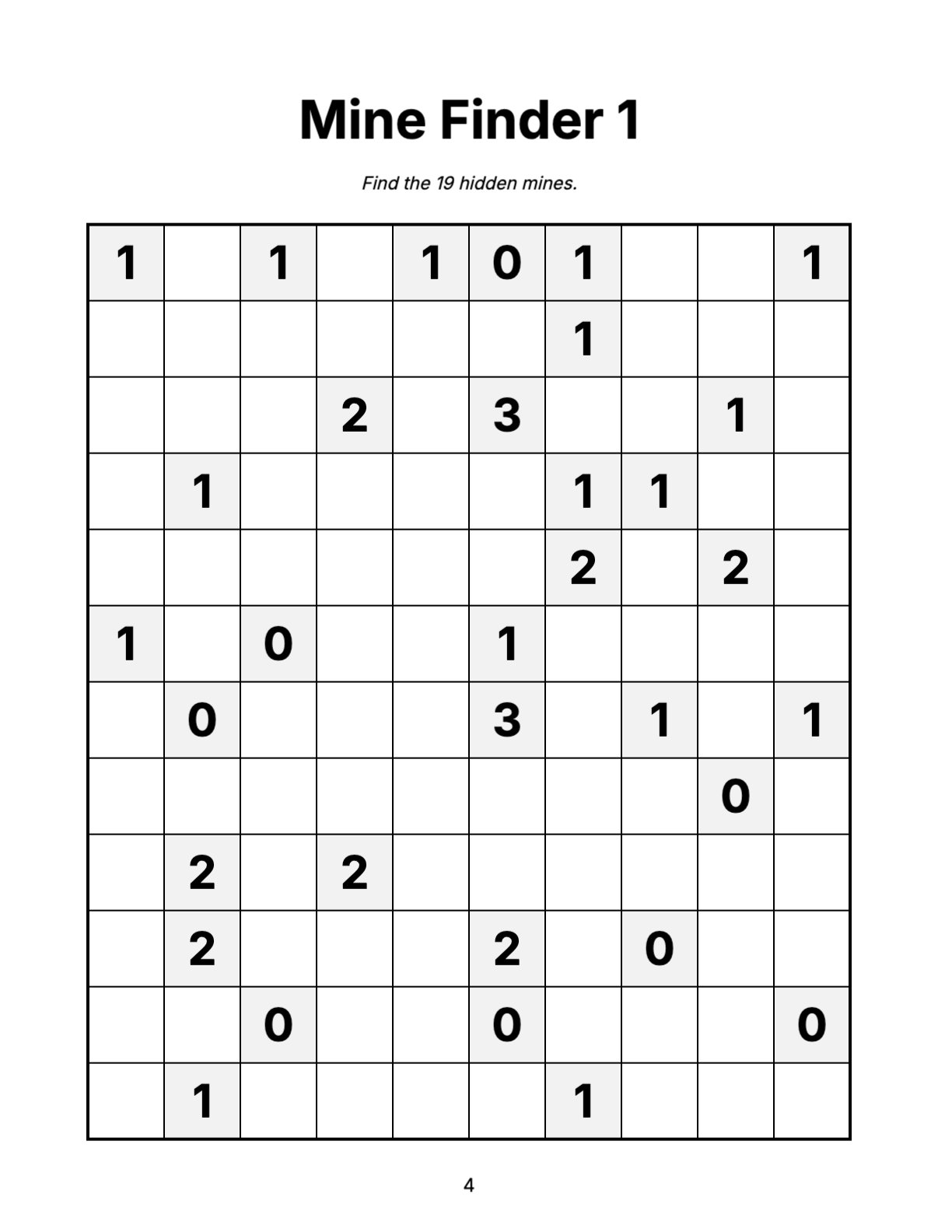
Mine Finder puzzle page from a Wisdom Effect book

Mine Finder

Find every hidden mine using the numbers that count the mines around each square.

When
1980s
Where
Home computers, later paper
Who
Unknown

Mine-sweeping games spread on home computers in the 1980s and became world famous when Microsoft's Minesweeper came with Windows in the early 1990s. On paper the same logic makes a pencil puzzle. Wisdom Effect is not connected with Microsoft.

Also known as minesweeper-style puzzle and Mines.

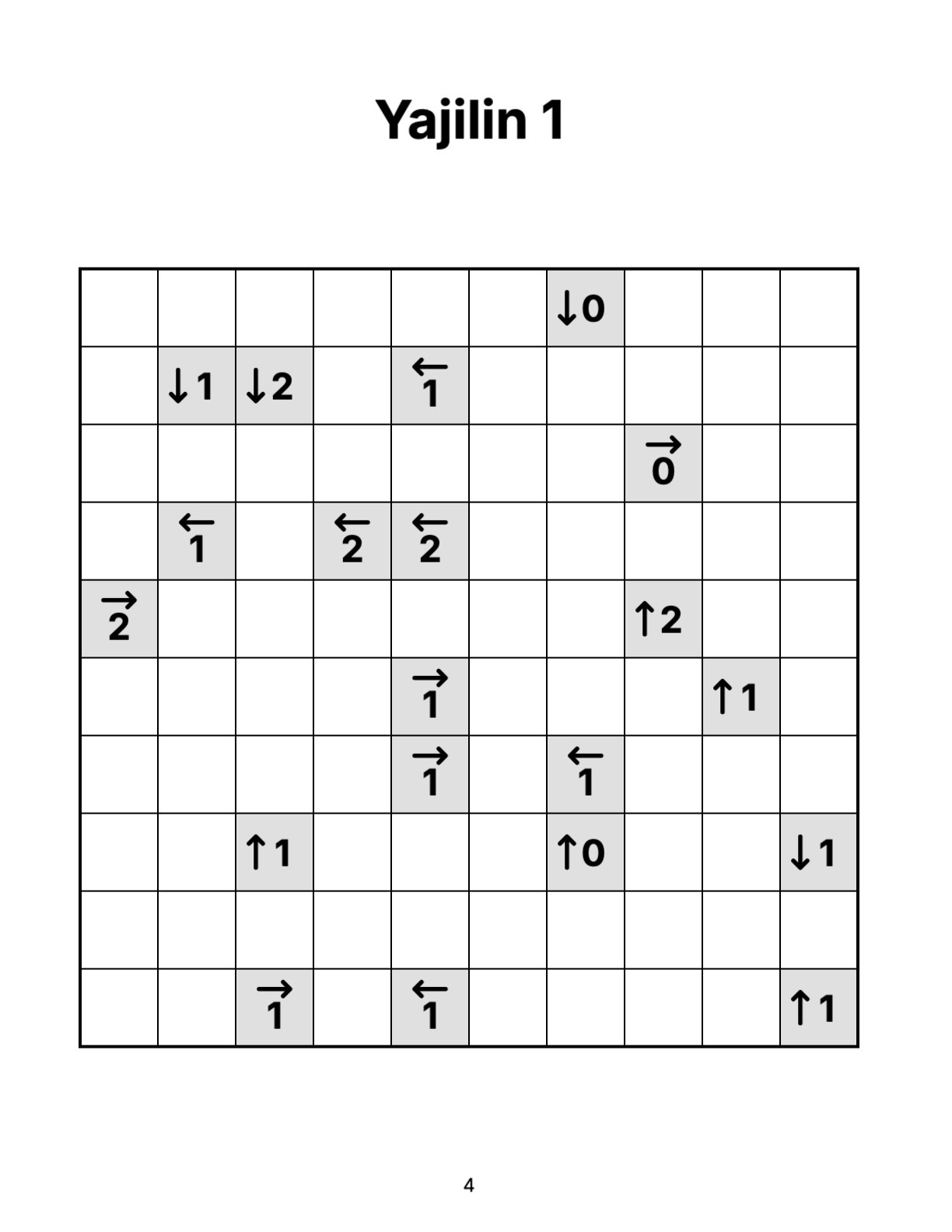
Yajilin puzzle page from a Wisdom Effect book

Yajilin

Shade the squares the arrows count, then draw one closed loop through every other square.

When
June 1999
Where
Japan
Who
Published by Nikoli

Puzzle Communication Nikoli first printed it in issue 86. The name joins yajirushi (矢印), the Japanese word for arrow, with an English word: most sources read it as link, others as ring, which is why the puzzle is also called Arrow Ring. It takes the arrow and number clue of an older Nikoli puzzle and adds a loop.

Also known as Arrow Ring and ヤジリン.

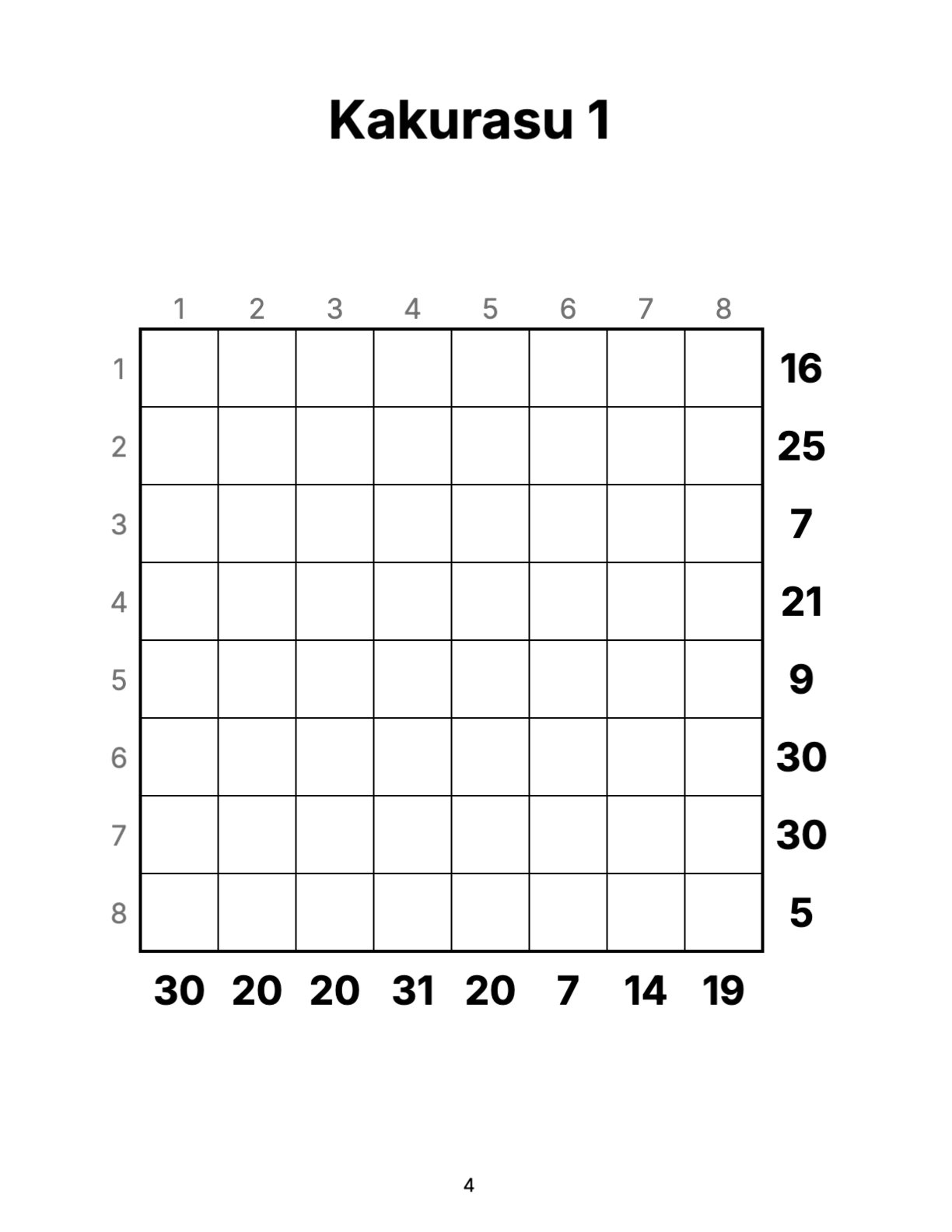
Kakurasu puzzle page from a Wisdom Effect book

Kakurasu

Shade squares until every row and column adds up to its sum, each square counting its place in the line.

When
Unknown
Where
Unknown (the name is Japanese)
Who
Unknown

Nobody has recorded who made the first Kakurasu or when. The puzzle carries a Japanese name, and English puzzle sites also call it Index Sums, after the rule: every square counts its index, its place in the row or column. It is a different puzzle from Kakuro, where digits are written into runs.

Also known as Index Sums and カクラス.

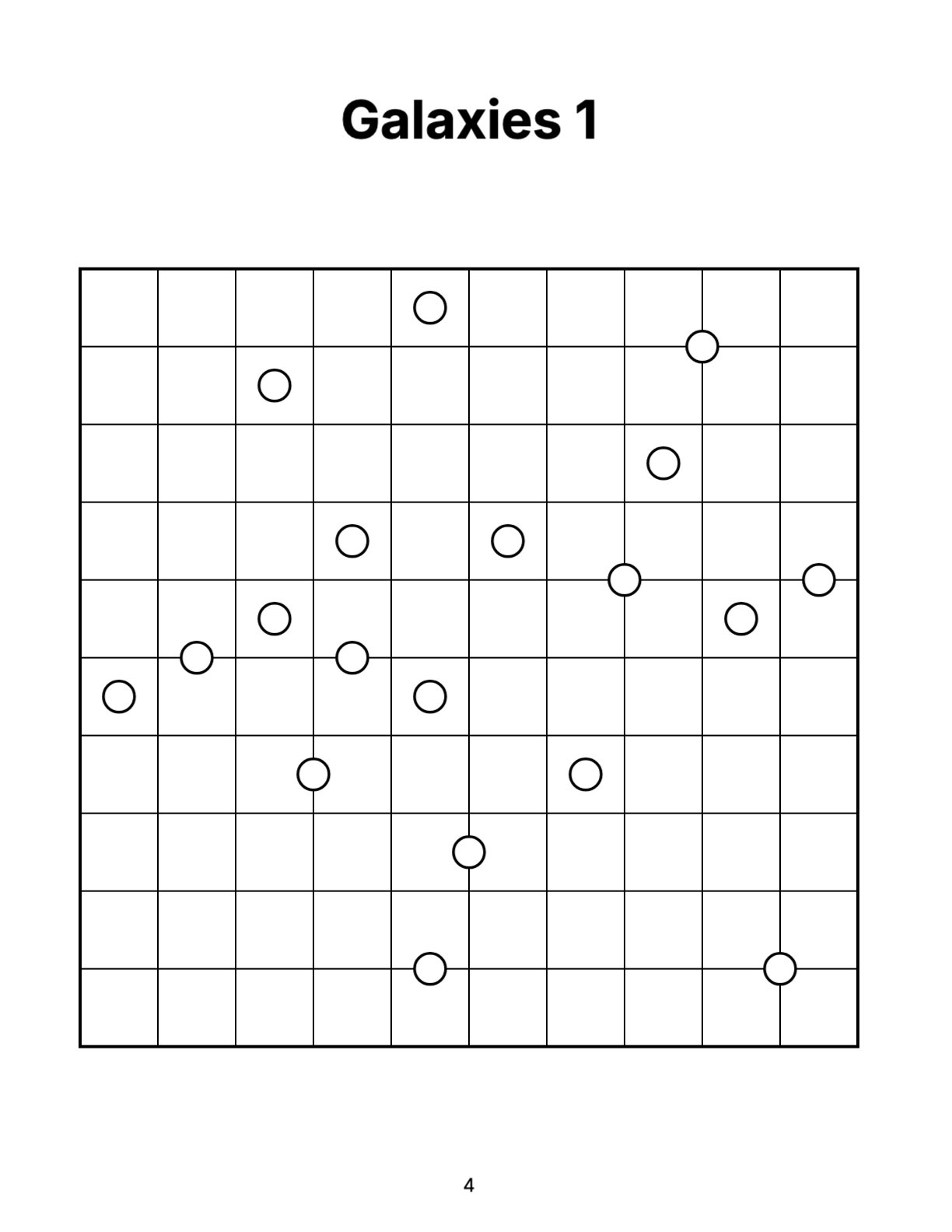
Galaxies puzzle page from a Wisdom Effect book

Galaxies

Divide the grid into galaxies, one dot in each, every galaxy the same after a half turn around its dot.

When
2001
Where
Japan
Who
Published by Nikoli

Nikoli first published the puzzle in 2001, in issue 96 of its magazine Puzzle Communication Nikoli, as Tentai Show. The name is a Japanese pun: "ten" means a dot and "taishō" symmetry, while "tentai" is a heavenly body. In English it is called Galaxies or Spiral Galaxies.

Also known as Tentai Show, Spiral Galaxies and 天体ショー.

Picture Logic

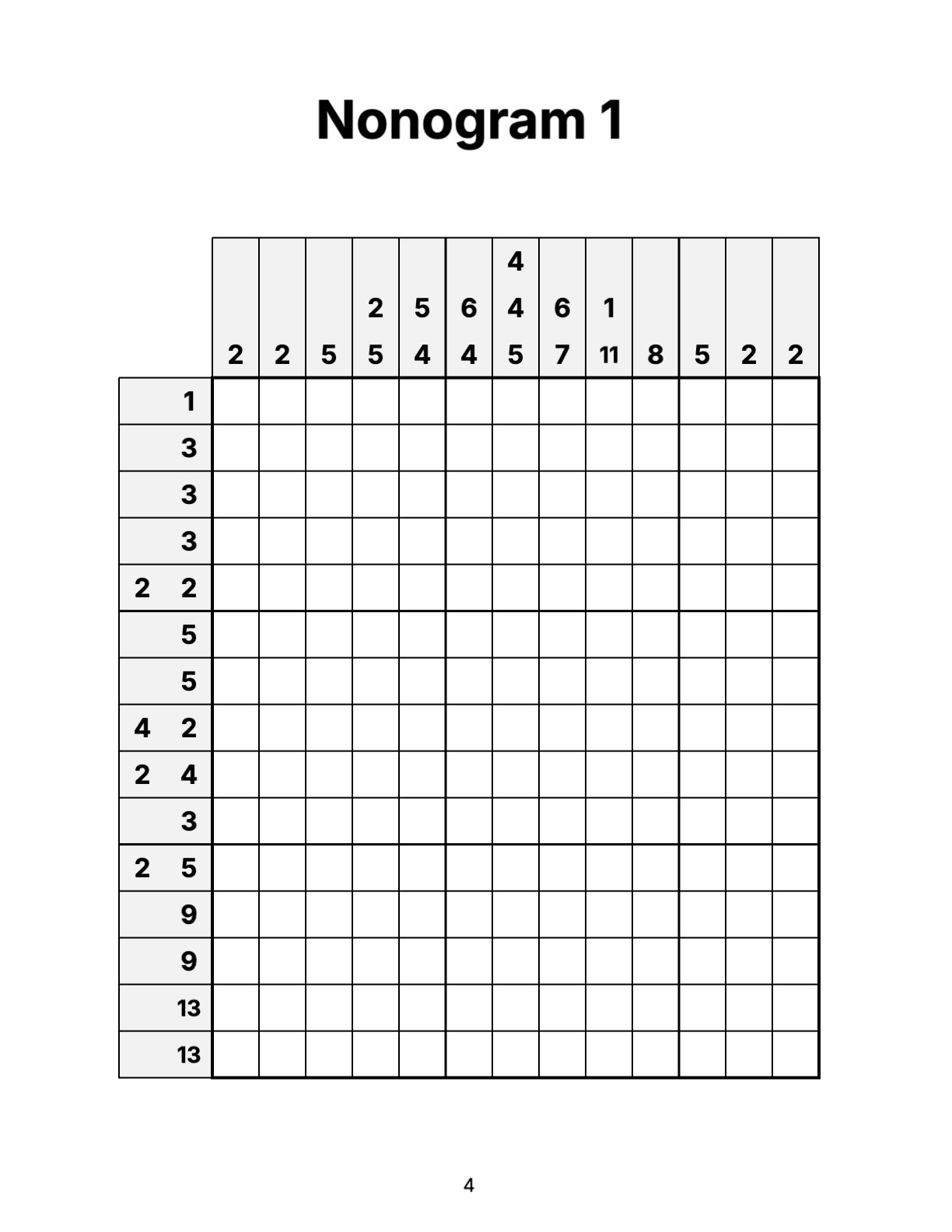
Nonogram puzzle page from a Wisdom Effect book

Nonogram

Fill squares by the number clues beside each row and column to uncover a hidden picture.

When
1987
Where
Japan
Who
Non Ishida, a graphic editor, and Tetsuya Nishio, a puzzle maker, each on their own

Non Ishida won a 1987 Tokyo contest with pictures made of lit and dark skyscraper windows and published three such puzzles in 1988 as Window Art Puzzles. The British puzzle collector James Dalgety named them nonograms ("Non" + "diagram"); The Sunday Telegraph printed them every week from 1990, and its readers renamed them Griddlers in 1998. Nintendo sells nonogram video games as Picross®. Griddlers® is a registered trade mark of Severex By, LLC; Wisdom Effect is not connected with Severex. Picross® is a registered trade mark of Nintendo; Wisdom Effect is not connected with Nintendo.

Also known as Hanjie, Paint by Numbers, Picture Logic, Japanese crossword, maľované krížovky (Slovak) and malované křížovky (Czech).

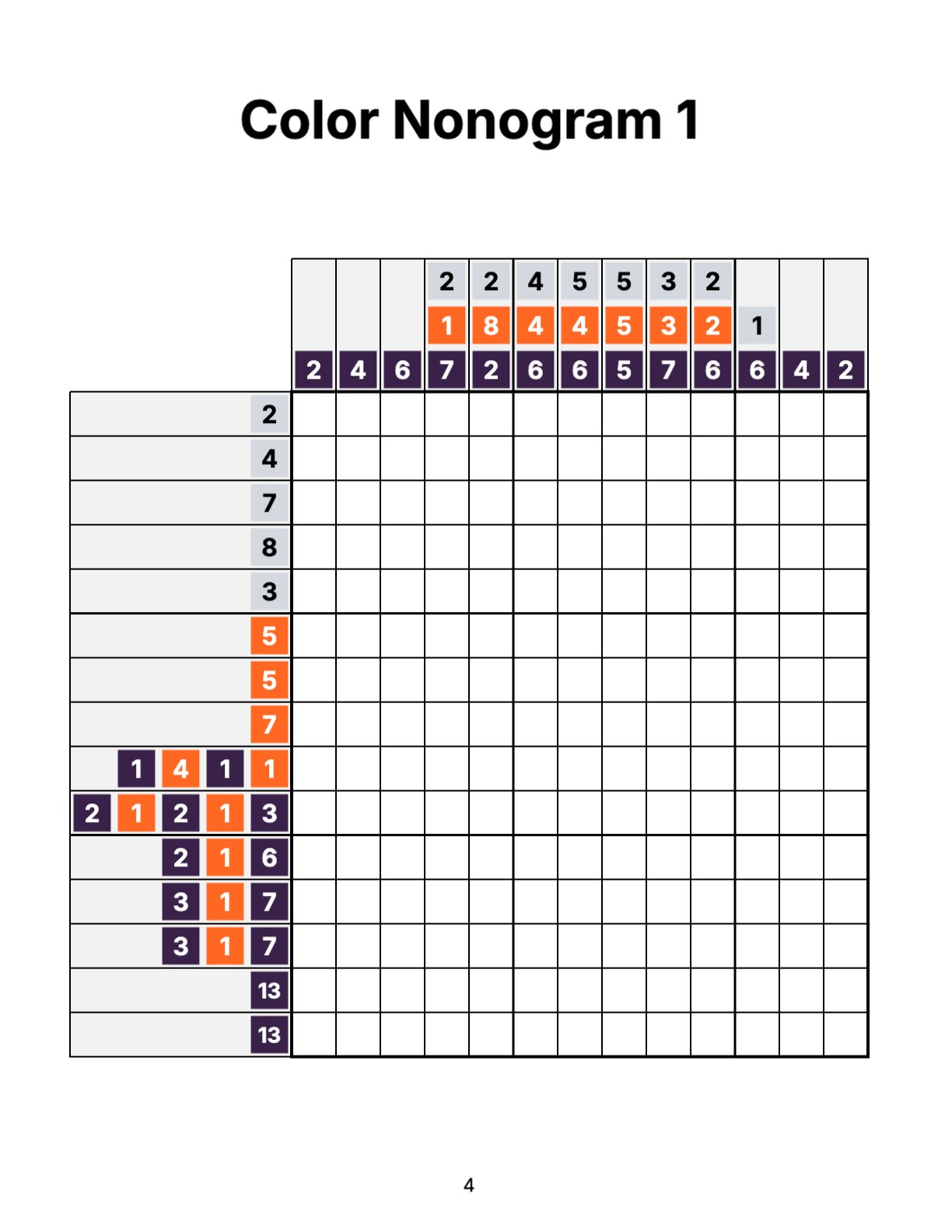
Color Nonogram puzzle page from a Wisdom Effect book

Color Nonogram

A nonogram in several colors: each clue number has a color, and the finished grid is a color picture.

When
Unknown, after 1987
Where
Puzzle magazines in several countries
Who
Unknown

Color versions grew out of the black and white nonogram as it spread through puzzle magazines and websites. They print in two colors or more. Many puzzle fans call them color griddlers, after Griddlers®. Griddlers® is a registered trade mark of Severex By, LLC; Wisdom Effect is not connected with Severex.

Also known as multicolor nonogram and color hanjie.

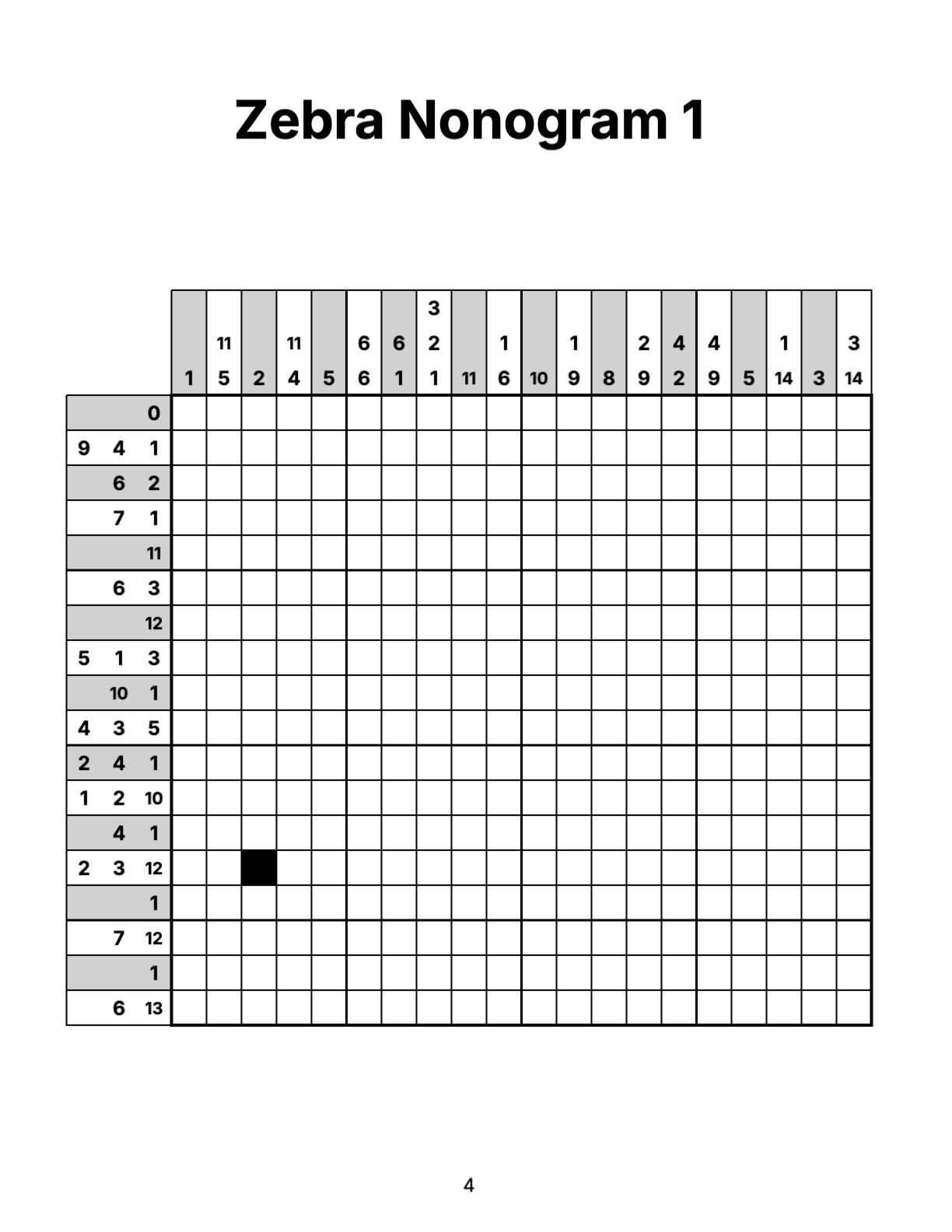
Zebra Nonogram puzzle page from a Wisdom Effect book

Zebra Nonogram

A nonogram with striped clues: shaded lines count the filled squares, white lines the empty ones.

When
Unknown
Where
Unknown
Who
Unknown

The puzzle comes from the Czech and Slovak magazines of picture logic puzzles, where it runs as the zebra variant. Zebra Nonogram is our English name for it.

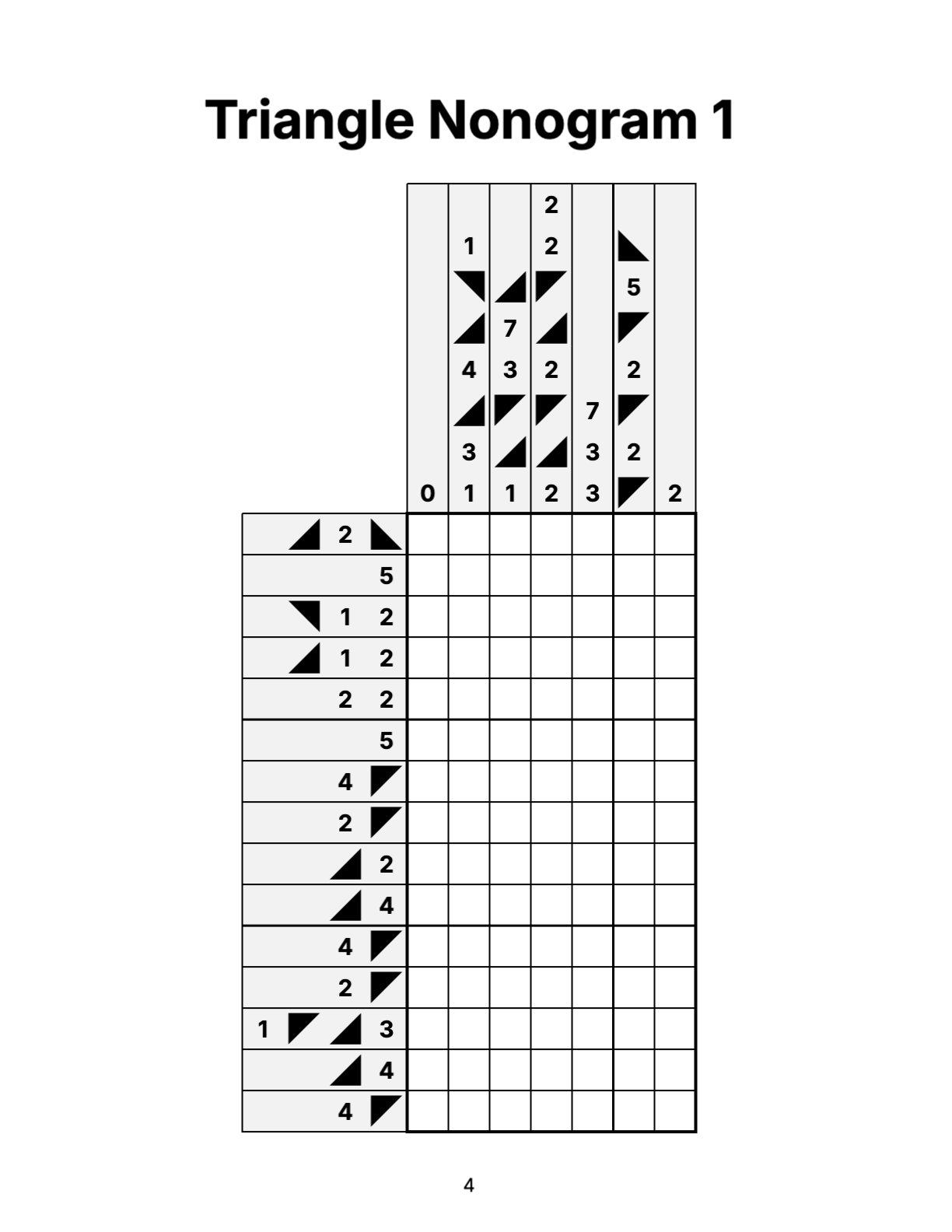
Triangle Nonogram puzzle page from a Wisdom Effect book

Triangle Nonogram

A nonogram with half squares: triangles in the clues give the picture smooth diagonal edges.

When
Unknown
Where
Unknown
Who
Unknown

The puzzle comes from the Slovak magazine of picture logic puzzles, where the triangles give the pictures 45° edges instead of steps.

Also known as trianogram.

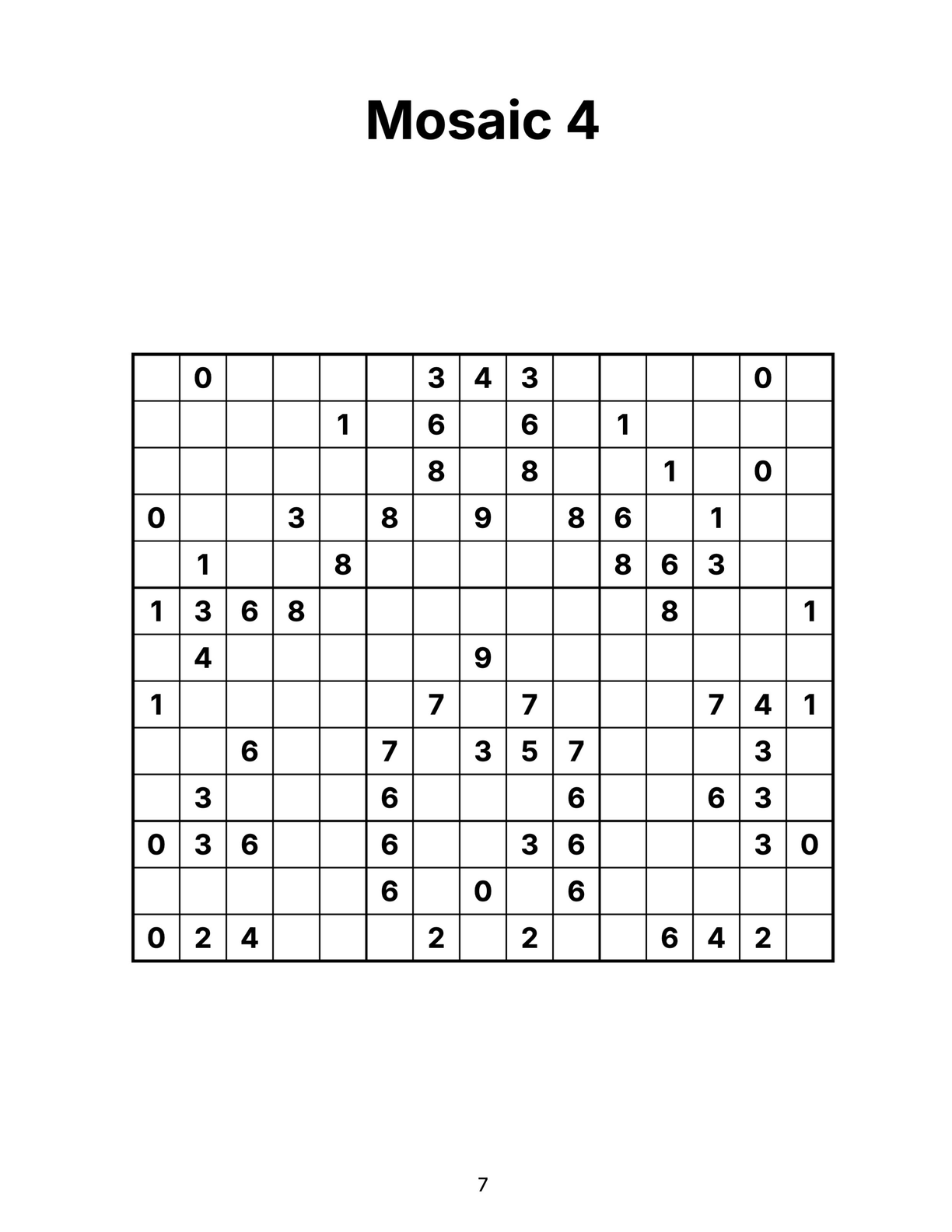
Mosaic puzzle page from a Wisdom Effect book

Mosaic

A picture logic puzzle with the numbers inside the grid: each counts the shaded squares around it.

When
Unknown
Where
Unknown
Who
Unknown

Puzzles of this kind run in puzzle magazines and apps under several names; the puzzle publisher Conceptis sells its version as Fill-a-Pix. Mosaic is our name for it, and Wisdom Effect is not connected with Conceptis.

Also known as mosaic logic puzzle.

Paths & Mazes

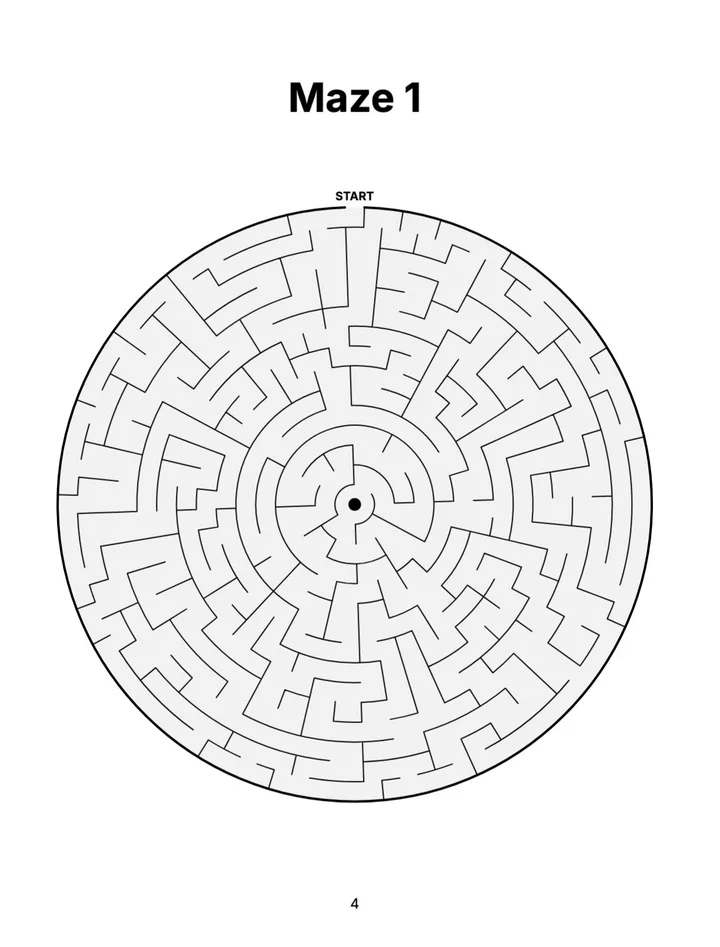
Maze puzzle page from a Wisdom Effect book

Maze

Find the way from the start to the finish without crossing a wall.

When
About 1200 BC (oldest known drawing)
Where
Pylos, Greece
Who
Unknown

A labyrinth is scratched on a clay tablet from Pylos. Hedge mazes spread through European gardens from the 16th century (the one at Hampton Court dates from about 1690), and mazes on paper became a classic of puzzle and activity books.

Also known as labyrinth.

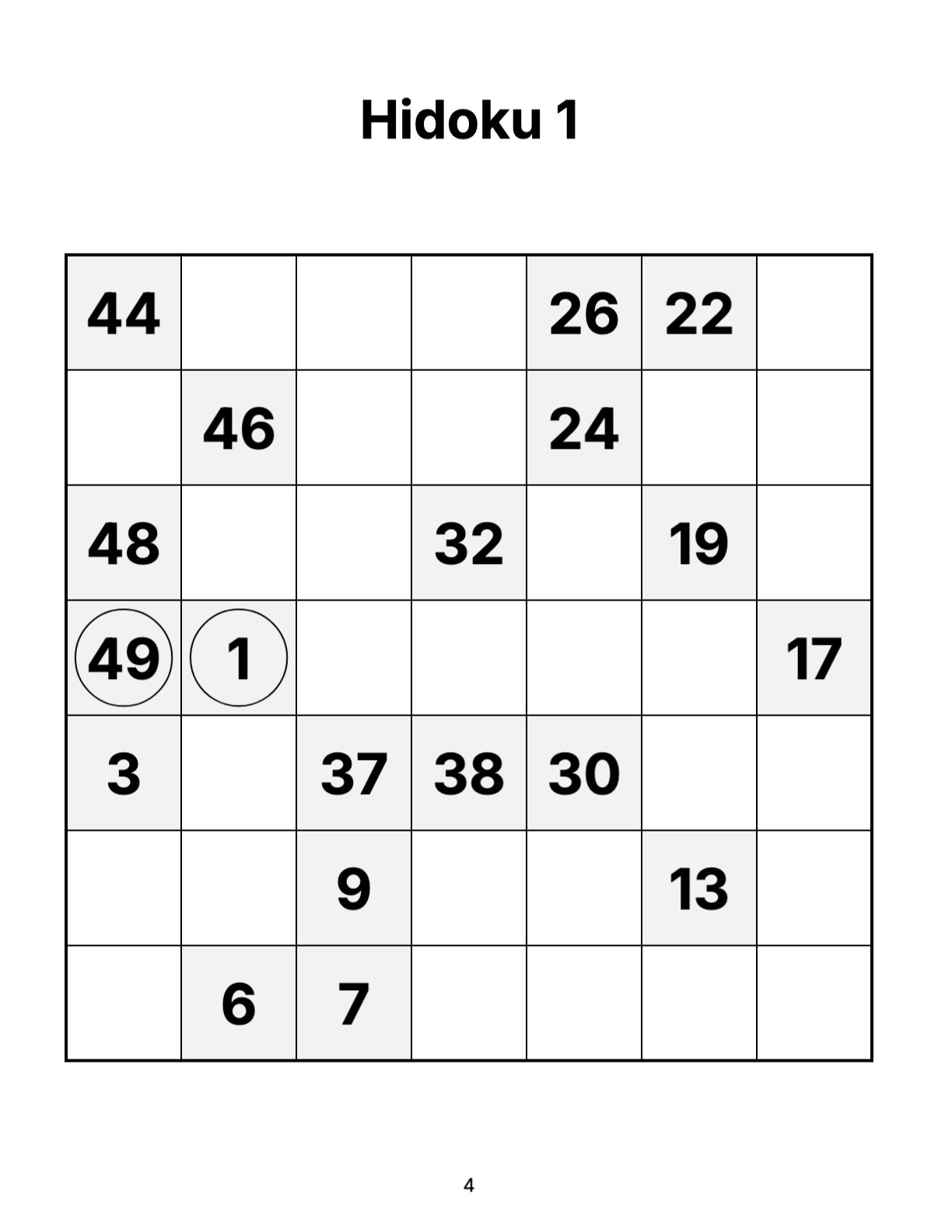
Hidoku puzzle page from a Wisdom Effect book

Hidoku

Fill the grid with one chain of numbers in which every number touches the next.

When
2000s
Where
Israel
Who
Gyora M. Benedek, an Israeli mathematician

Gyora Benedek publishes the puzzle as Hidato®, a name that comes from the Hebrew word for riddle. Hidoku and number snake are the names other puzzle makers use; grids may also be hexagons or other shapes. Hidato® is a registered trade mark of Doo-Bee Toys & Games; Wisdom Effect is not connected with Doo-Bee Toys & Games or Gyora Benedek.

Also known as number snake and number chain.

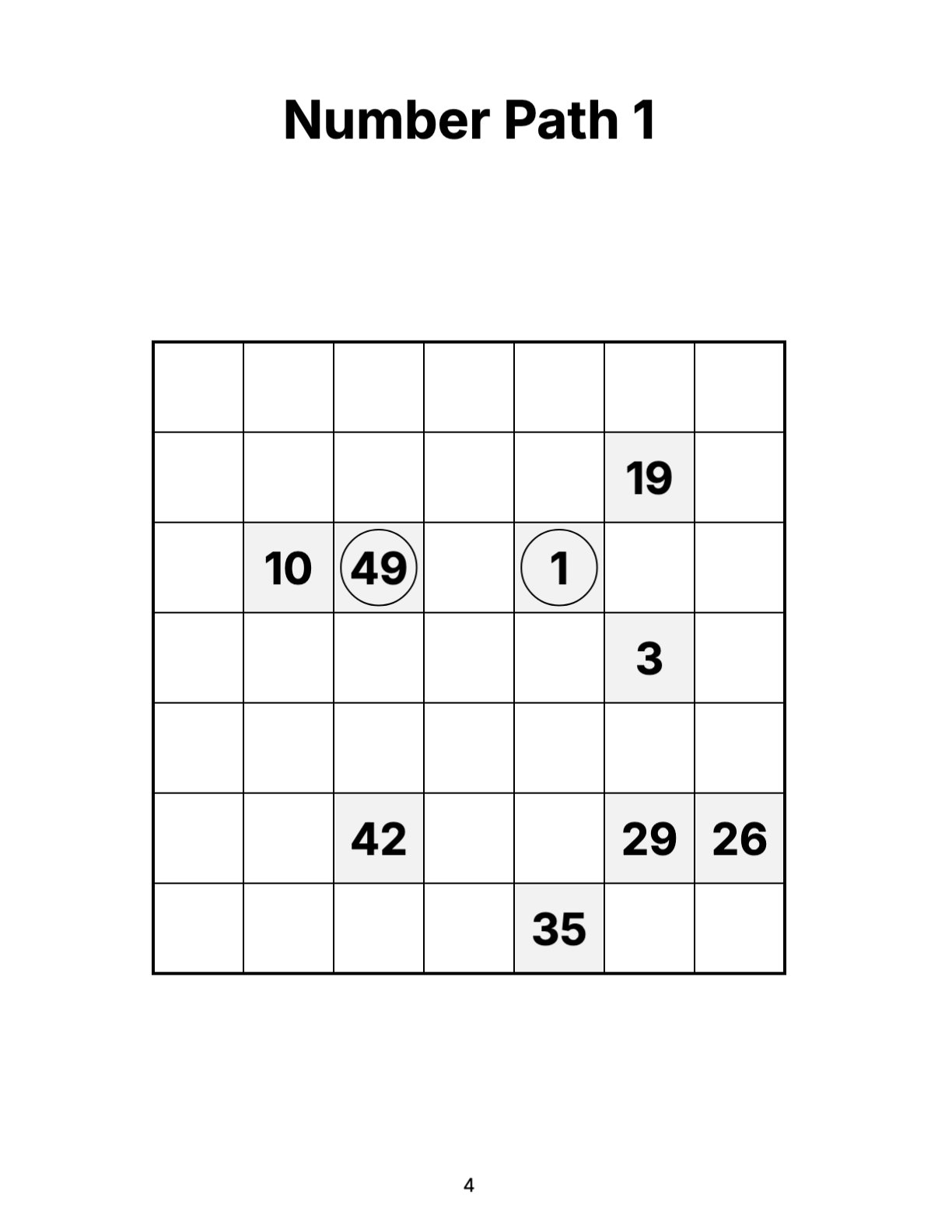
Number Path puzzle page from a Wisdom Effect book

Number Path

Fill the grid with one path of numbers in which every number sits next to the next, never diagonally.

When
2008
Where
USA
Who
Marilyn vos Savant, in Parade magazine

Marilyn vos Savant made the puzzle popular in her Parade magazine column, where it runs as Numbrix®. It is the side-step cousin of Hidoku: the same chain of numbers, but every step goes up, down, left or right. Number Path is the plain name Wisdom Effect uses for these rules. Numbrix® is a registered trade mark of Parade's publisher; Wisdom Effect is not connected with Parade.

Also known as Hamiltonian path puzzle and orthogonal number chain.

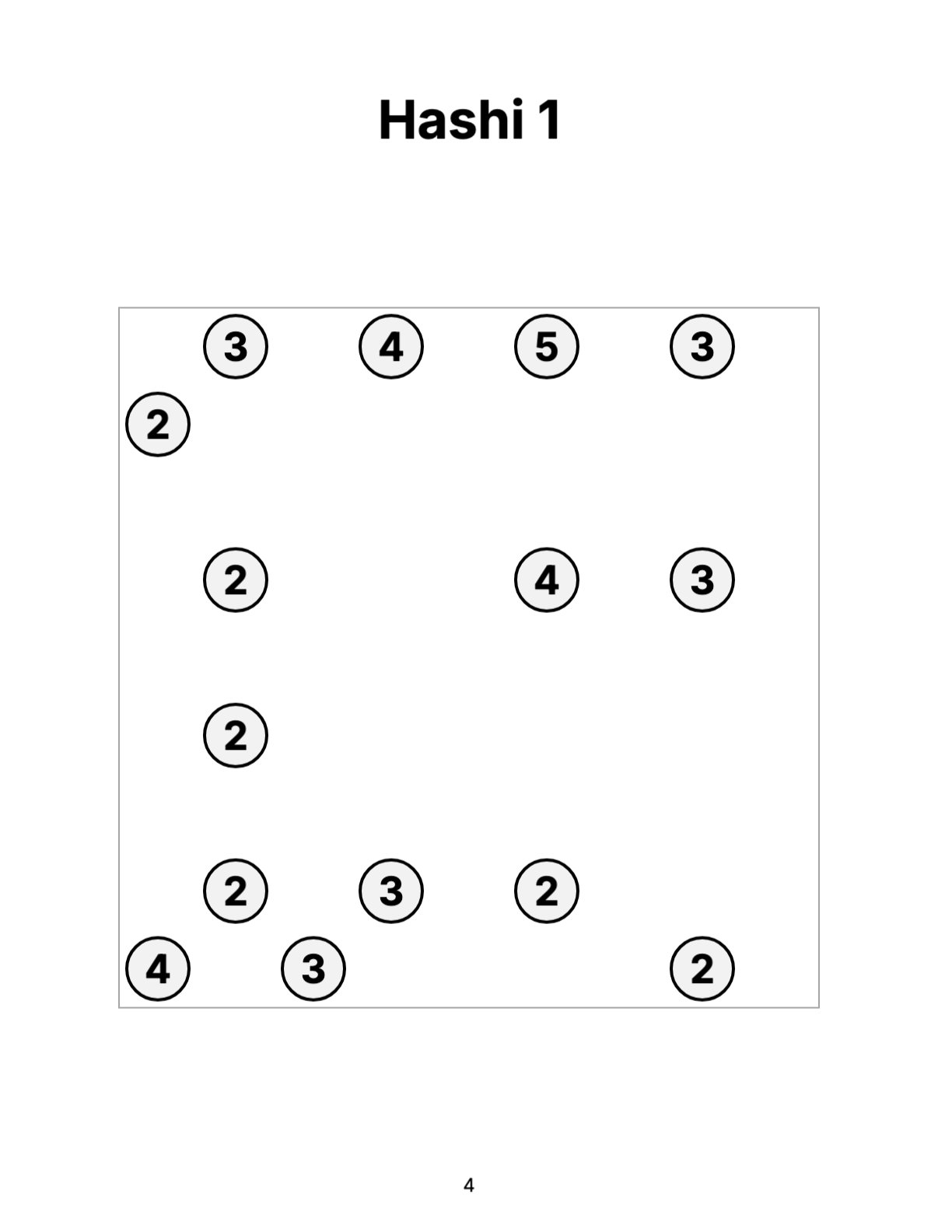
Hashi puzzle page from a Wisdom Effect book

Hashi

Join numbered islands with bridges until each island has as many bridges as its number.

When
September 1990
Where
Japan
Who
Nikoli, the Japanese puzzle publisher

It first ran in issue 31 of the magazine Puzzle Communication Nikoli, after an earlier form in issue 28 (December 1989). The full Japanese name, Hashiwokakero, means "build bridges!"; The Times prints it as Hashi, and the English name Chopsticks comes from a mistranslation of hashi.

Also known as Bridges, Hashiwokakero, Chopsticks and Ai-Ki-Ai (in France, Denmark, the Netherlands and Belgium).

Math Puzzles

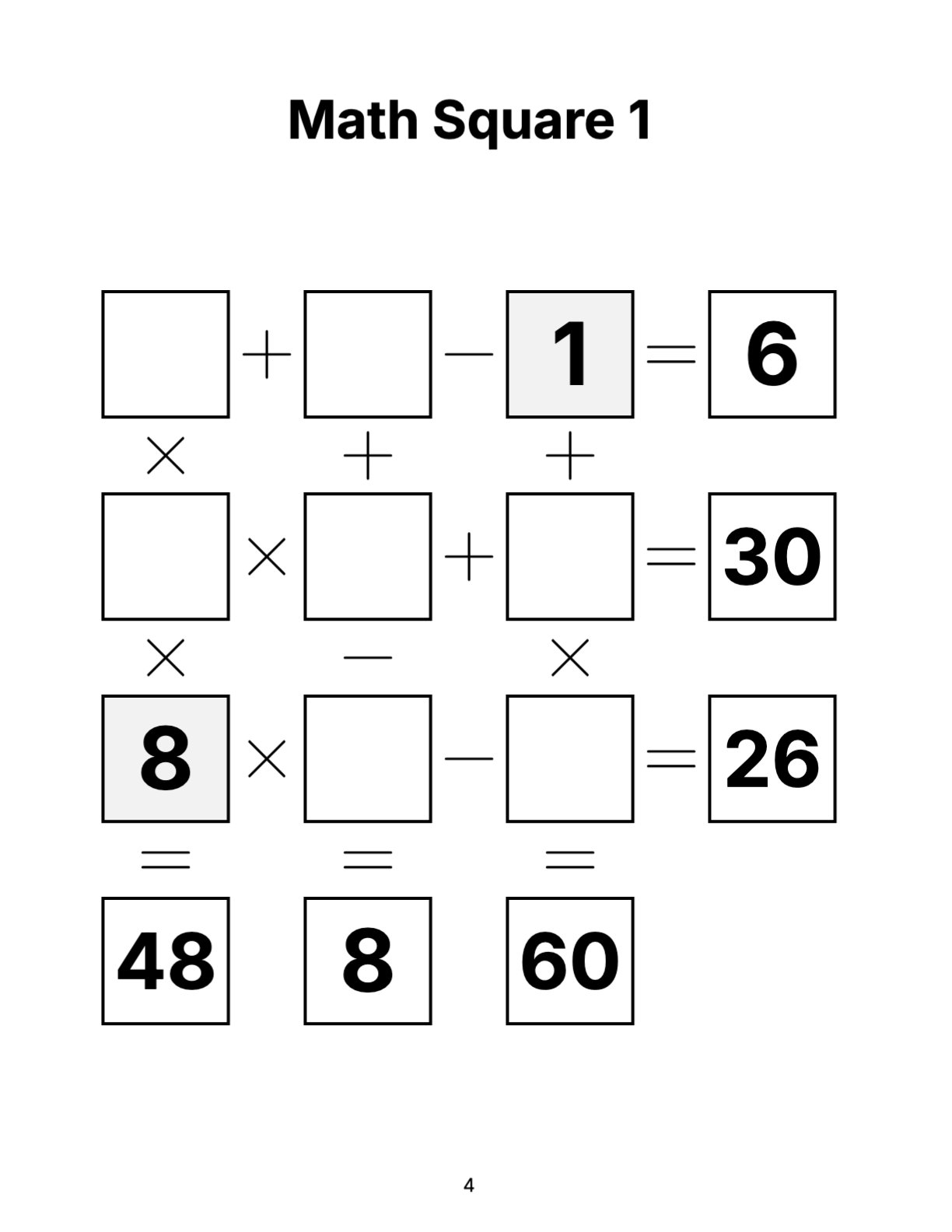
Math Squares puzzle page from a Wisdom Effect book

Math Squares

Place each number once so that every row and column, worked out sign by sign, gives its result.

When
Unknown
Where
Puzzle magazines and school worksheets
Who
Unknown

Number grids whose rows and columns cross like the words of a crossword appear in puzzle magazines and in classroom worksheets that practice arithmetic. No inventor or first appearance is known.

Also known as math crossword, number crossword and arithmetic square.

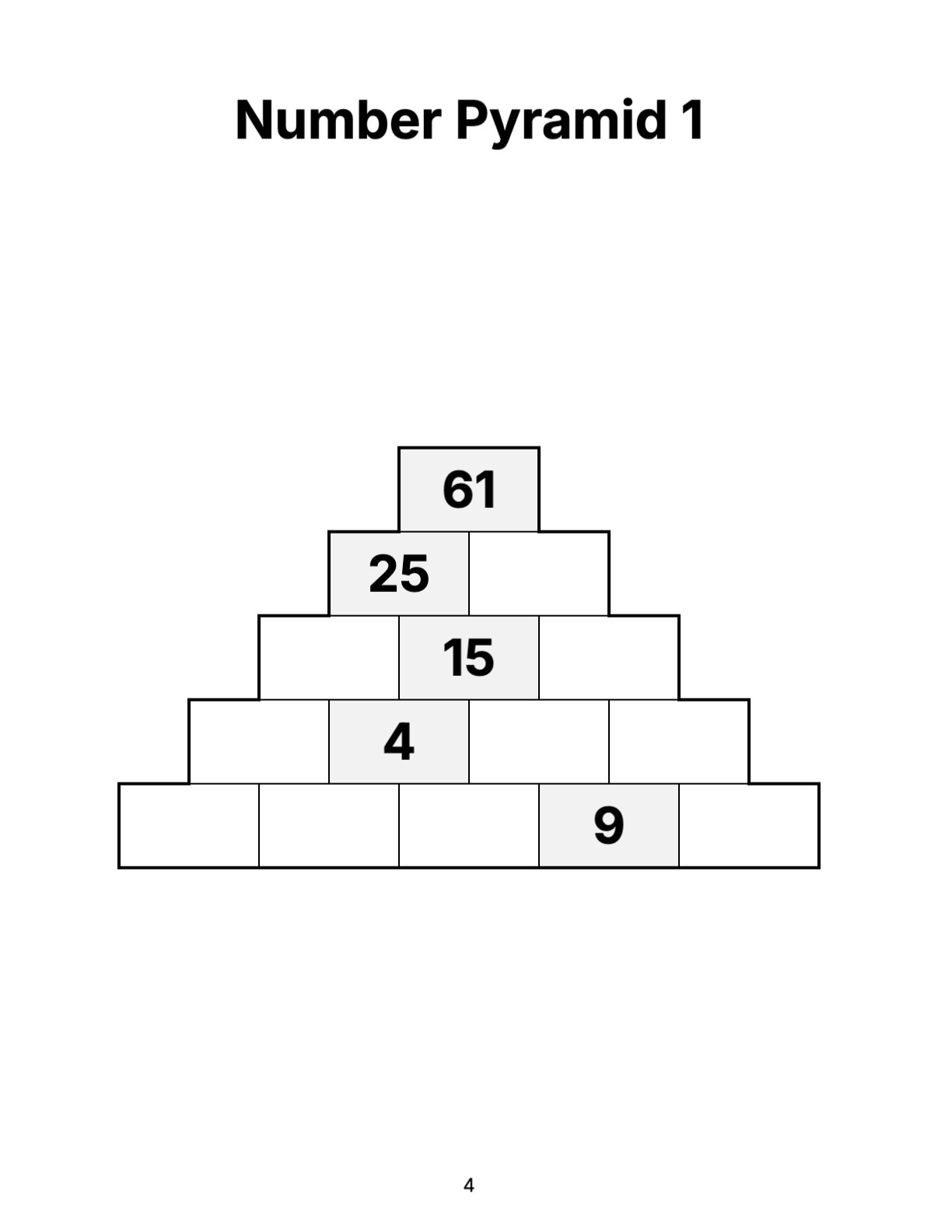
Number Pyramids puzzle page from a Wisdom Effect book

Number Pyramids

Fill the pyramid so that every brick holds the sum of the two bricks below it.

When
Unknown
Where
Primary school mathematics
Who
Unknown

Number pyramids are a classic of primary school arithmetic, especially in German-speaking countries, where they are called Zahlenmauer (number wall) or Rechenpyramide. Teachers use them to practice adding and taking away; the taller ones lead to the first equations. No inventor or first appearance is known.

Also known as addition pyramid, sum pyramid, number wall and math pyramid.
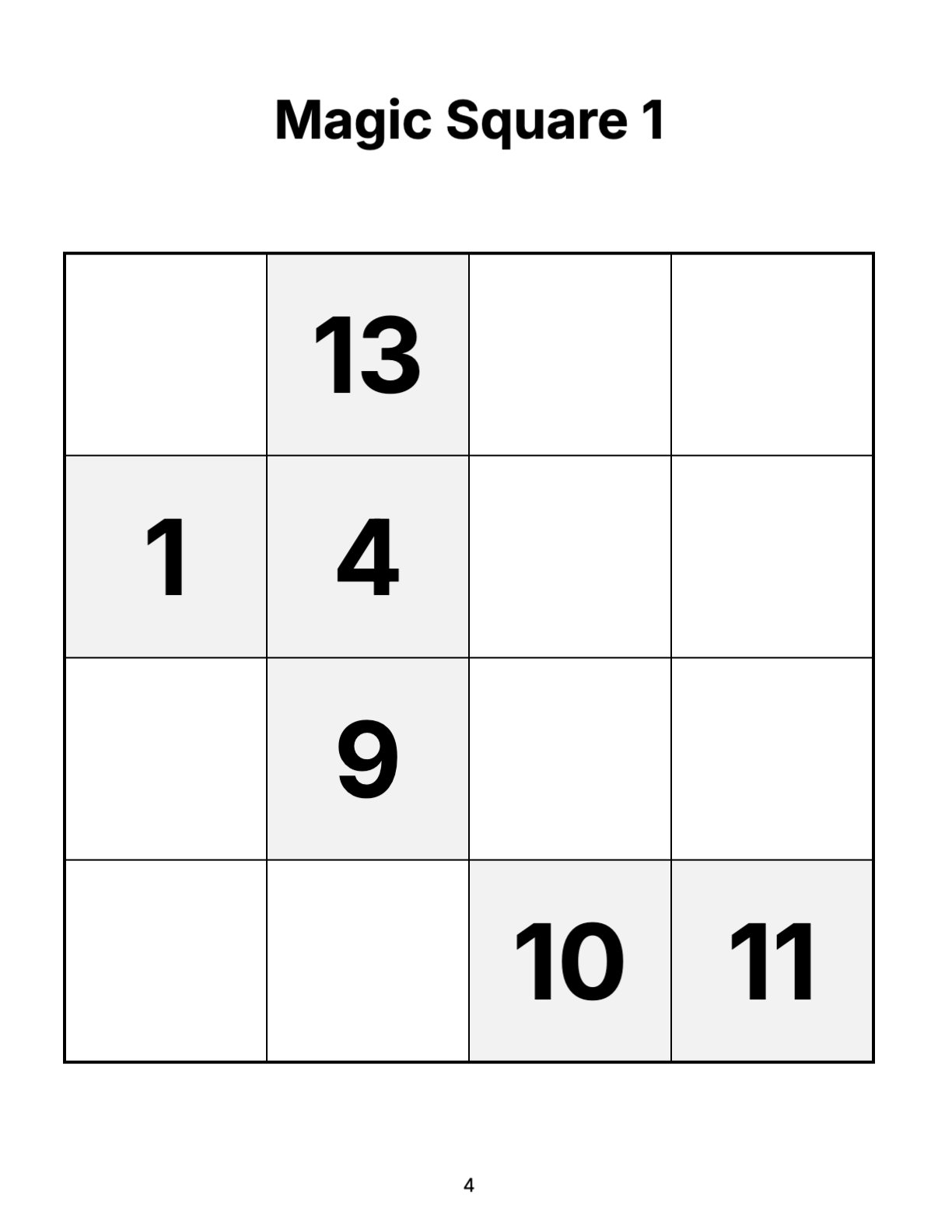
Magic Squares puzzle page from a Wisdom Effect book

Magic Squares

Place each number once so that every row, every column and both diagonals add up to the same magic sum.
When
At least 2,000 years ago
Where
China (the Lo Shu square)
Who
Unknown

The Lo Shu square of the numbers 1 to 9 is the oldest known magic square; a Chinese legend tells of a turtle that rose from the Luo river with the pattern on its shell. Magic squares travelled to India, the Islamic world and Europe, where Albrecht Dürer engraved a 4×4 square into his Melencolia I, with the year 1514 in its bottom row. As a puzzle with numbers to fill in it appears in puzzle books and school worksheets.

Also known as Lo Shu square, magic sum square and number square.

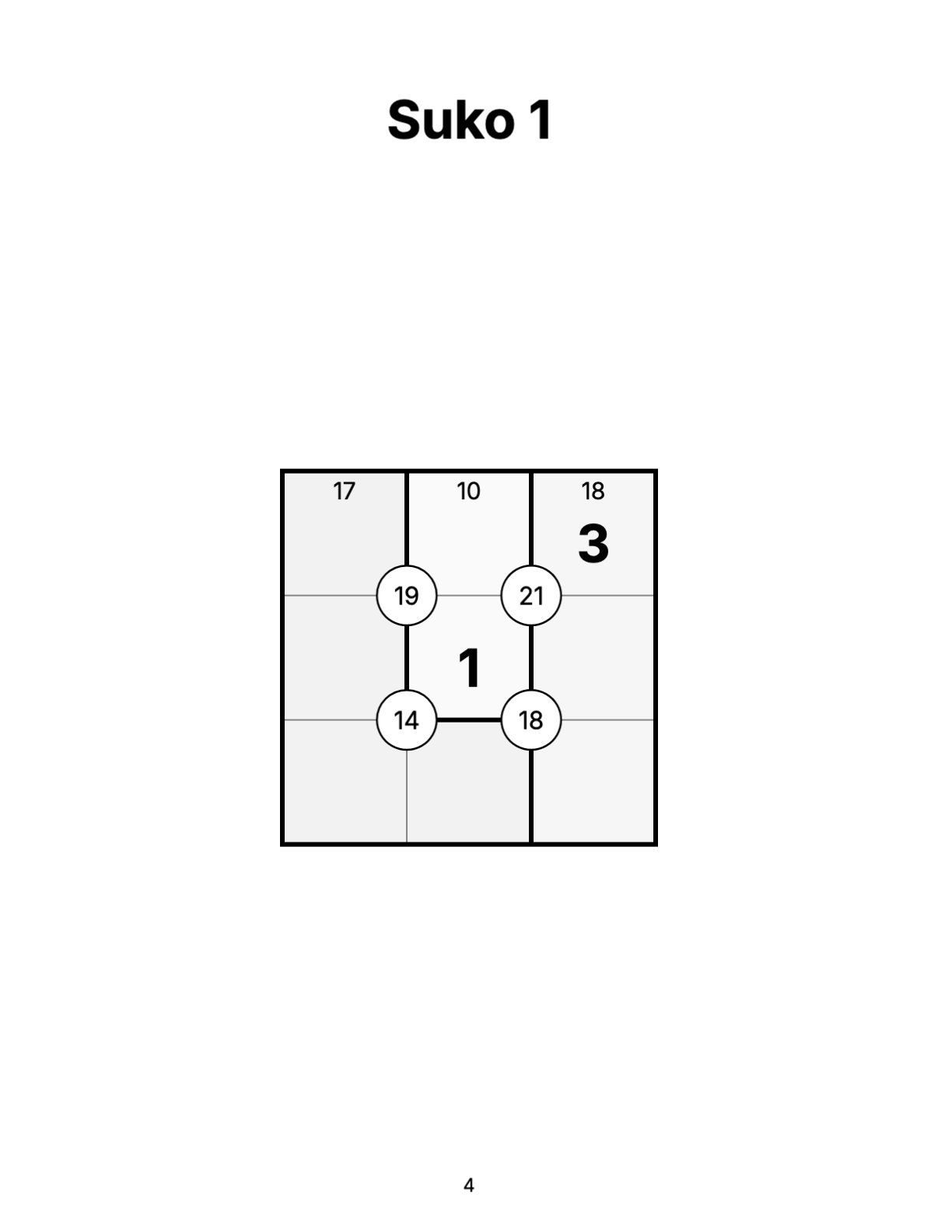
Suko puzzle page from a Wisdom Effect book

Suko

Place the numbers 1 to 9 so that the squares around every circle and the squares of every shaded area add up to their sums.

When
The 21st century
Where
British newspapers
Who
Kobayaashi Studios (Sujiko, by Jai Gomer)

Suko grew out of Sujiko, a 3×3 grid of the numbers 1 to 9 with four circle sums, credited to Jai Gomer of Kobayaashi Studios and printed in British newspapers such as The Times. Suko adds shaded areas with sums of their own, so it needs fewer printed numbers, often none.

Also known as Sujiko, circle sum puzzle and number sum puzzle.

Make a book of any of them

One type per book or several in a mixed book. Free trial with 150 credits, no credit card.

Start free