
Find the last number of a circle or an area
A circle or an area with one empty square gives its number away: the sum minus the numbers it already has. A circle of 24 around 9, 8 and 3 holds 24 − 20 = 4 in its last square.
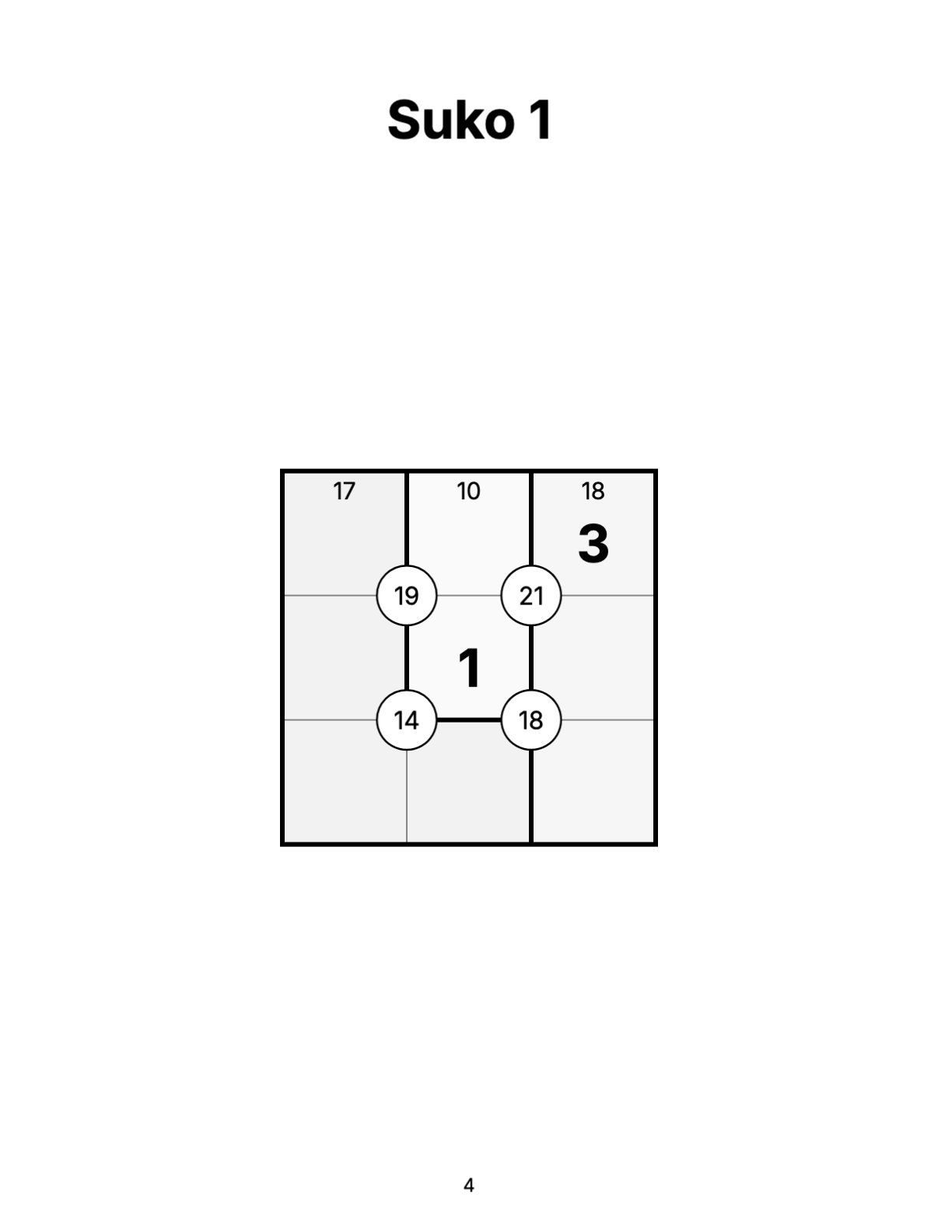
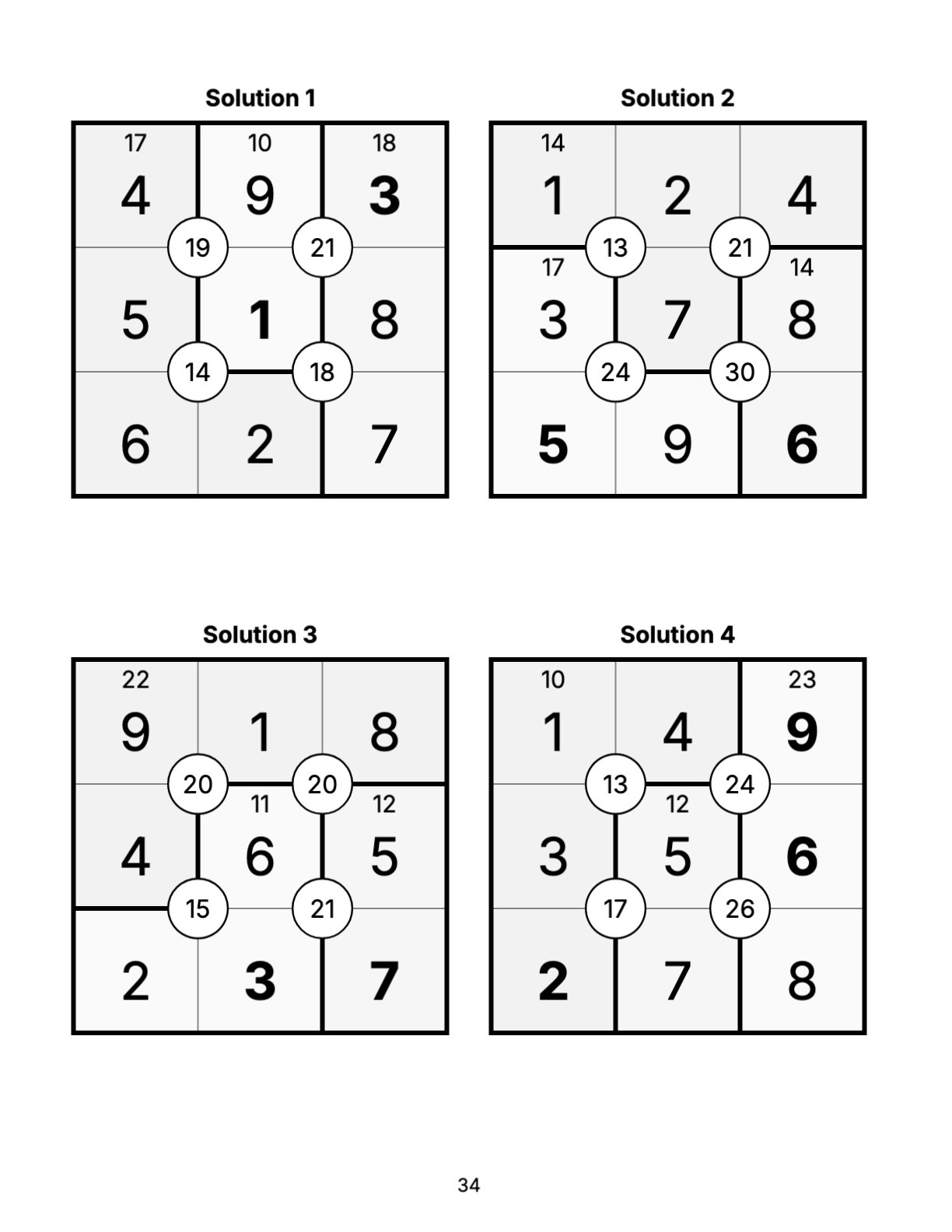
Place the numbers 1 to 9 so that the squares around every circle and the squares of every shaded area add up to their sums.
The grid has 3×3 squares (4×4 or 5×5 in some books). The numbers 1 to 9 go in once each: 1 to 16 in a 4×4 grid, 1 to 25 in a 5×5 grid.
A circle sits on every crossing inside the grid. Its number is the sum of the four squares around it.
The grid is split into shaded areas. The small number in an area is the sum of all its squares.
Some books print a few numbers to start. Fill in the rest; every puzzle has exactly one solution.
Start with the first way and move on when it gives nothing new.
A circle or an area with one empty square gives its number away: the sum minus the numbers it already has. A circle of 24 around 9, 8 and 3 holds 24 − 20 = 4 in its last square.
An area of two empty squares with the sum 7 needs a pair of free numbers that add up to 7: 1 and 6, 2 and 5 or 3 and 4. A circle through one of the squares decides which pair and which order.
Every number goes in once. When a number fits no empty square but one, because every other circle or area would miss its sum with it, it goes in that square.
A corner square sits in one circle only, the middle square of a 3×3 grid in all four. Two circles side by side share two squares, so the difference of their sums is the difference of the squares that are not shared.
In harder grids a circle or an area may still need three or four numbers. List the sets of free numbers that add up to what it is missing: a number that fits no set is out, and a number in every set belongs to it.
Who made Suko, when and where, and its other names: puzzle types.
Print-ready Suko books for Amazon KDP, every puzzle with its answer key.
Suko book generatorJust one page? Free Suko Puzzle Generator