
Cut the ends of the range
The small side of a sign is never the largest number and the big side is never 1. In a 5×5 grid, A < B means A is 1 to 4 and B is 2 to 5.
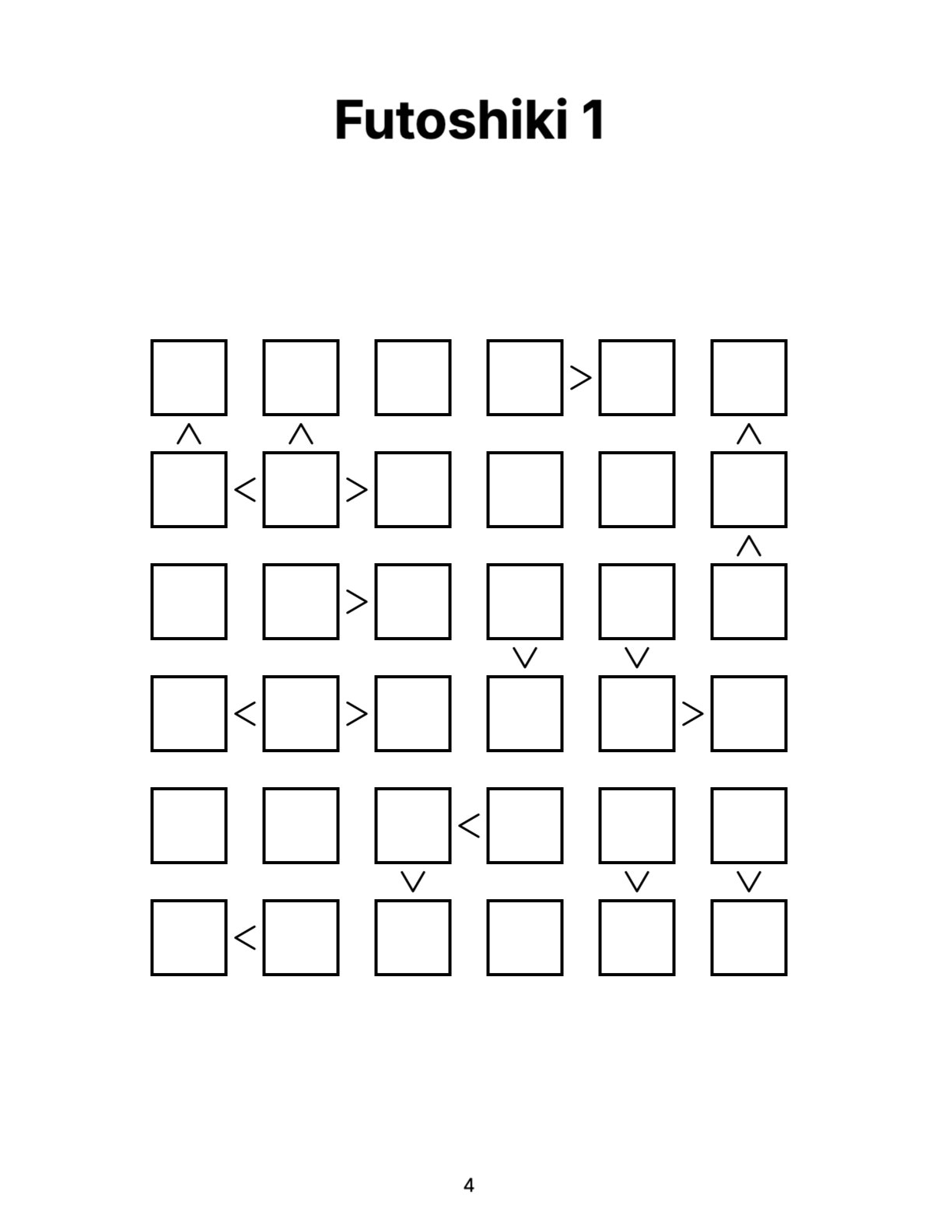
Fill a square grid with numbers that never repeat in a line and obey the signs between them.
A grid of 5×5 squares uses the numbers 1 to 5, a 7×7 grid the numbers 1 to 7, and so on.
Every row and every column holds each number exactly once. There are no boxes and no sums.
A sign between two squares points to the smaller number: 2 < 4, 5 > 3. Between two squares one above the other the sign is turned on its side (∧ or ∨), and the point again faces the smaller number.
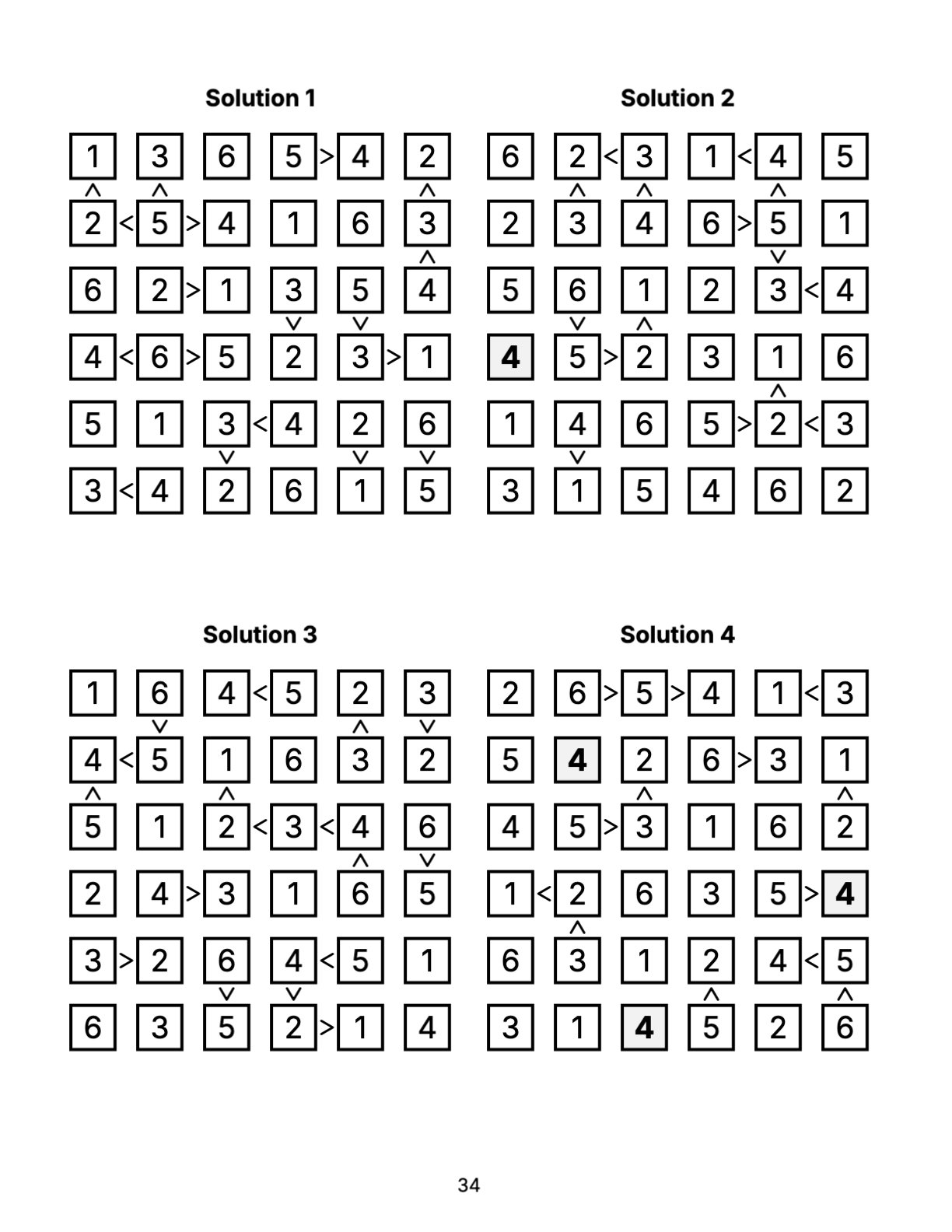
A few numbers are given. Fill in the rest so that every sign is true. Every puzzle has exactly one solution.
Start with the first way and move on when it gives nothing new.
The small side of a sign is never the largest number and the big side is never 1. In a 5×5 grid, A < B means A is 1 to 4 and B is 2 to 5.
A < B < C in a 5×5 grid: A is at most 3 and C at least 3. A whole row of five squares with four signs pointing the same way is simply 1 2 3 4 5.
A square smaller than a given 2 is 1. A square larger than a given 4 in a 5×5 grid is 5.
If a number fits only one square of a row or column, it goes there. If a square can hold only one number after its row, its column and its signs, write it in.
If two squares of a row can only hold 2 and 4, strike 2 and 4 from the rest of the row. A < sign between them tells you which is which: 2 on the small side.
Who made Futoshiki, when and where, and its other names: puzzle types.
Print-ready Futoshiki books for Amazon KDP, every puzzle with its answer key.
Futoshiki book generatorJust one page? Free Futoshiki Puzzle Generator