In short
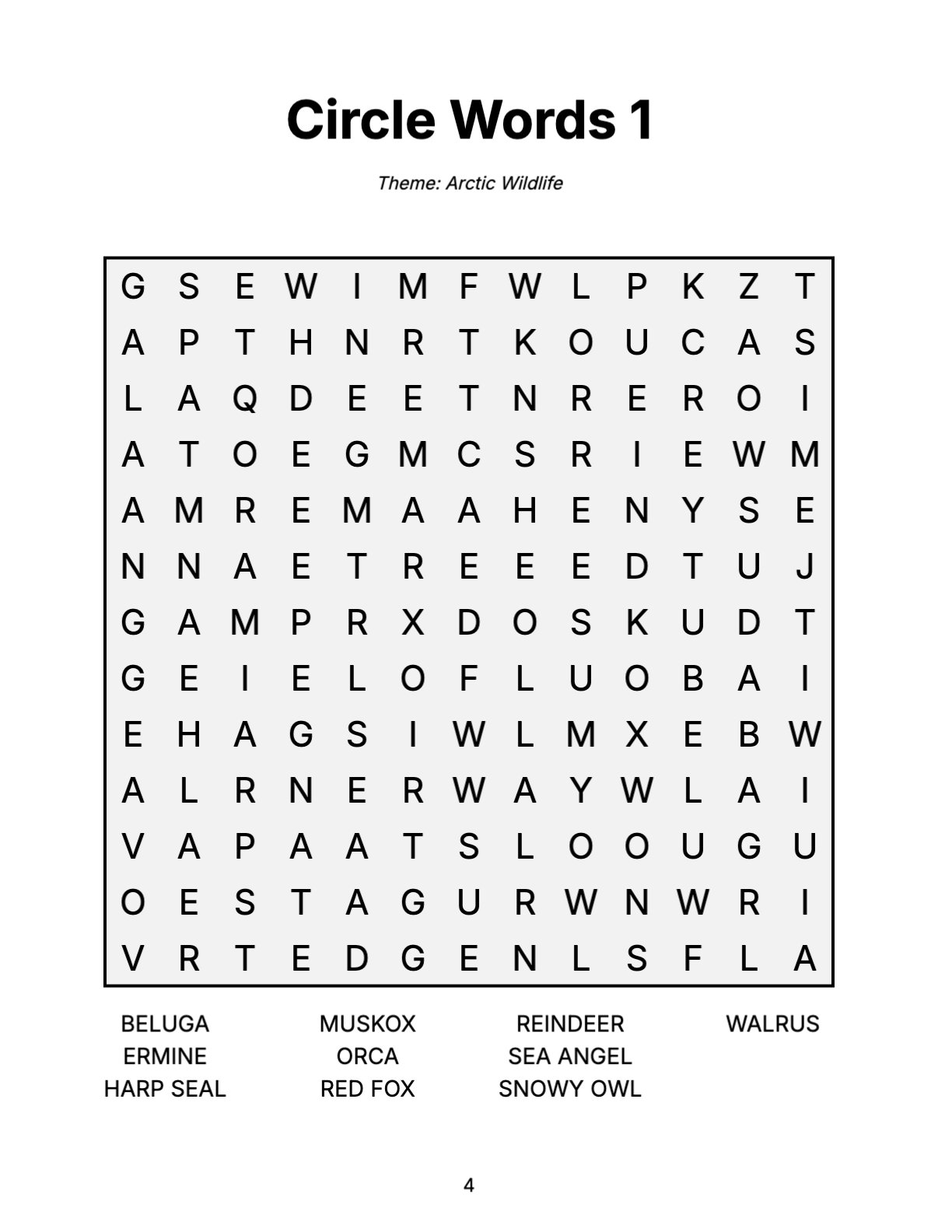
In a circle word search a word does not run along a line: it wraps around a tiny ring of squares, two wide, and may begin at any of its letters and read either way round. Only words of 4, 6 or 8 letters fit, which shapes everything from your word lists to the age group. Below: how the loops work, a worked example of reading one, why each word reads in a single loop, the presets, and how to publish and position the book.
On this page
Three Loop Sizes, Two Ways to Lie
Picture a block of squares exactly two squares wide. Every square of it sits on its edge, so walking around the edge visits each square once. A 2×2 block holds a word of 4 letters, a 2×3 block one of 6, and a 2×4 block one of 8. That ring is the loop. The word may start at any of its squares and travel clockwise or counterclockwise, while ordinary filler letters fill the rest of the grid, as in a classic word search.
The longer blocks can stand (two wide, taller than wide) or lie on their side (two tall). Standing-only puzzles give the eye one shape per word length to look for; puzzles where loops stand and lie double that. Loops never share a square, and the settings cap the word count so the loops take up no more than about half of the grid, leaving plenty of filler to hide them in.
We know of no documented origin for this loop format; the rules above are the ones Wisdom Effect prints in one sentence under every word list.
Reading a Loop: GARDEN and FROG
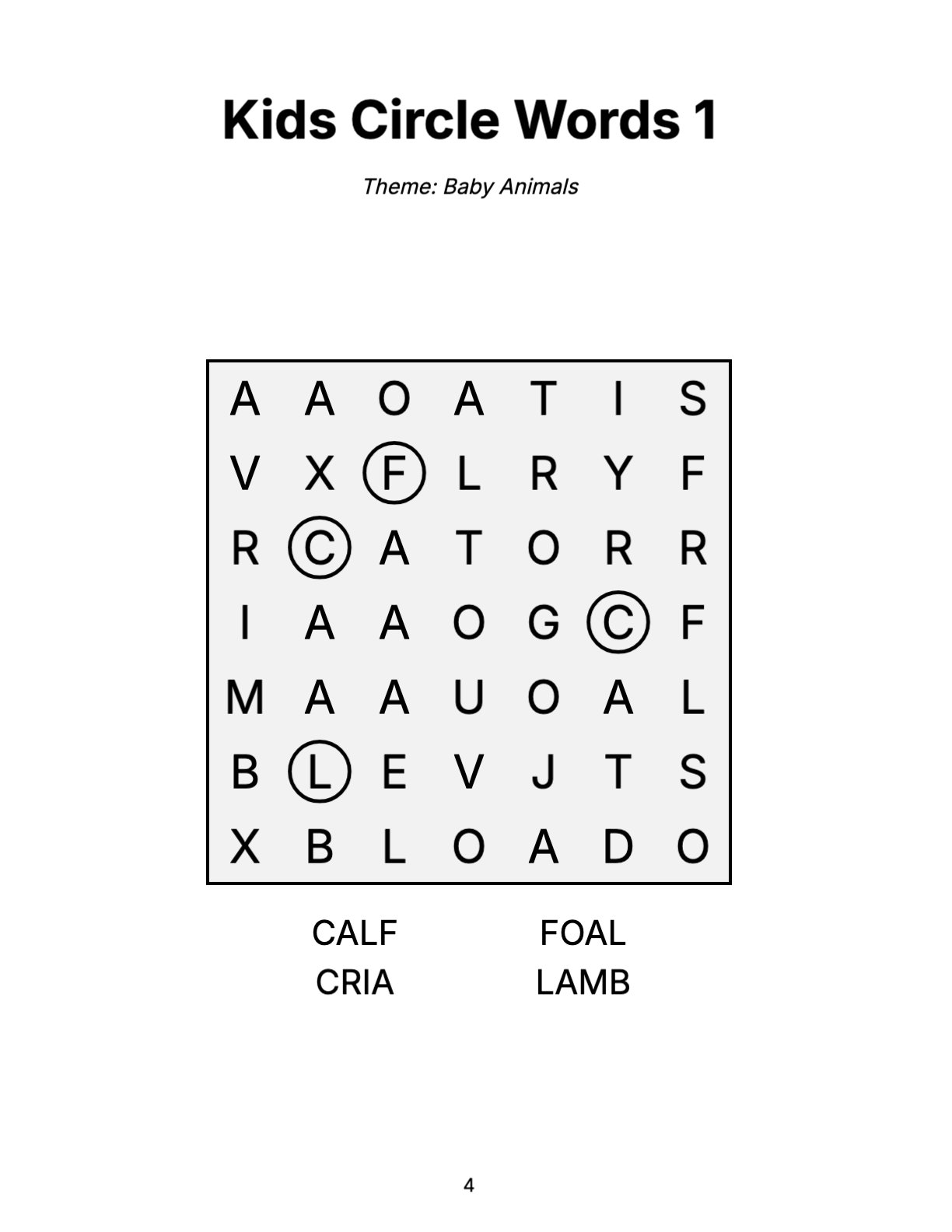
Take FROG in a 2×2 loop. Going around a square block, the first and third letters always land on opposite corners, and so do the second and fourth. So F and O sit corner to corner, R and G sit corner to corner, and the four letters form a tight square cluster. A solver who knows this stops tracing and simply looks for an F with an O diagonally next to it.
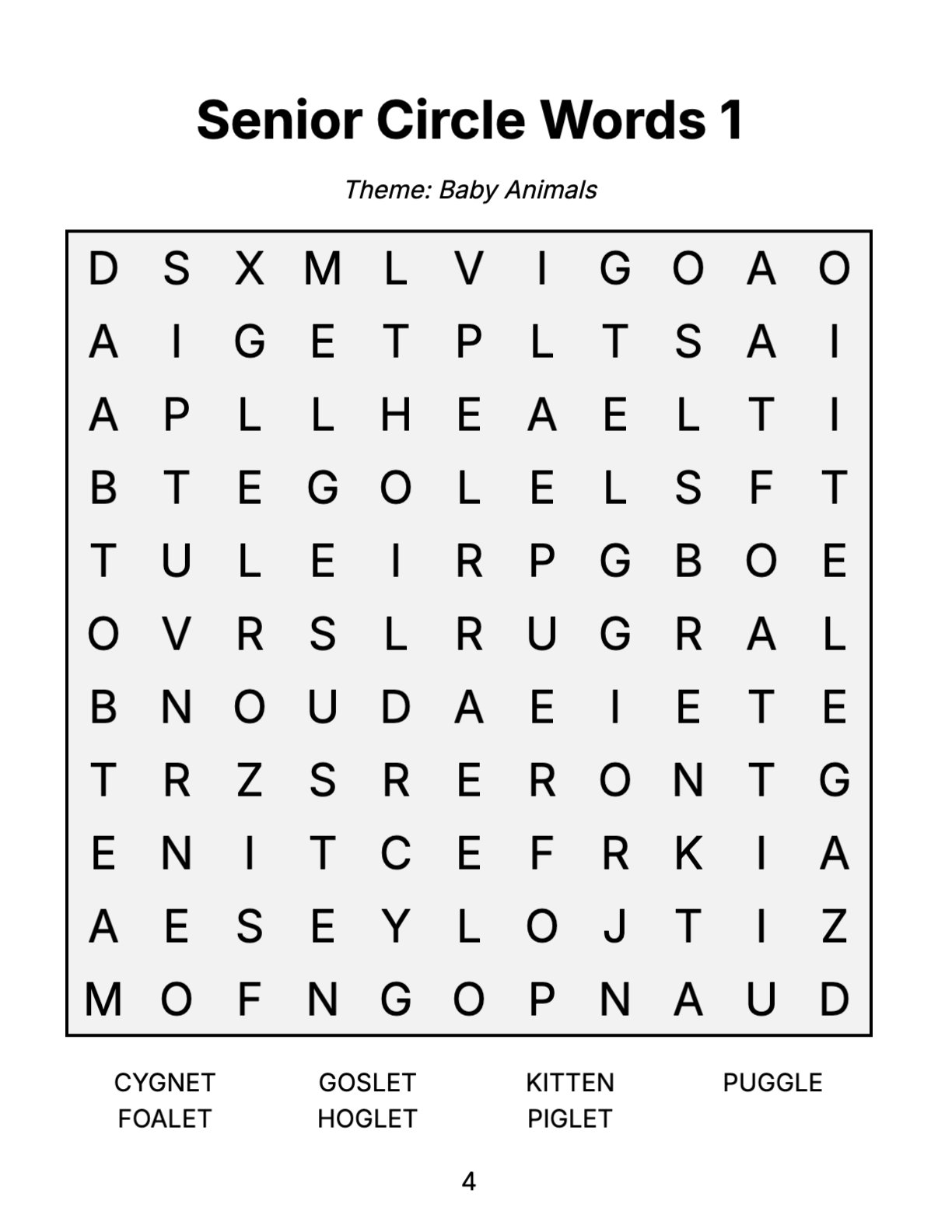
Now GARDEN in a standing 2×3 loop, starting at the top left and going clockwise: G and A on the top row, R and D down the right side, E and N back up the left. On the page that prints as GA on the top row, NR in the middle and ED at the bottom. Read row by row it is nonsense, which is exactly why the puzzle is hard to scan; read around the ring it is the word.
A practical method follows. Pick the rarest letter of a word, find each copy of it in the grid, and check the ring of squares around it for the letters on either side of it in the word. Three neighbors decide quickly whether a loop is there. Longer words are easier to confirm and harder to spot, because their letters sit up to three rows apart.
Why Each Word Wraps One Loop Only
Short rings are easy to form by accident. Four filler letters can spell a 4-letter word around some 2×2 block, and words can hide in each other: the four squares at the end of a 2×4 loop are themselves a 2×2 loop, so BAIT could read a second time inside SWIMBAIT. Two words that are rotations or reversals of each other, such as STAR and RATS, would read around the same ring.
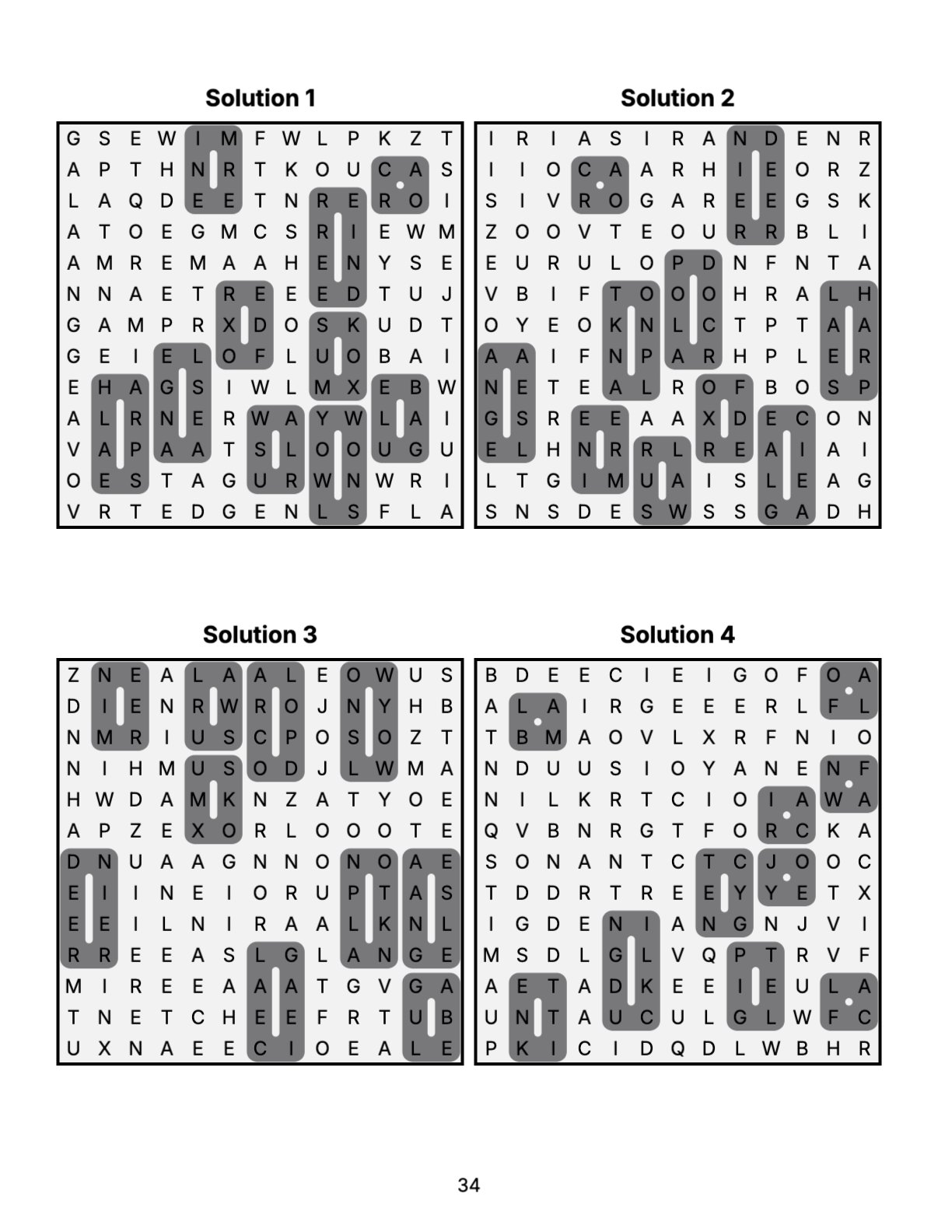
Wisdom Effect looks for every word around every loop of its length in the finished grid, standing and lying, even when the book lays loops one way only. A second reading made of filler letters is broken by changing a filler letter; if that cannot work, the loops are laid out again. Pairs like STAR and RATS, and a short word inside a longer one, never share a puzzle. The answer key, which marks each word with a rounded box around its ring, is therefore the only solution.
Levels for Children, Adults and Seniors
Loop size matters more than grid size. A 2×2 ring is visible as a little square; a lying 2×4 ring stretches four columns and turns two corners. The standard presets climb from small standing loops to long loops both ways.
Kids books run from 6×6 to 10×10 with 3 to 8 words, 4-letter words by default and 6-letter loops for older children; every preset circles the first letter of each word, which turns the search into a matter of choosing the direction. Senior books keep to one loop size, 6-letter words in 2×3 rings, on 9×9 to 13×13 grids with 4 to 12 words in large print, and only the two harder senior presets lay loops on their side.
| Level | Grid | Words | Loop sizes | Orientation |
|---|---|---|---|---|
| Easy | 10×10 | 6 | 2×2, 2×3 | Standing |
| Medium | 13×13 | 10 | 2×2, 2×3, 2×4 | Standing |
| Hard | 15×15 | 14 | 2×2, 2×3, 2×4 | Standing and lying |
| Expert | 16×16 | 16 | 2×3, 2×4 | Standing and lying |
Building Lists of 4, 6 and 8 Letters
The length rule is strict: a 5- or 7-letter word has no loop and is left out. Curated themes handle this by borrowing words of the right lengths from the theme’s next lists. Your own lists do not borrow, so a row with too few words of the chosen sizes prints a puzzle with fewer words. Every row becomes one puzzle, with the row’s title printed as its theme.
Write more candidates than you need, sorted roughly by length. For a kids book that means plenty of 4-letter words: BIRD, FISH, LAMB, MILK, SHIP, TREE. Senior books need 6-letter words only: GARDEN, CANDLE, PEPPER, WINTER. The word check under the settings lists what it could not use and why, and how many puzzles would come out short.
Language support works as in the other word types: themes in English and 8 translated languages, letters such as Å, Ä or Ñ kept in the grid. A translated word may change length, though, so a German or Spanish book can fit different words than the English one from the same theme.
Publishing and Positioning the Book
Circle word searches suit buyers who already own a shelf of classic word search books and want a new rule without a new skill. The name alone does not explain the puzzle, so let the subtitle do it: "Circle Word Search: 80 Puzzles Where Every Word Wraps Around a Loop" or, for children, "4-Letter Word Loops for Kids Ages 6 to 8". Large print books can promise one loop size, which is a real selling point for solvers who dislike surprises.
For the interior, a standard circle book holds one or two grids per page, with as many as nine solutions on an answer page; kids and senior books keep one grid per page and four solutions at most. A 16×16 grid with lying loops is easiest to read on 8.5×11 at one per page, and the configurator warns when letters would print small on the trim you picked.
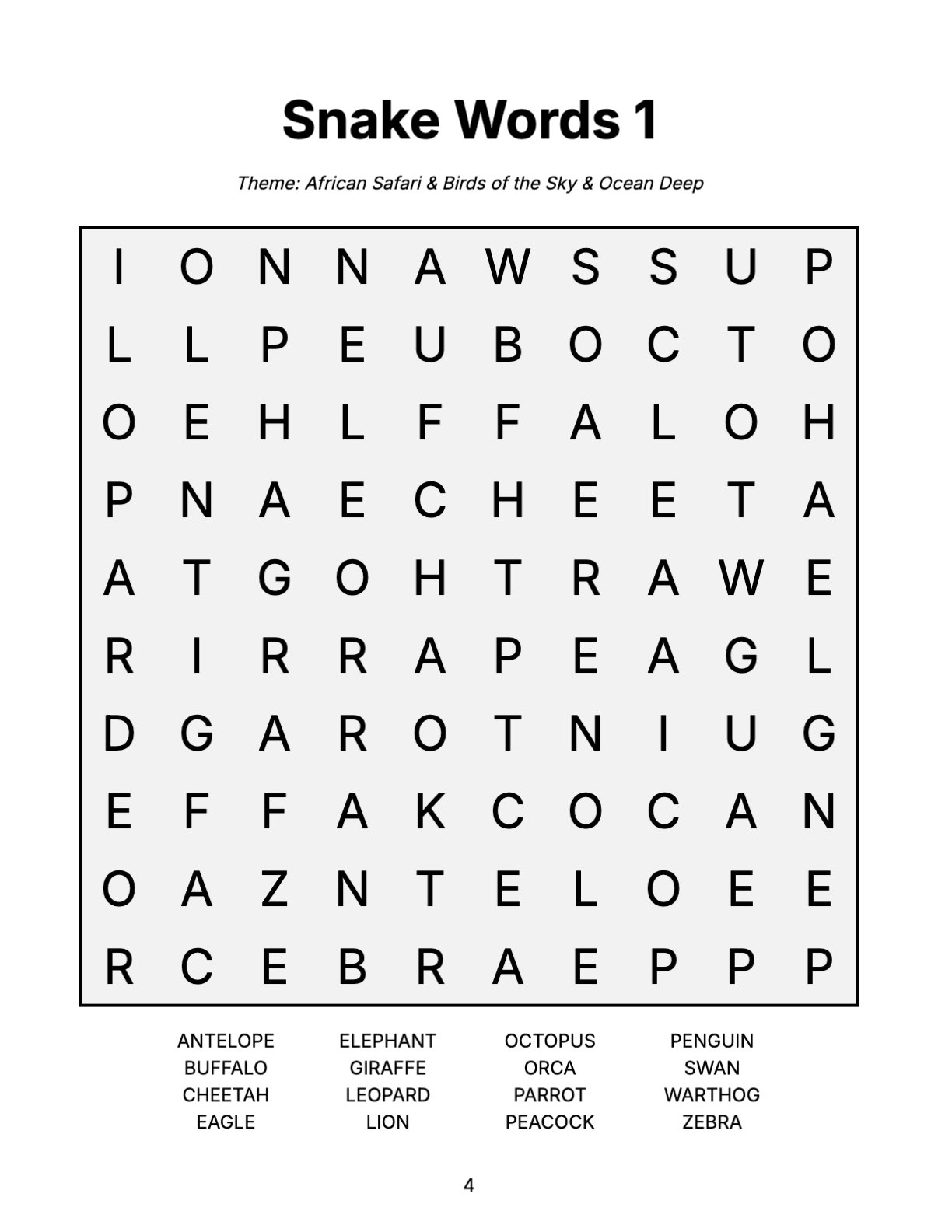
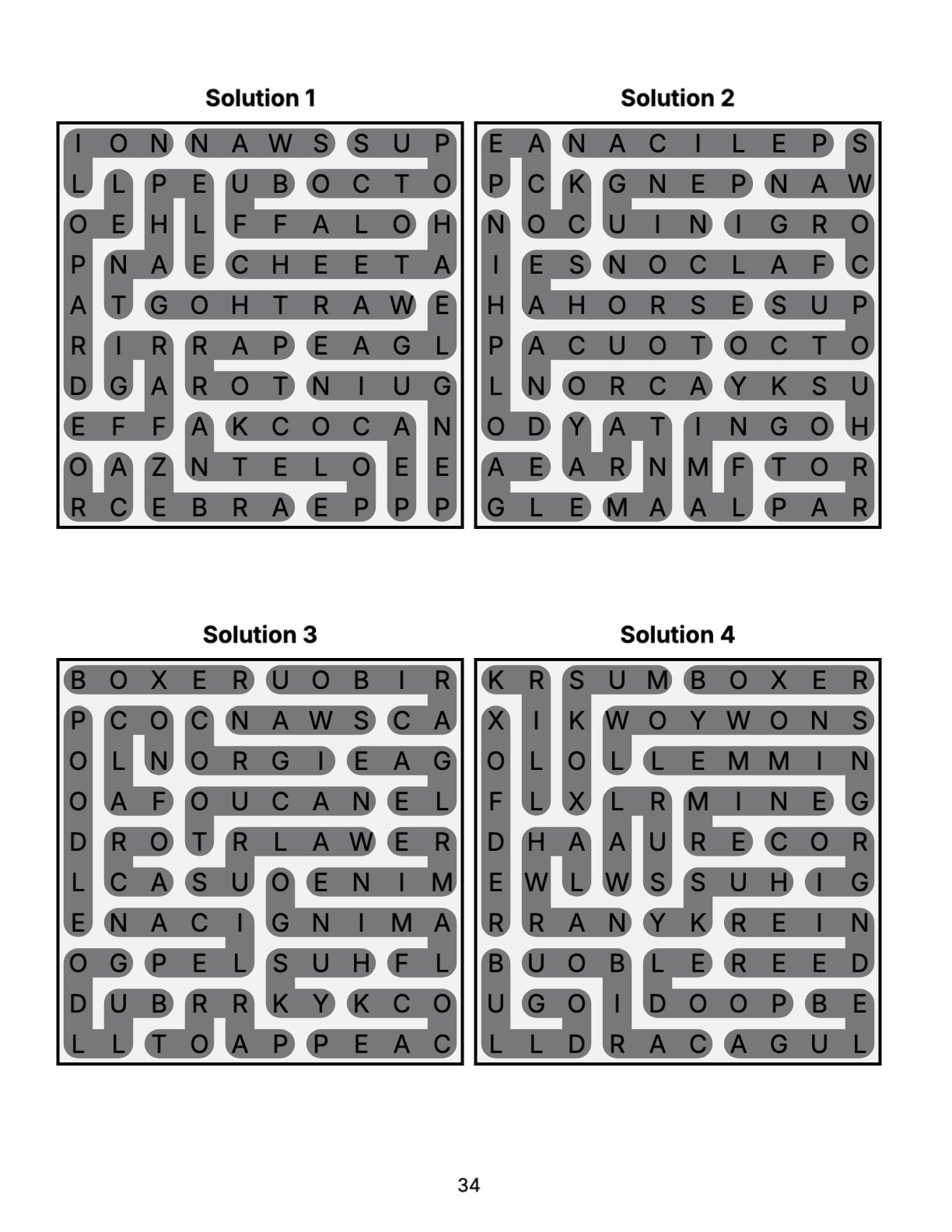
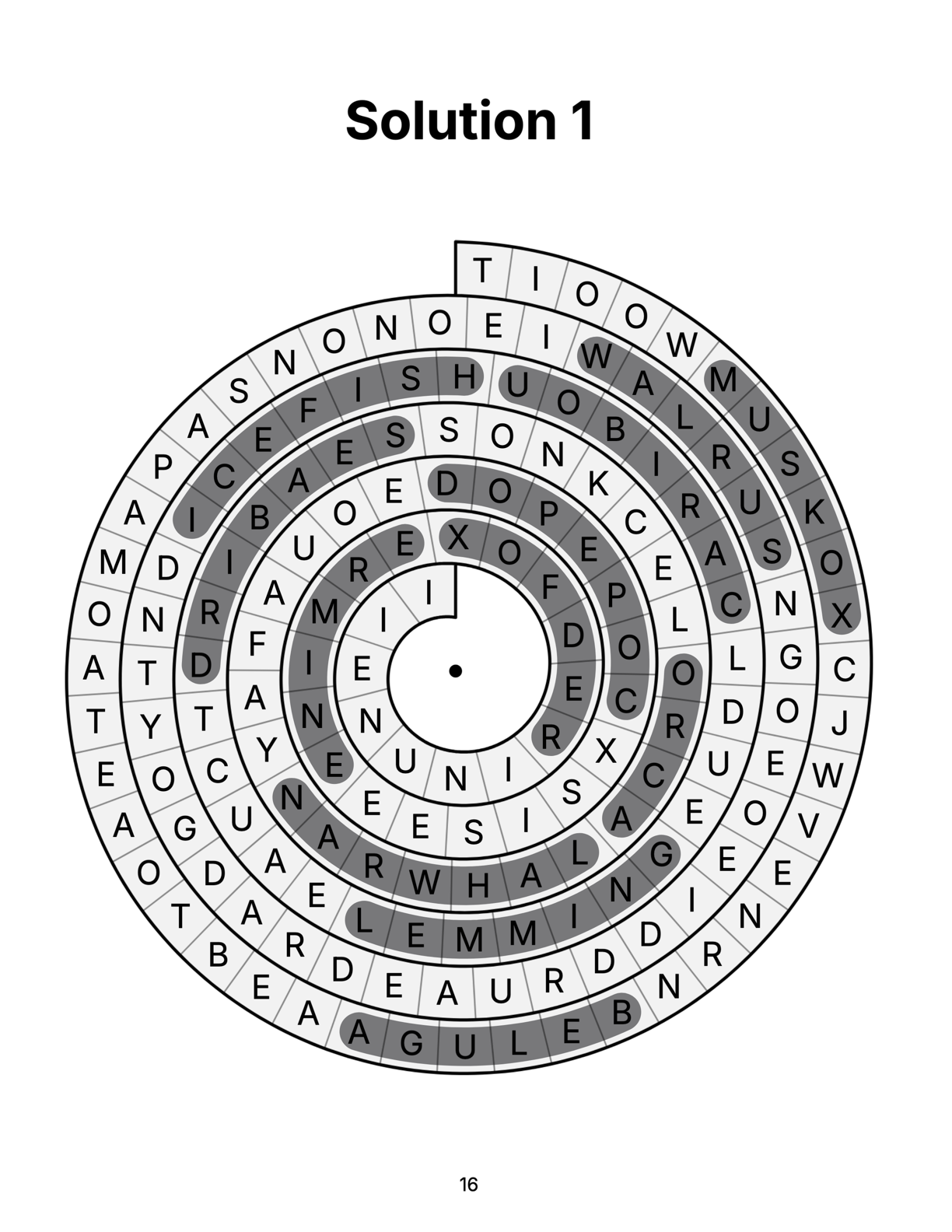
To make the book in Wisdom Effect, choose the edition and the Circle Word Search card on /create, a level, a theme and, if you like, your own loop sizes and orientation. Each puzzle is one credit at any grid size, every plan from Starter up includes the type, and the editor guide covers trim, pages, cover and export. Circle grids also work as a chapter of a mixed puzzle book next to snake word searches and the spiral word search, each a different way for words to stop being straight.
Tools for This Guide
Circle Word Search Book Generator
Circle word search books with 2×2, 2×3 and 2×4 loops, 9 languages, Kids and Large Print editions.
OpenFree Circle Word Search Generator
One free circle word search page to print, from a theme or a list of 4-, 6- and 8-letter words.
OpenKids Puzzle Book Generator
Kids activity books with short word loops, mazes and other first puzzles in big print.
OpenFrequently Asked Questions
How do you solve a circle word search?
Choose a word, find its rarest letter, and check the ring of squares around it for the letters before and after it. A 4-letter word fills a 2×2 square, 6 letters a 2×3 block and 8 letters a 2×4 block, read clockwise or counterclockwise from any start.
Can I make a circle word search with my own spelling words?
Yes, as long as the words have 4, 6 or 8 letters. Words of other lengths are left out, and the word check lists them so you can swap them for words that fit.
Is there a free printable circle word search maker?
Yes. The free tool prints a single page, as a US Letter or A4 PDF, Classic or kids style at Easy or Medium (Hard is in the book generator), from a theme or your own 3 to 24 words, with an answer page. Free pages are for personal and classroom use.
Is it the same as a word circle app game?
No. Those games build words from a wheel of letters. A circle word search is a printed letter grid in which each listed word wraps around a small block two squares wide.
Do loops ever overlap or share letters?
No. Every loop has squares of its own, and filler letters fill the squares between loops.
What does a circle word search book cost?
One credit per puzzle at every grid size, from 6×6 to 16×16, so a 70-puzzle book costs 70 credits. Starter, Pro, Publisher and the free trial include the type.