In short
In a Nurikabe the reader shades a grid into one connected sea and leaves islands of white squares, each island as large as the number inside it. The rules fit on a sticky note, yet a good grid can hold an adult for half an hour. This guide covers the opening moves and the harder reasoning behind them, how island size and logic level relate, what children need from the puzzle, why home-made grids so often go wrong and how to publish a finished book on Amazon KDP.
On this page
Islands, a Sea and Four Rules
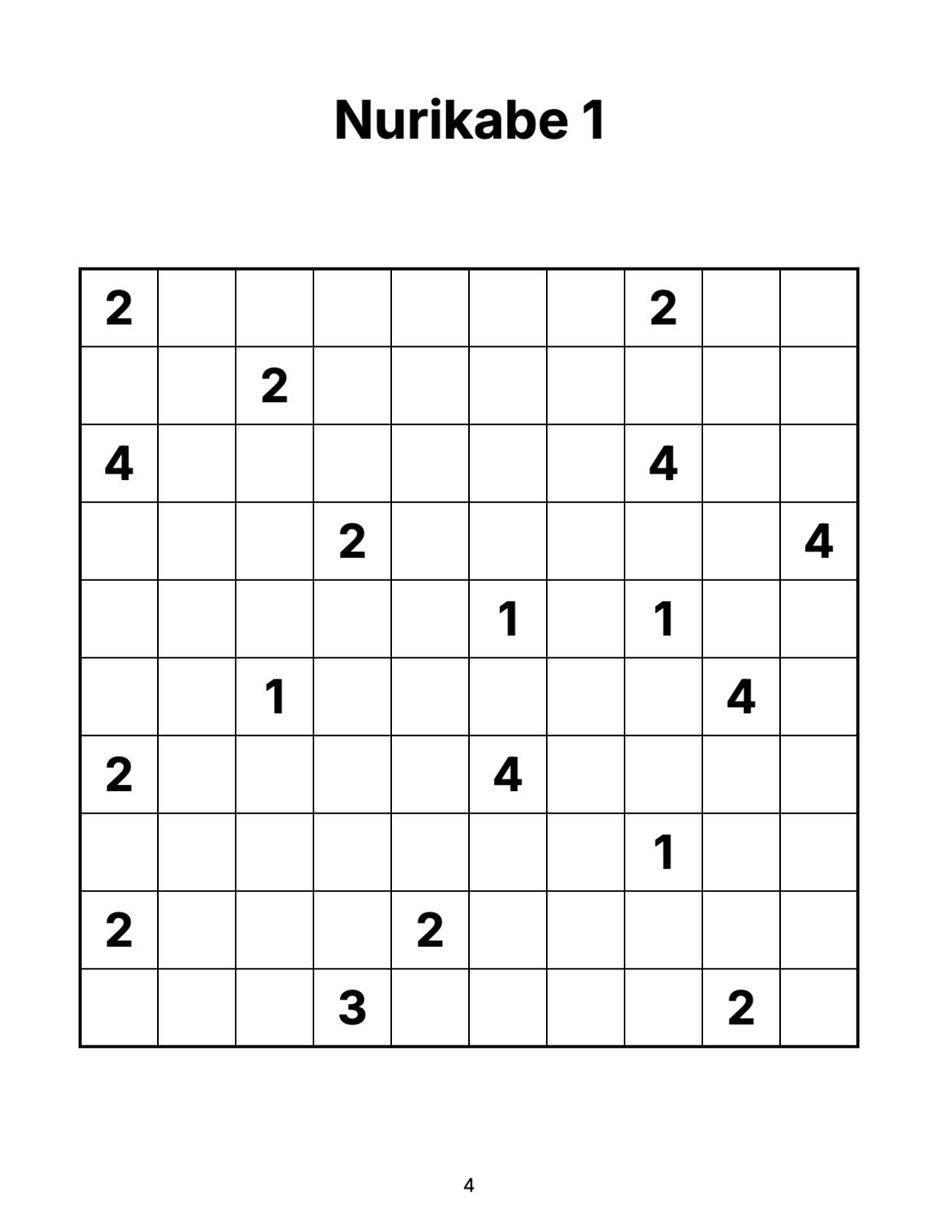
Some squares of a Nurikabe grid carry a number; the rest are blank. The reader shades squares, and the shaded squares are the sea. First rule: the sea is one body of water, every shaded square joined to the others side by side. Second: the sea never fills a 2×2 block. Third: the unshaded squares form islands, each containing exactly one number, which is the island’s size in squares. Fourth: islands may touch at a corner but never along a side. When those four hold, the grid is solved.
A puzzle author known as renin sent the idea to the Japanese magazine Puzzle Communication Nikoli, which first printed it in 1991, and the name comes from the nurikabe, a wall spirit of Japanese folklore that blocks travellers’ way at night. It uses digits only, so a Nurikabe book needs no translation beyond its title and instructions.
Opening Moves on a Fresh Grid
Every 1 is an island already, so the squares beside it are sea. Shade them first; where a grid has several 1s, that alone starts a few lines of water.
Then look for squares that would glue two islands together. In a row reading 3, blank, 2, the blank square touches both numbers; left white, it would put two numbers in one island, so it is sea. The same goes for numbers that touch diagonally: a 2 with a 4 to its lower right leaves two squares that each touch both numbers, and both are sea.
Distance rules out more. An island of 3 squares reaches at most two steps from its number, and in general an island of n squares reaches n − 1 steps, so a blank square that no number can reach this way joins the sea. Corners far from any clue often fall this way. Last of the opening moves, the 2×2 rule: wherever three squares of a 2×2 block are sea, the fourth must stay white and belong to some island.
When the Easy Moves Run Out
Count the water. Every square is either sea or island, and the islands add up to the numbers, so the grid size minus the sum of the numbers is the size of the sea. On an 8×8 grid whose numbers add up to 24, exactly 40 squares are shaded; when that many are shaded, every other square is island.
Follow the only exit. An island that still needs squares and has one open neighbour must grow through it, and a pocket of sea with one open neighbour must flow through it too, because the sea is one piece. These two moves often run in a chain across the grid.
List the shapes. A 3 next to a wall may have only three ways to finish. A square inside all of them is island; a square touching all of them is sea, because every finished island is wrapped in water. At the higher levels the list shrinks further: a shape that would cut the sea into two parts, or leave a 2×2 block of sea elsewhere, is not allowed. When nothing is certain, shade one square in your head and follow it a few steps; if a rule breaks, the opposite is true.
Island Size and Logic Level
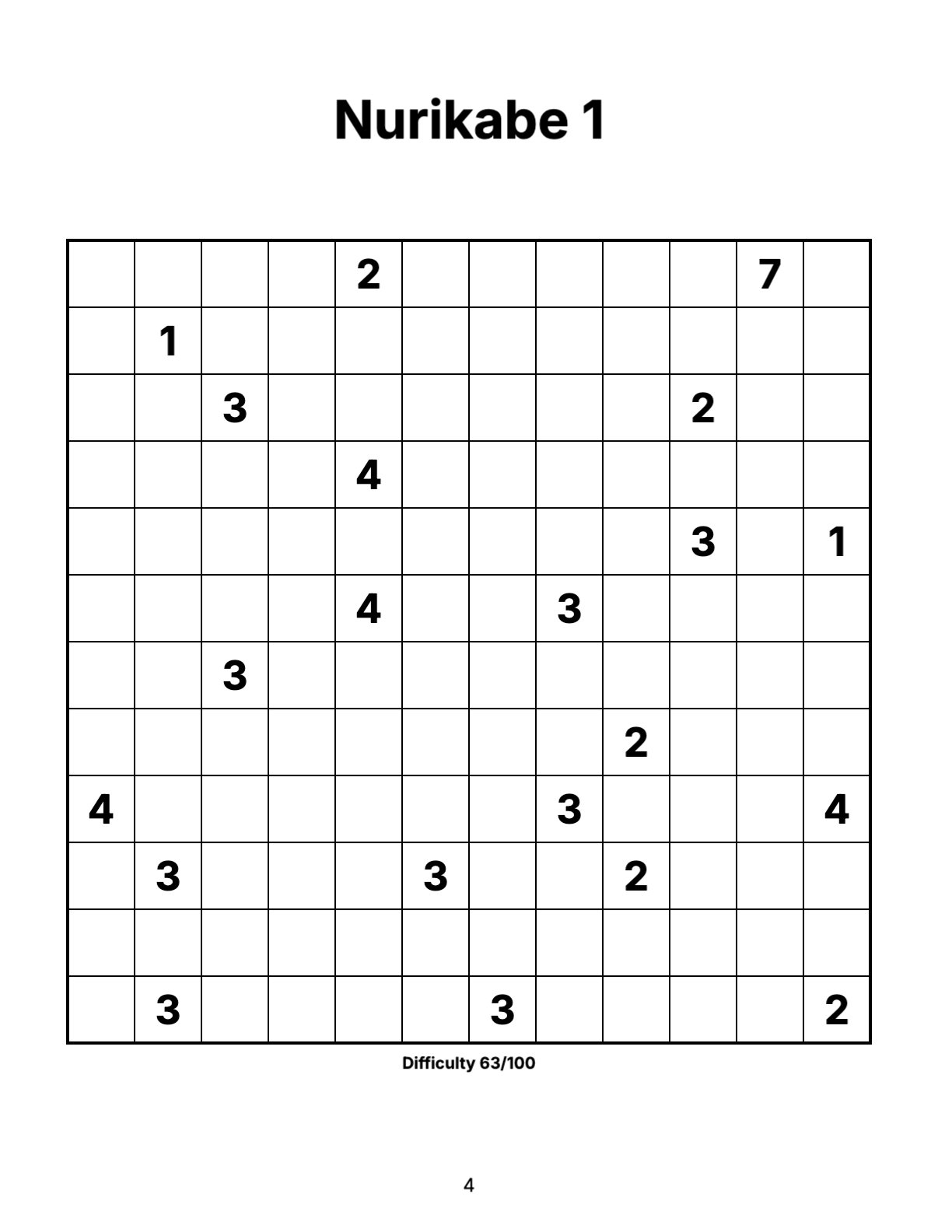
Wisdom Effect sorts Nurikabe puzzles by the moves they require. A program that solves like a person works through each grid using only the techniques of its level: Easy grids need the opening moves and single exits, Medium grids the shapes an island can still take, Hard grids the squares that would cut the sea, and Expert grids a square tried and followed to a contradiction. A grid the program cannot finish with that logic is reworked (a number moved, islands grown, split or joined) and solved again, so each printed puzzle has one answer.
Bigger islands mean fewer numbers and longer reasoning. The largest island is 5 squares at Easy, 7 at Medium, 9 at Hard and 10 at Expert, and an Easy 8×8 holds about 12 numbers, a Hard 12×12 about 23. A score from 1 to 100 grades each grid inside its level’s quarter of the scale (Easy 1 to 25 up to Expert 76 to 100), climbing with the number of deductions and with fewer numbers per square; it can print under the grid.
| Level | What the reader must see | Largest island | Preset grid |
|---|---|---|---|
| Easy | Ones, squares between numbers, single exits | 5 squares | 8×8 |
| Medium | Every shape an island can still take | 7 squares | 10×10 |
| Hard | Squares that would split the sea | 9 squares | 12×12 |
| Expert | A square tried until a rule breaks | 10 squares | 12×12 |
Nurikabe for Children and the Classroom
For children the rules are easiest to explain as a map: colour the sea, keep the islands dry, and every island has as many squares as its number says. The Kids edition of Wisdom Effect keeps islands to at most four squares and offers three presets: Tiny (5×5, from age 6), Small (6×6, ages 7 to 8) and Big (8×8 at Medium, from age 9). Pages hold one or two grids with big squares, so a crayon works as well as a pencil.
Teachers and parents outside the English-speaking world can print the same puzzles with the title and instructions in Dutch, German, French and the other book languages (a Publisher plan or the free trial). For a single worksheet the free Nurikabe generator prints Easy and Medium pages with answers for personal and classroom use, and the kids puzzle book generator combines Nurikabe with mazes, word searches and other children’s puzzles.
Making Your Own Nurikabe Puzzles
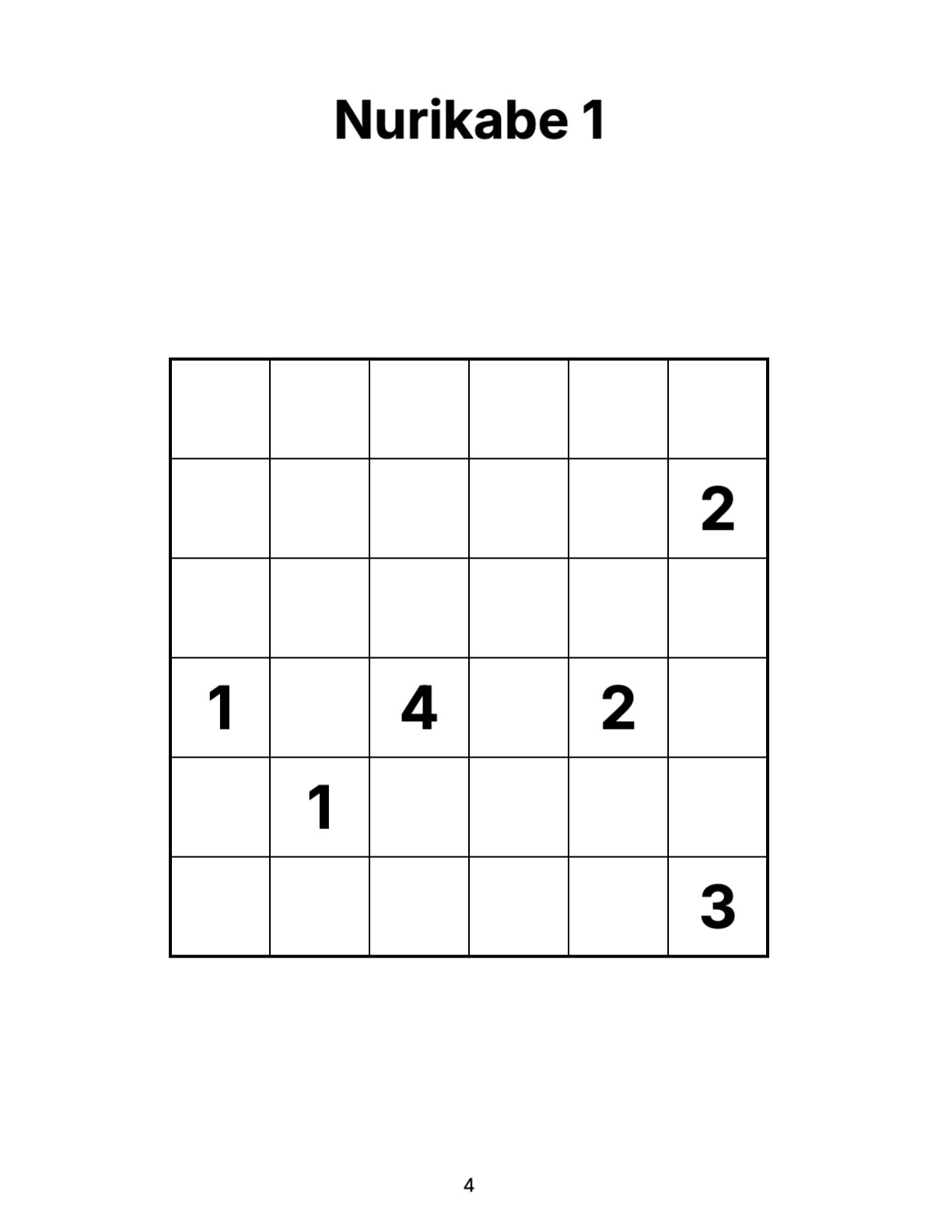
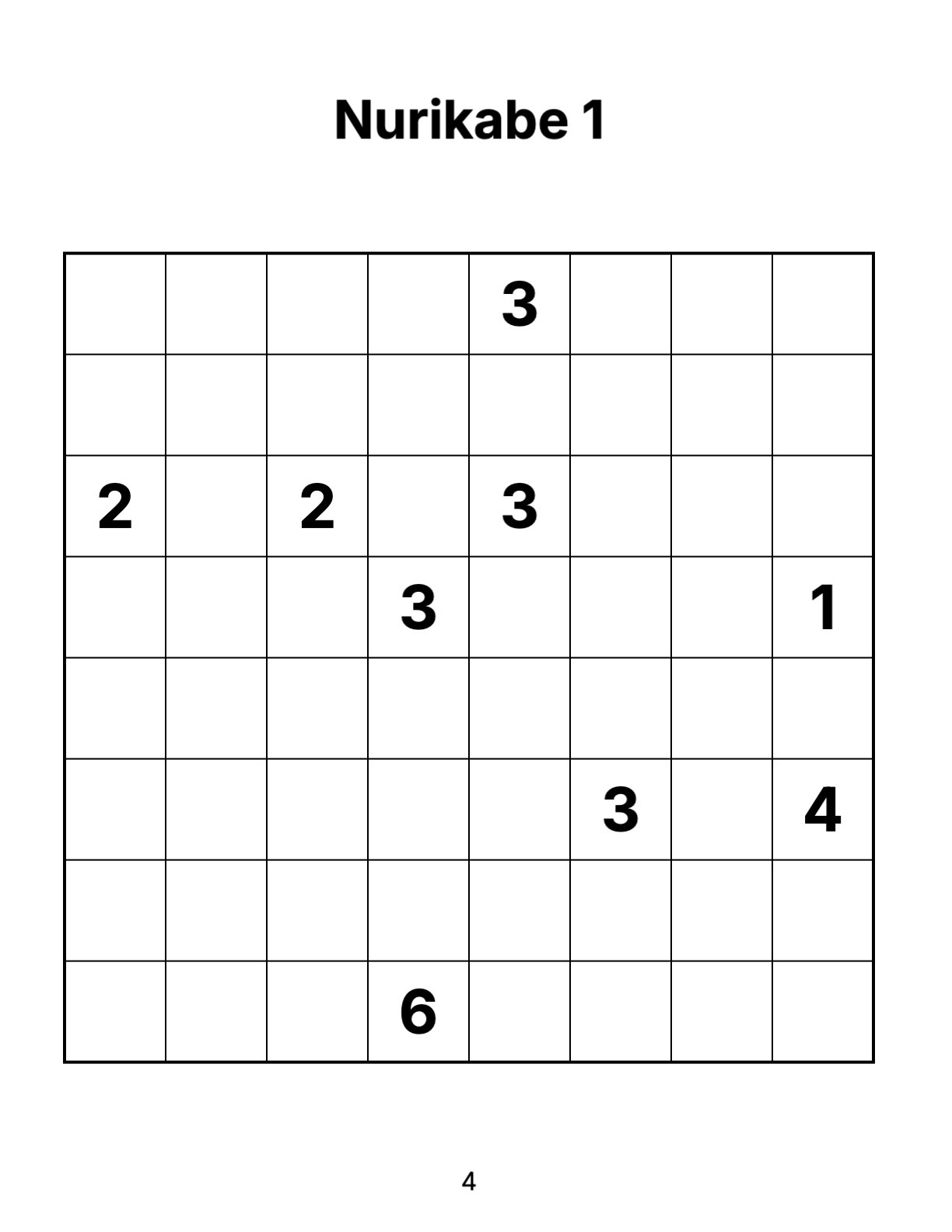
Building a Nurikabe by hand looks easy: shade a sea, write each island’s size into one of its squares, done. The trouble is that the numbers rarely pin the drawing down. A 3 in open water can grow in many directions, and if a second shading also keeps all four rules, readers find it, compare it with the answer key and decide the book is wrong. Checking a hand-made grid for a single solution means solving it every way it could go, which is the work a generator takes over.
A generator does both jobs at once. In Wisdom Effect you choose the edition, the level and a grid from 7×7 to 15×15 (Expert stops at 12×12), and each puzzle is built, solved and, where needed, repaired before it is shown. The Book Code makes the set reproducible: keep the code to rebuild the same grids, change it for a fresh set. The Book Check re-solves the first puzzles and lists how many logic finished, the range of their scores and how many islands a grid has on average.
Publishing a Nurikabe Book on KDP
A Nurikabe book suits adults who already enjoy pencil logic and want something beyond Sudoku. Name the puzzle and the promise in the title, for instance “Nurikabe Puzzle Book: 150 Island Logic Puzzles from Easy to Expert with Solutions”, and describe the grid sizes and levels in the description. Seniors get their own edition: one puzzle per page in large print, with the presets Relaxed (6×6), Classic (8×8) and Challenging (10×10, Hard).
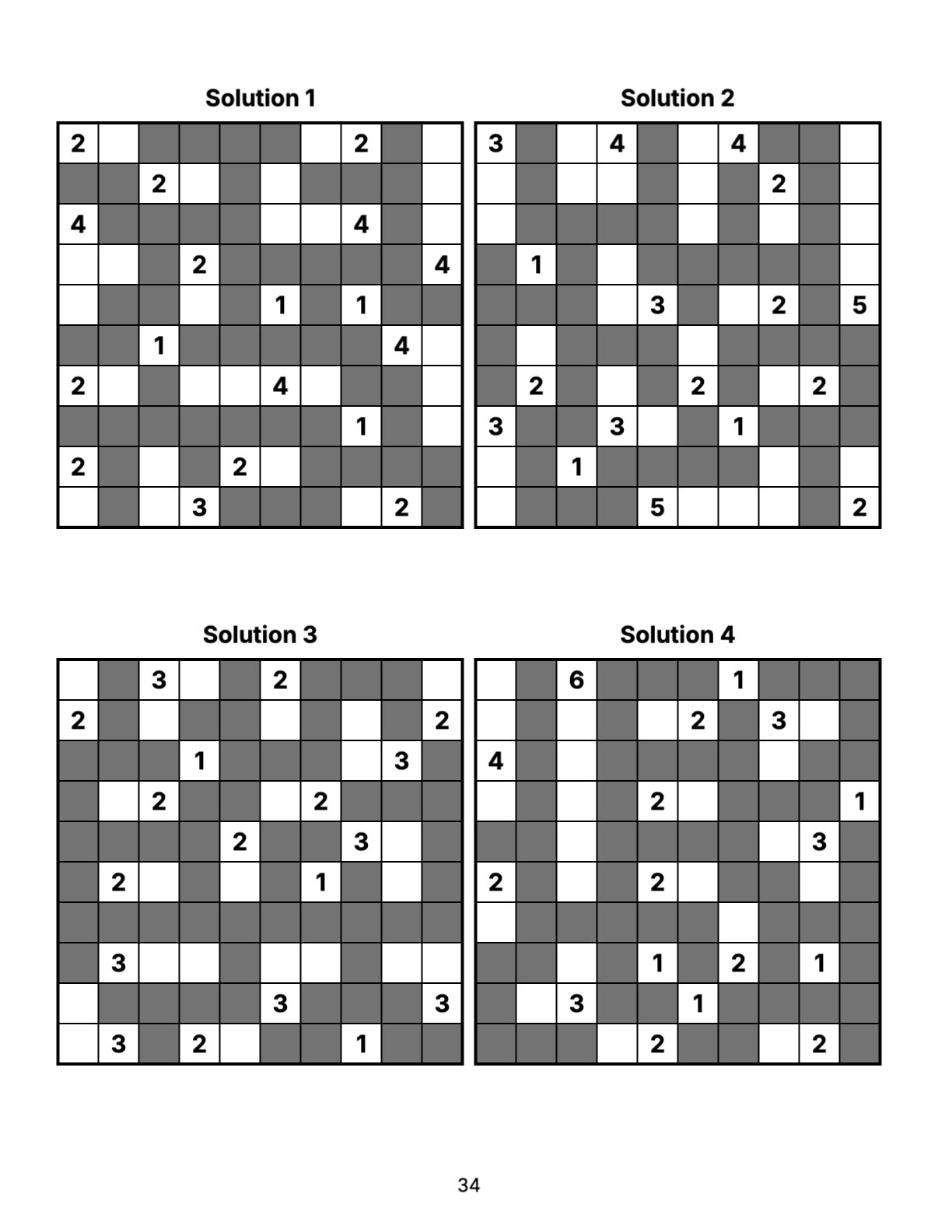
The answer key shades the sea mid grey, so the white islands with their numbers stand out even in black-and-white print; in the editor, Puzzle Design can replace the shading with a small dot in each sea square to save ink, and sets the border, the grid lines, the number size and a lines or tiles look. Standard books print one, two or four puzzles per page and up to nine solutions; the editor guide covers the page and export settings.
Nurikabe grids are charged one credit each, or two at Expert or above 12×12; a 100-puzzle book of Hard 12×12 grids comes to 100 credits. The type is part of the Pro and Publisher plans and the free trial. As a chapter of a mixed puzzle book it sits well beside Hashi, another puzzle of islands, and Yajilin, another shading puzzle.
Key rules
- Grid size minus the sum of the numbers gives the size of the sea.
- Larger islands and fewer numbers make the harder levels: up to 5 squares at Easy, 10 at Expert.
- Kids grids run from 5×5 to 8×8 with islands of at most four squares.
- Hand-made grids can allow two shadings; generated ones are solved before they print.
Tools for This Guide
Nurikabe Puzzle Book Generator
Nurikabe puzzle books: one solution each, Easy to Expert, difficulty scores, Kids & Large Print.
OpenFree Nurikabe Puzzle Generator
A free printable Nurikabe page in Easy or Medium with an answer key.
OpenKids Puzzle Book Generator
Kids puzzle books: Nurikabe, mazes, word search and more, with big squares and simple rules.
OpenFrequently Asked Questions
How do you solve a Nurikabe puzzle?
Shade the sea so it is one connected area with no 2×2 block, and leave islands of white squares, each holding one number equal to its size; islands never share a side. Begin by shading around the 1s and between numbers that are one square apart.
Does Nurikabe go by other names?
Yes. The Japanese name is ぬりかべ, after a wall spirit of folklore. Some English books print the puzzle as Islands in the Stream or Cell Structure. The rules do not change with the name.
Can I make my own Nurikabe puzzles?
By hand it is hard, because most hand-drawn grids allow more than one shading. A generator solves each grid before printing it: the free Nurikabe generator makes single pages for personal or classroom use, and the book generator makes whole books with a commercial licence on paid plans.
Is Nurikabe suitable for children?
Yes, from about age 6 on a 5×5 grid. Telling it as islands and sea makes the rules easy to remember, and the Kids edition keeps the islands to four squares or fewer on grids up to 8×8.
Which grid sizes work well in print?
For adults, 10×10 to 12×12 on an 8.5×11 page is a comfortable range, and 15×15 is the largest Wisdom Effect makes. Children start at 5×5 or 6×6; seniors do well with 6×6 to 10×10 in large print, one per page.
How is Nurikabe different from Shikaku?
In both, a number gives the size of an area. A Shikaku covers every square with rectangles; a Nurikabe leaves a connected sea of shaded squares and islands of any shape between them.