In short
In a zebra nonogram the clue strips alternate like a zebra’s stripes: shaded strips count the filled squares, white strips the empty ones. The pictures are the familiar ones, but every second line has to be read from its empty side. This guide explains the rule and the meaning of 0, works through white lines on two real pages, covers the checks, grid sizes and editions, who buys the variant and how to present it, and how the strips print in a black and white book made in Wisdom Effect.
On this page
- 1.The Zebra Rule: Shaded Strips and White Strips
- 2.Solving the White Lines, With Examples
- 3.One Picture per Puzzle, Checked With the Zebra Rule
- 4.Grid Sizes, Editions and the 20×20 Start
- 5.Who Buys Zebra Nonograms and How to Present Them
- 6.Strips in Black and White Print
- 7.Making a Zebra Book in Wisdom Effect
- 8.Frequently Asked Questions
The Zebra Rule: Shaded Strips and White Strips
A zebra nonogram keeps the grid and the pictures of a classic nonogram and changes what half of the numbers mean. The clue strips alternate by whole lines: the 1st, 3rd, 5th … row and column are shaded, the 2nd, 4th, 6th … are white. A shaded strip lists the blocks of filled squares in order, the classic clue. A white strip lists the runs of empty squares in order; between two runs sits at least one filled square, and filled squares may also open or close the line.
A “0” therefore means opposite things. On a shaded strip the line holds no filled square; on a white strip it holds no empty square, so every square of it is filled. The variant runs in Czech and Slovak magazines of picture logic puzzles; Zebra Nonogram is the English name Wisdom Effect gives it.
Solving the White Lines, With Examples
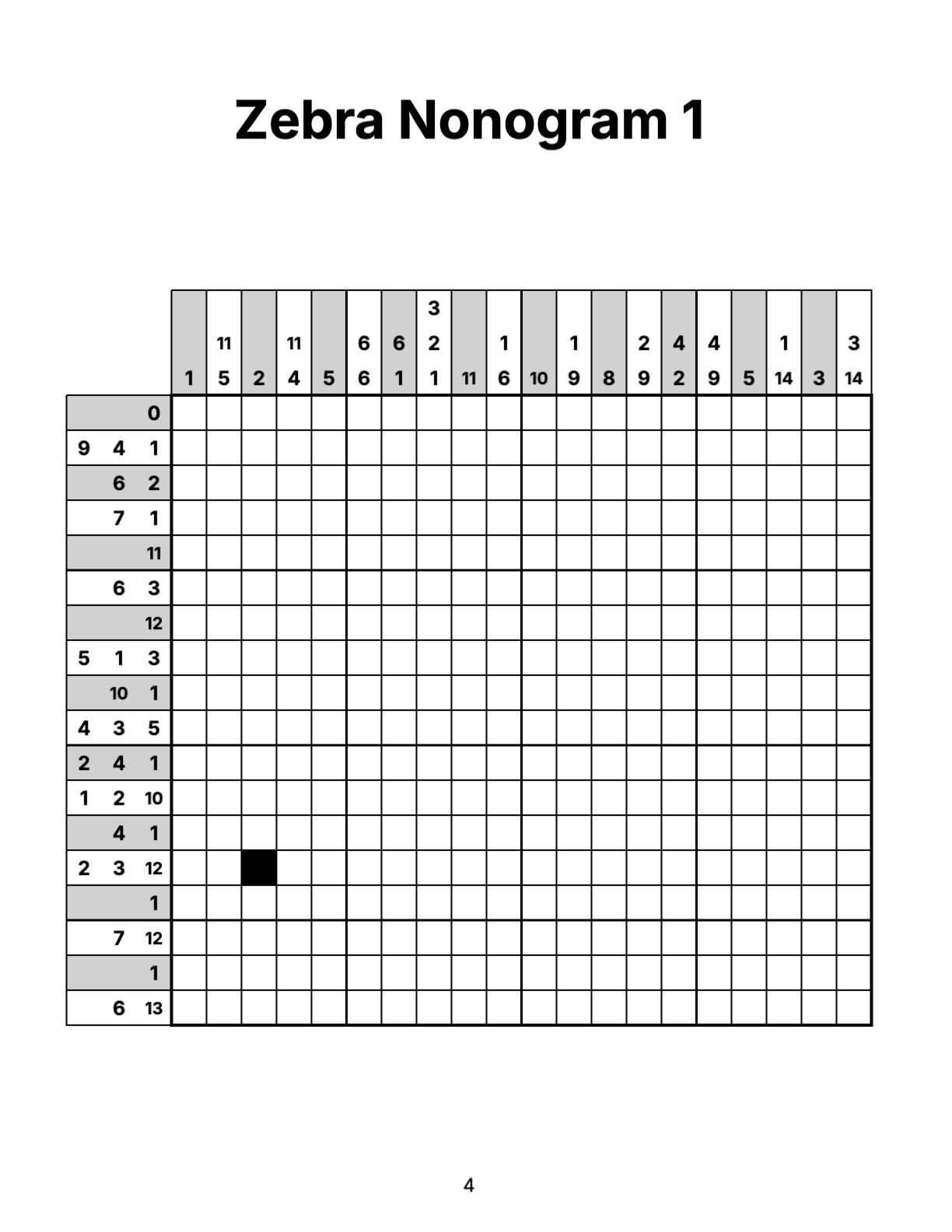
A shaded line is solved like any nonogram line. For a white line, swap the roles in your head: its numbers are blocks of empty squares, so slide, overlap and count them exactly as you would filled blocks, and remember that what you find are dots. On the standard page above, the second row is white and marked 9 4 1 in a line of 20. Its run of nine empty squares covers squares 5 to 9 wherever it starts, and since 9 + 4 + 1 = 14 squares are empty, exactly six are filled.
The senior page below has a quicker case. Its second row is white and marked 7 7 in a line of 15. Two runs of seven with at least one filled square between them need all 15 squares, so the row is decided at once: seven dots, one filled square in the middle, seven dots. The last row carries the same clue and the same answer.
Most zebra deductions happen where a shaded line crosses a white one. A dot found in a white row is an empty square for the shaded column below it, which counts filled blocks; a filled square found in that column is a separator between runs for the next white row. Totals make a good check: in a white line the filled squares always number the line length minus the sum of its clues.
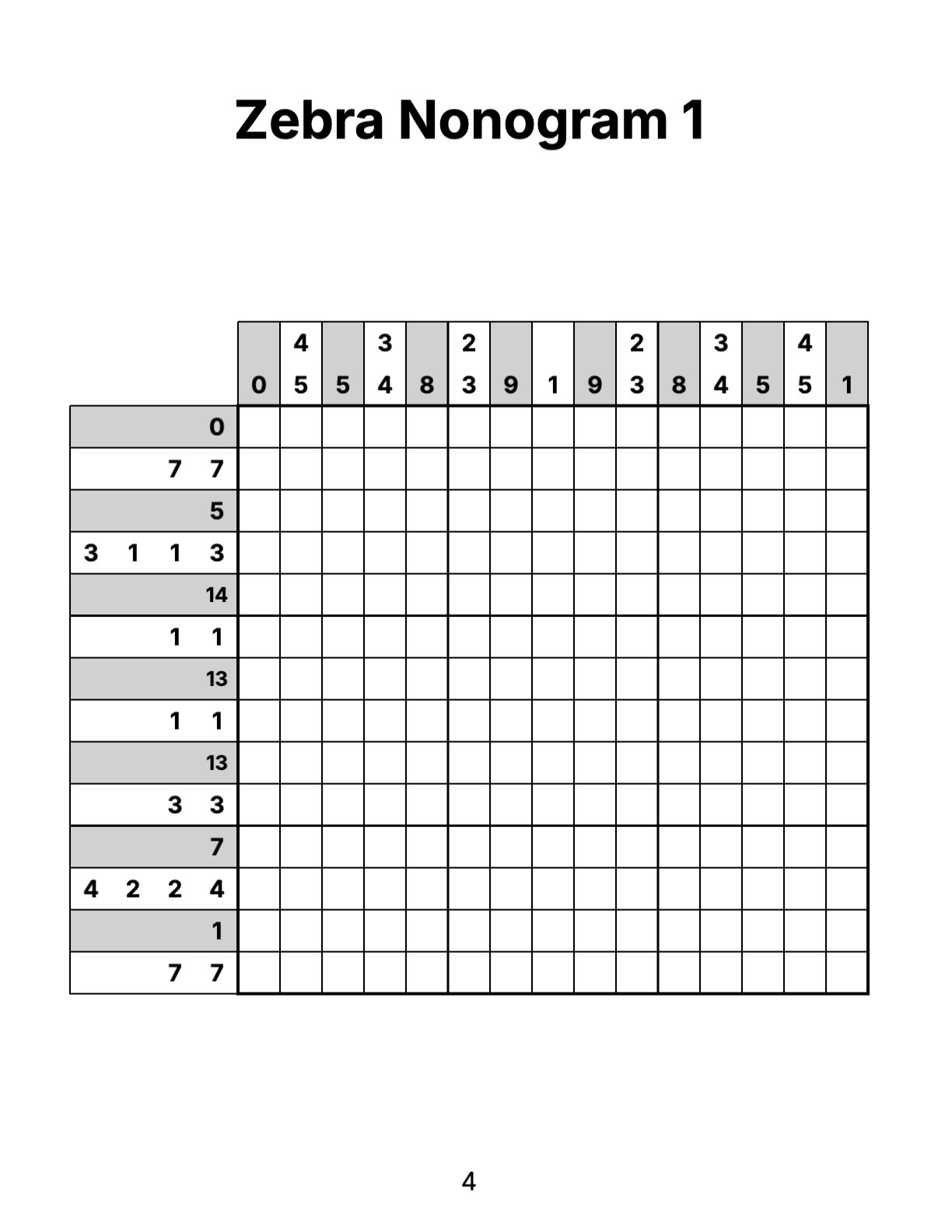
One Picture per Puzzle, Checked With the Zebra Rule
A fair zebra nonogram reaches one picture by logic alone. Wisdom Effect solves each puzzle with the zebra rule and the logic of its level before printing: Easy and Medium line by line, Hard with trial and contradiction. Where the strips leave a choice, a deciding square is printed as a given, a filled square or a dot, and the solve runs again.
The white lines describe each picture from its empty side, so the same picture may need different givens as a zebra nonogram than as a classic one. The Book Check in the configurator reports the first puzzles of your book: how many have one solution, their range on the 1–100 complexity scale, how many need trial and how many print givens.
Grid Sizes, Editions and the 20×20 Start
Zebra books use the nonogram presets, from Easy 10×10 to Expert 25×25. A new standard book starts at Hard 20×20, because the strips take room: a 15×15 grid with its strips leaves about a third of a letter page empty. Senior books start at Classic 15×15, go up to 20×20 and print one large puzzle per page.
There is no Kids edition. Reading every second line from its empty side is a step beyond the classic rule, so the variant is for solvers who already know nonograms; children start better with a Kids nonogram book. Holiday editions put the season’s pictures first.
| Edition | Presets and grids | Logic | Puzzles per page |
|---|---|---|---|
| Standard | Easy 10×10, Medium 15×15, Hard 20×20 (default), Expert 25×25 | Line by line up to Medium, trial from Hard | 1, 2 or 4 |
| Senior | Relaxed 10×10, Classic 15×15 (default), Challenging 20×20 | As Standard, large print | 1 |
Who Buys Zebra Nonograms and How to Present Them
The natural buyer already owns a nonogram book and wants the next step. A zebra book can be the second volume of a classic series drawn from the same library, or the advanced chapter of a variety book. Few buyers know the name, so explain the rule in the subtitle, for example “Zebra Nonograms: Picture Logic Puzzles with Striped Clues for Experienced Solvers”, and again in the first lines of the description.
Inside, print the instruction under each title and order the puzzles easiest first, so the first pictures teach the white lines. For large print, the Senior edition on an 8.5×11 trim gives strips and numbers room. With the wide strips, one puzzle per page keeps a 20×20 grid readable; two per page suit 10×10 grids.
Strips in Black and White Print
Readers must always see which kind of strip they are reading. The shaded strips take the book’s shading color from Puzzle Design; if that color is switched off or too faint to tell from the paper, they print as an 18 % tint of the ink instead. The numbers stay dark on both kinds of strip.
The answer key shows the solved pictures, several to a page, with their names. Titles, the instruction and the rating line follow the book language; library picture names are English, so books in other languages print only the names of your own pictures.
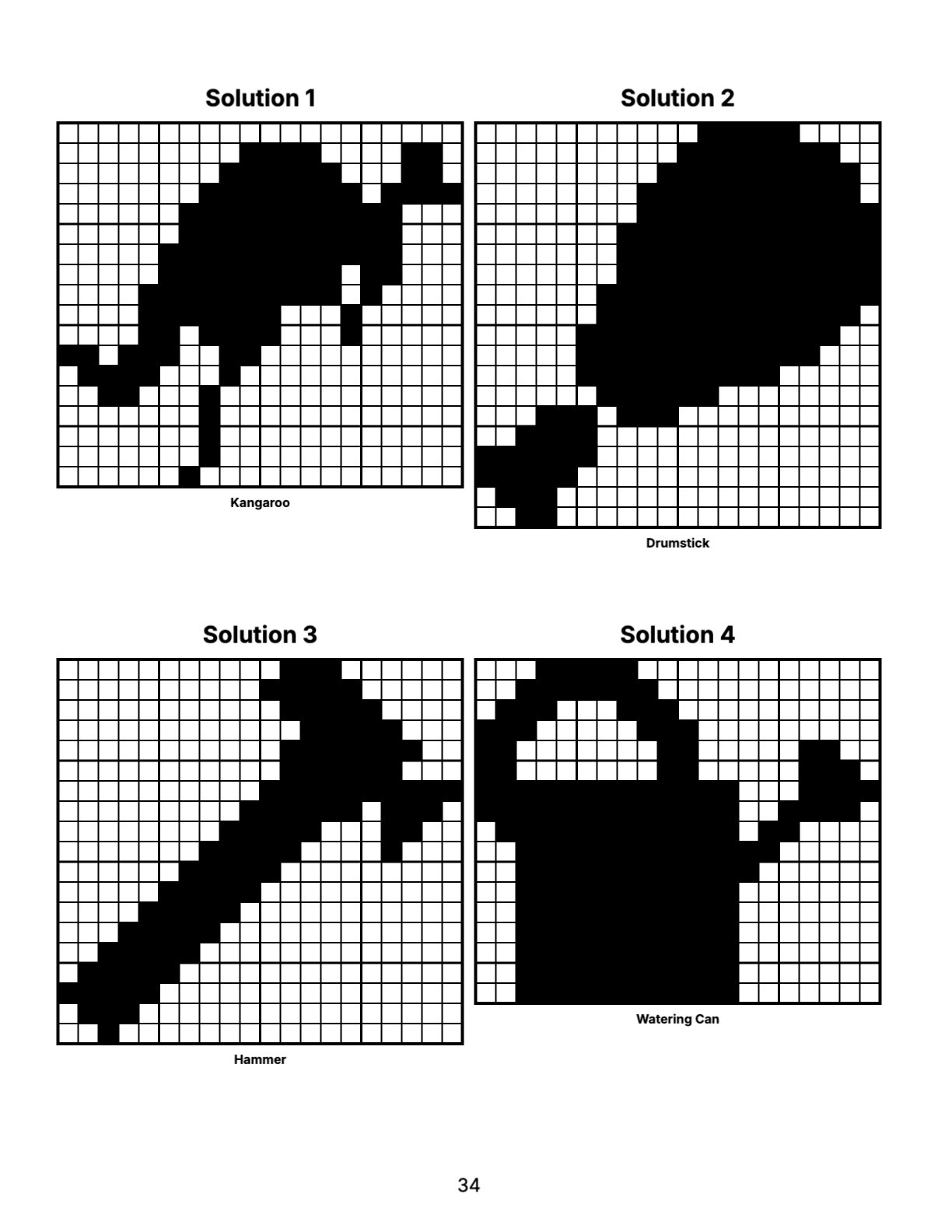
Making a Zebra Book in Wisdom Effect
On /create choose Standard, Senior or a holiday edition and the Zebra Nonograms card. Pictures come from the black and white set of the nonogram library, which holds 330+ pictures together with its color set, from patterns, or from your own images and pixel-editor drawings, each checked with the zebra rule before it is saved. In the editor, the Puzzle Design panel puts the strips in the shading color or the gray tint and sets line weights and number size; the editor guide covers the rest.
Zebra nonograms are part of the Publisher plan and the free trial, at two credits per puzzle of any size, so 50 puzzles cost 100 credits. In a mixed book, put a classic nonogram chapter first and the zebra chapter after it, so readers learn the base rule before the twist. To try the rule yourself, print the free zebra nonogram page.
Key rules
- Shaded strips list filled blocks; white strips list runs of empty squares.
- Solve a white line as a classic one with filled and empty swapped.
- A 0 on a shaded strip means all empty, on a white strip all filled.
- New standard books start at 20×20; Senior and holiday editions, no Kids edition.
Tools for This Guide
Zebra Nonogram Puzzle Book Generator
Make zebra nonogram books with striped clues in Standard, Large Print and holiday editions.
OpenFree Zebra Nonogram Generator
Print a single zebra nonogram page with its answer key, free and without an account.
OpenNonogram Puzzle Book Generator
The classic black and white nonogram books, a Kids edition included.
OpenTriangle Nonogram Puzzle Book Generator
Another black and white variant: triangle nonograms with half squares.
OpenFrequently Asked Questions
What do the white rows mean in a zebra nonogram?
Their numbers count runs of empty squares, in order. Between two runs there is at least one filled square, and the line may start or end with filled squares.
What does 0 mean in a zebra nonogram?
On a shaded strip the line has no filled squares. On a white strip it has no empty squares, so the whole line is filled.
Which lines of a zebra nonogram are shaded?
The 1st, 3rd, 5th … row counted from the top and the 1st, 3rd, 5th … column counted from the left. Their numbers are classic clues.
Is a zebra nonogram harder than a classic one?
The logic is the same, but every second line is read the other way round, which slows most solvers down at first. Grid size and level still set the difficulty.
Where does the zebra nonogram come from?
From Czech and Slovak magazines of picture logic puzzles, where it runs as the zebra variant. Zebra Nonogram is the English name used here.
How many credits does a zebra nonogram book cost?
Two per puzzle whatever the grid, so 50 puzzles cost 100 credits, on the Publisher plan or in the free trial.