In short
Shikaku asks the solver to cut a grid into rectangles, one number in each, every number equal to the area of its rectangle. It is arithmetic dressed as geometry, which suits adults who like numbers and children learning their times tables alike. This guide works through the typical moves, explains what separates a lively Shikaku page from a dull one and shows how to turn the puzzles into a KDP paperback.
On this page
Shikaku in One Rule
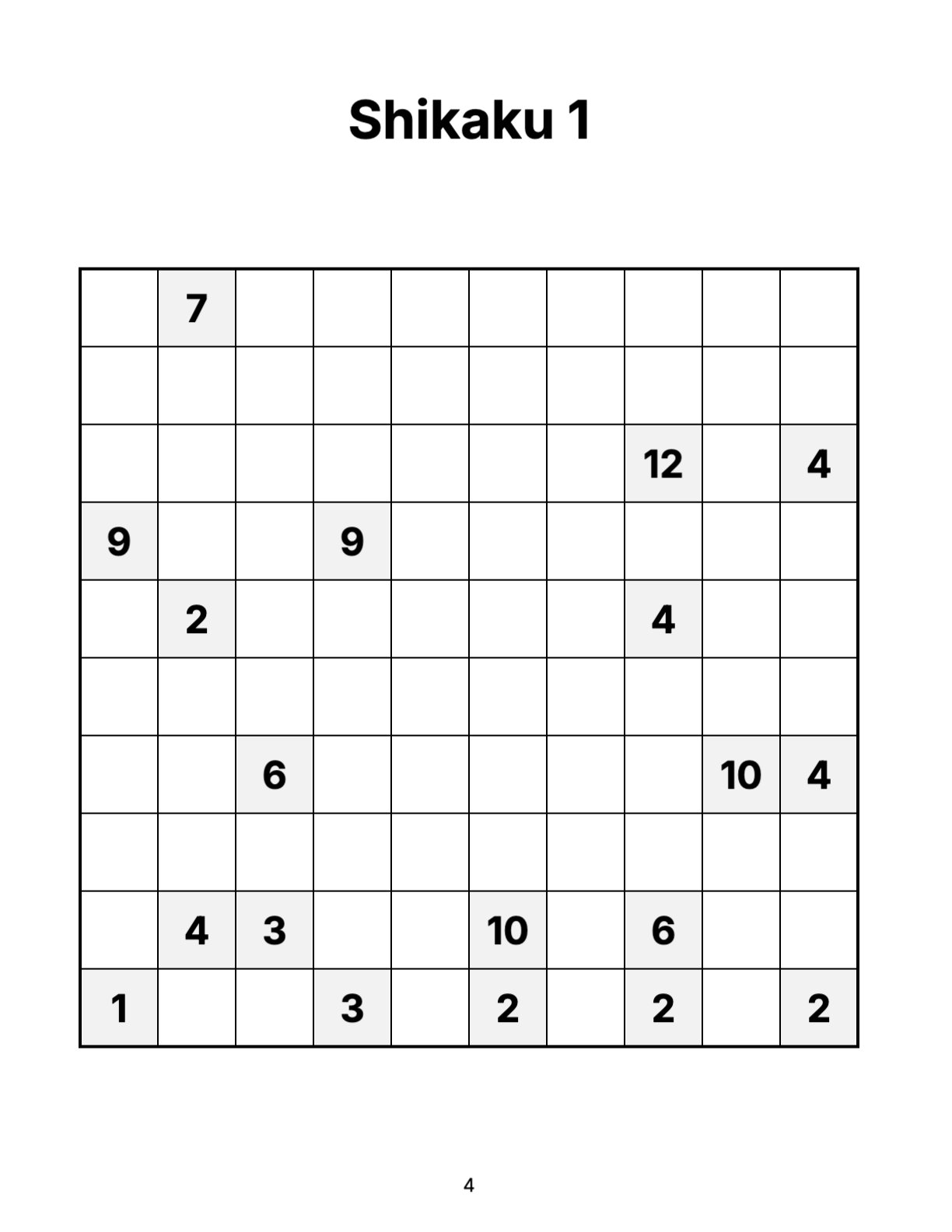
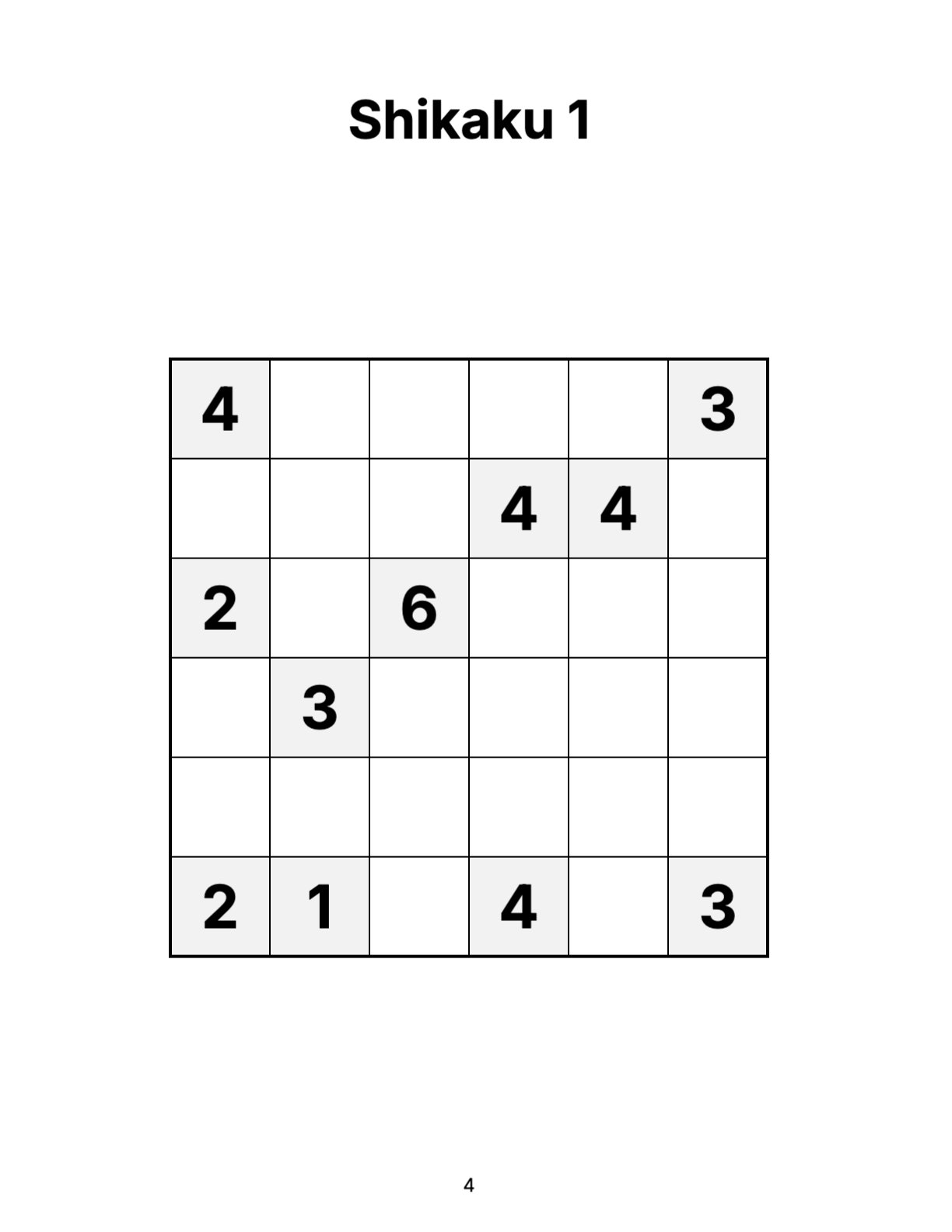
A Shikaku is a square grid with numbers scattered across it and one instruction: cut the grid along its lines into rectangles, each containing exactly one number that equals its count of squares. A 6 may become a strip of 1×6 or a block of 2×3; a 4 a strip of four or a 2×2 square, since a square is a rectangle too. The puzzle is done when every square belongs to a rectangle.
Yoshinao Anpuku invented it and the Japanese magazine Puzzle Communication Nikoli first printed it in 1989 as Shikaku ni Kire, “divide into rectangles”. English books mostly shorten that to Shikaku or translate it as Rectangles. There are no words in the grid, so the same book works for readers anywhere: only the title, the one-line instruction and the difficulty line change with the book language.
A Small Grid, Move by Move
Picture a 5×5 grid whose top-left square holds a 2, with a 3 to its right. Reaching right would put two numbers in one rectangle, so the 2 takes the square below it. The edge of the grid did half the work.
Next, a 5 in the middle of the grid. Five has no factors but 1 and itself, so its rectangle is a straight line: on a 5×5 grid the whole row or the whole column through it, and if the row already holds another number, the column. Every prime number (2, 3, 5, 7, 11) is a strip.
Empty squares help too. If the bottom-right corner can be reached only by a 3 two squares above it, the 3 runs down the last column to the corner. And placements overlap: a 6 walled into a corridor two squares wide and four long can only be 2×3, at the top or at the bottom, so if it sits in a middle row, both middle rows are its already.
Strips, Blocks and Prime Numbers
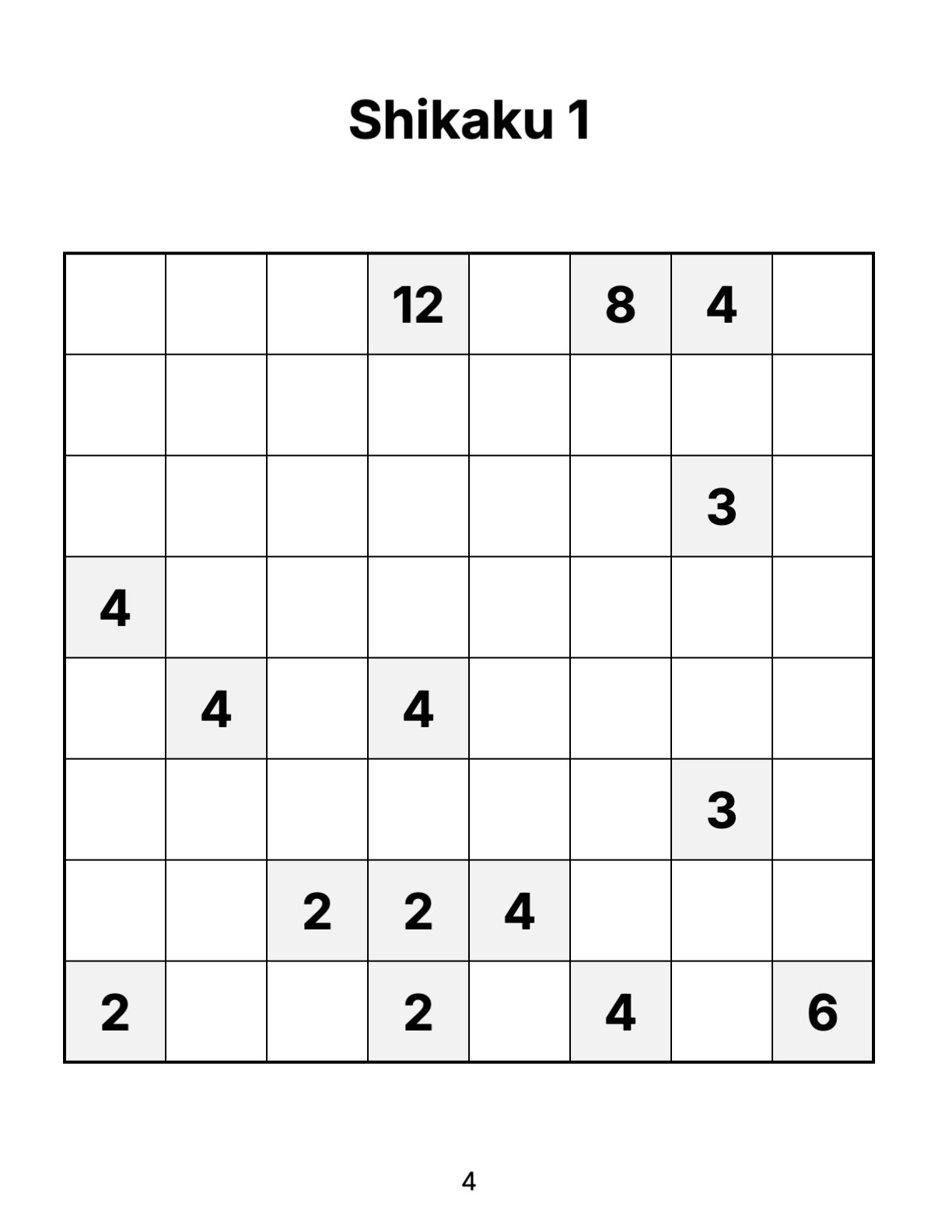
The mix of numbers decides how a Shikaku feels. Primes leave a choice of direction and position only, so a page of 2s, 3s and 5s plays like a quick scan. Numbers such as 8, 12 or 16 have several shapes each (a 12 can be 1×12, 2×6 or 3×4), and a page dominated by them is slow without being clever. A good page mixes both.
Wisdom Effect builds that mix on purpose. When it cuts an Easy grid, prime sizes get three times the weight of the others, so Easy puzzles lean toward strips beginners can place; from Medium up every size has the same chance. The largest rectangle grows with the level: 8 squares at Easy, 12 at Medium and 16 at Hard and Expert, while the Kids edition stops at 6 squares on Easy and 8 on Medium. The number of each rectangle sits on a random square of it, so readers cannot rely on corners.
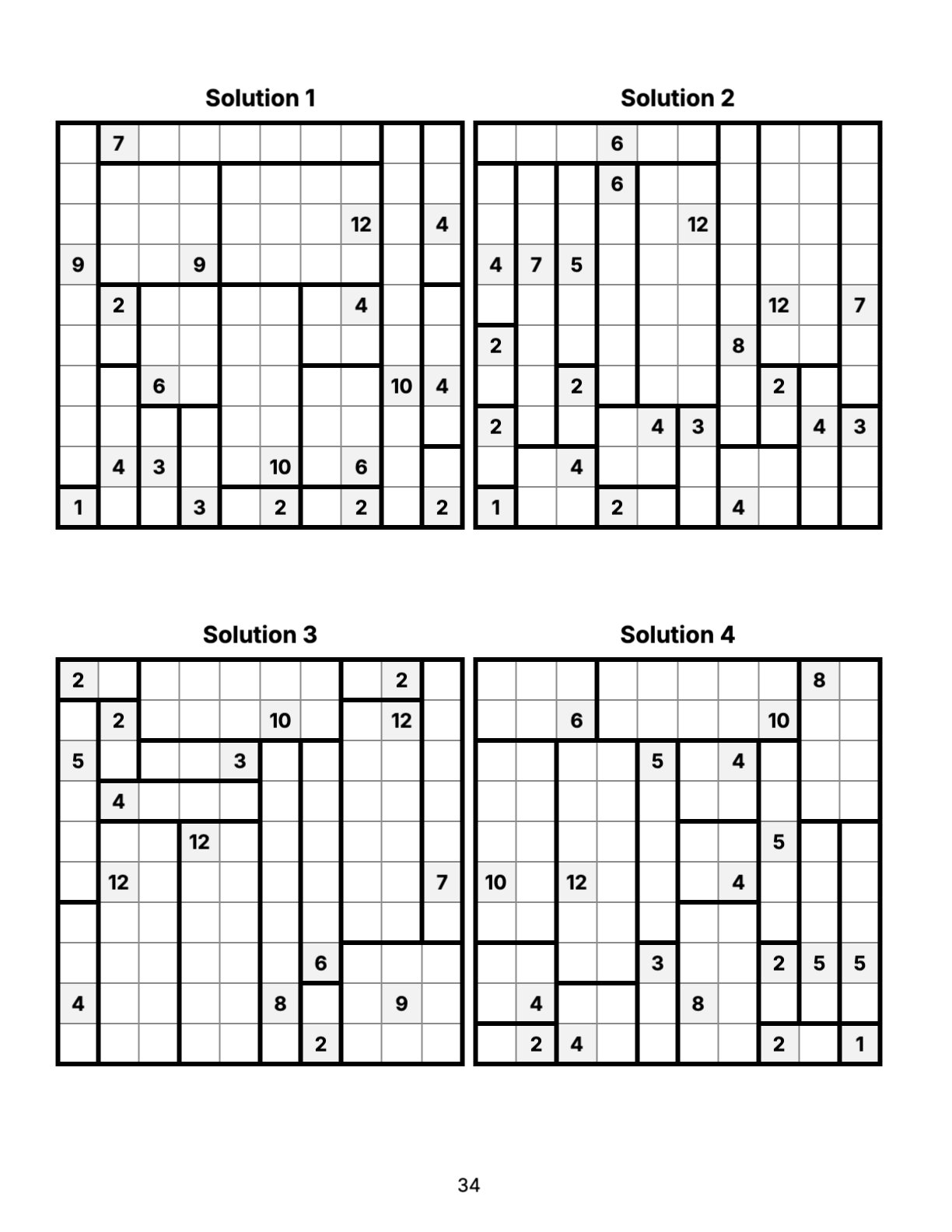
Three publishing mistakes recur with this puzzle: grids too large for the trim, where a pencil line no longer fits inside a square (the configurator warns first); answer keys whose thin lines look like the grid itself (Wisdom Effect outlines each rectangle heavily); and books that call every puzzle “hard” without saying how hard.
Four Levels, Four Kinds of Reasoning
A larger grid only means more of the same moves. The levels differ in the kind of deduction a grid demands, so a program that reasons like a reader solves each puzzle, and its level is the hardest move it needed. Easy asks for numbers with one placement left and squares only one number reaches. Medium adds squares shared by every placement of a number, as with the 6 in the corridor. Hard adds rejecting a placement that would leave a neighbour without room or strand a square. Expert adds putting a rectangle on trial and following it until something breaks: a written-down chain, not a lucky guess.
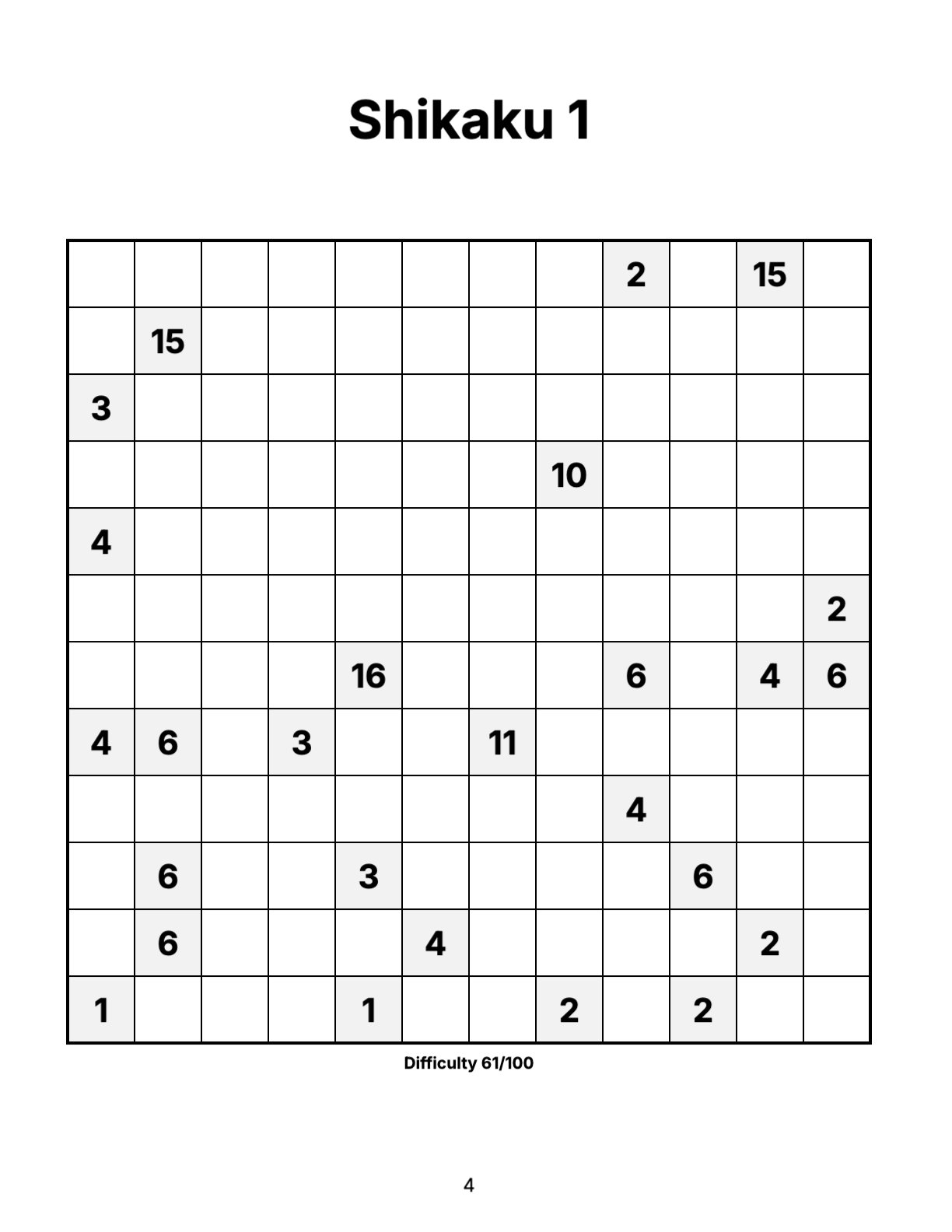
Grids the solver cannot finish never reach the page: the generator shifts a number inside its rectangle, merges two rectangles or splits one, and tries again, so every printed puzzle has a single answer. Each also gets a score from 1 to 100 (Easy 1–25, Medium 26–50, Hard 51–75, Expert 76–100), higher inside its band the more deductions it takes and the fewer numbers it gives. Printed under the grid as “Difficulty 42/100”, it shows which puzzles of a level are the tough ones.
| Level | New kind of move | Largest rectangle | Preset grid | Credits per puzzle |
|---|---|---|---|---|
| Easy | One placement left; a square only one number reaches | 8 squares | 8×8 | 1 |
| Medium | Squares every placement of a number shares | 12 squares | 10×10 | 1 |
| Hard | Placements that would block a neighbour | 16 squares | 12×12 | 1 |
| Expert | A rectangle on trial, followed to the end | 16 squares | 14×14 | 2 |
Kids, Standard and Senior Books
Children meet the puzzle as counting and shapes, and soon as multiplication: asking how a 12 can lie is times-table practice with a pencil. The Kids edition has three presets, Tiny (5×5, ages 6 and up), Small (6×6, ages 7 to 8) and Big (8×8 at Medium, ages 9 and up). Adults who already solve number puzzles get longer solves from 12×12 up.
For seniors the size of a square matters more than the size of the grid. The Senior edition prints one puzzle per page in large type, with the presets Relaxed (6×6, Easy), Classic (8×8, Medium) and Challenging (10×10, Hard). For a large print book the dedicated large print generator page collects the settings of every type.
| Edition | Grid sizes | Levels | Puzzles per page | Answers per page |
|---|---|---|---|---|
| Kids | 5×5 to 8×8 | Easy, Medium | 1 or 2 | 1, 2 or 4 |
| Standard | 7×7 to 17×17 (Expert up to 15×15) | Easy to Expert | 1, 2 or 4 | 1, 2, 4, 6 or 9 |
| Senior | 6×6 to 10×10 | Easy to Hard | 1 | 1, 2 or 4 |
Positioning a Shikaku Book on Amazon
A Shikaku book speaks to readers who like number logic without arithmetic drills. English books also print the puzzle as Rectangles, so a subtitle can carry both names, for example “Shikaku Puzzle Book: 120 Rectangles Logic Puzzles from Easy to Expert”. A kids title works better naming the age and the skill: “Rectangle Puzzles for Kids 7–9: Shapes and Multiplication”. State the grid sizes and the puzzle count in the description.
Plan the page count before you design: one hundred puzzles one per page plus an answer key at nine per page come to 112 pages before the title page and contents, far above the 24 KDP needs. On a pocket 6×9 book, try two grids per page and watch the configurator, which warns when squares would print too small to draw in. Grading the book from Easy to Expert gives readers somewhere to start and somewhere to go.
Shikaku also earns its place in a mixed collection. It pairs naturally with Galaxies, the other puzzle of dividing a grid, and with Suguru, another grid split into outlined regions. The mixed puzzle book guide shows how to give each chapter its own level and settings.
Making the Book in Wisdom Effect
Pick the edition on the create page and click the Shikaku card; the standard edition opens on the Medium preset, 10×10. A preset sets level and grid together, the Logic & Printing panel changes the level alone and switches the score line, and the slider sets the grid. The Book Code fixes the set of puzzles: the same code rebuilds the same book. The Book Check re-solves the first grids and reports how many logic finished, their score range and their average number of rectangles. The editor guide shows every screen.
Each Shikaku costs one credit, two when it is Expert or larger than 12×12, so 80 Hard puzzles at 12×12 cost 80 credits and 80 Expert ones 160. The book type belongs to the Pro and Publisher plans and the free trial; a book in another language than English needs Publisher or the trial. Large books keep generating in the background while you work on the design.
Launch Shikaku Editor opens the pages. Under Puzzle Design you choose whether numbered squares are shaded, how heavy the border and the solution rectangles are drawn, whether the grid prints as lines or as rounded or dashed tiles, and how large the numbers are. Then export the interior as a PDF and design the cover, whose spine width follows the page count.
Key rules
- Prime numbers are always strips; composite numbers give the reader choices.
- Easy grids favour prime sizes and rectangles of up to 8 squares; Hard and Expert allow 16.
- Kids presets run from 5×5 at age 6 to 8×8 at age 9; seniors get one large grid per page.
- Expert puzzles and grids larger than 12×12 cost two credits each.
Tools for This Guide
Shikaku Puzzle Book Generator
Shikaku puzzle books: one solution each, Easy to Expert, difficulty scores, Kids & Large Print.
OpenFree Shikaku Puzzle Generator
A free printable Shikaku page in Easy or Medium with an answer key.
OpenKids Puzzle Book Generator
Kids puzzle books: Shikaku, mazes, word search and more, with big squares and simple rules.
OpenFrequently Asked Questions
How do you solve a Shikaku puzzle?
Draw rectangles along the grid lines so that each one holds a single number equal to its count of squares. Begin with numbers near the edges that fit one way only, place prime numbers as strips, and ask for each empty square which numbers could still reach it.
Is Shikaku the same as Rectangles or Divide by Box?
Yes, all are one puzzle. Shikaku shortens the Japanese title Shikaku ni Kire, meaning “divide into rectangles”. Nikoli, its first publisher, calls it Divide by Box in English, other books print Rectangles or Divide by Squares, and Sikaku is another spelling.
How many rectangles does a Shikaku grid have?
It depends on the size and the level. In Wisdom Effect an Easy 8×8 grid holds about 18 rectangles, a Hard 12×12 about 24 and a 17×17 about 45. However many there are, their numbers add up to the squares of the grid.
What is the difference between Shikaku and Galaxies?
Both divide a grid into regions. In Shikaku every region is a rectangle and its number gives the area. In a Galaxies puzzle a region can take any shape, no size is given, and each region must look the same after a half turn around its dot.
Can I print Shikaku puzzles for free?
Yes, for personal and classroom use: the free Shikaku generator makes Easy and Medium pages with answers and needs no sign-up. Puzzles for a book you sell come from the book generator, and books made on a paid plan include a commercial licence.