In short
A Number Path hides one route through every square of the grid: 1, 2, 3 and onward to the last square, each step going up, down, left or right. Because the path never moves diagonally, a checkerboard pattern governs where every number can stand. This guide shows that rule and other solving tricks, explains why these puzzles print so few numbers, walks through the levels and editions, and gives title and pairing ideas for a Number Path book on Amazon KDP.
On this page
What Is a Number Path?
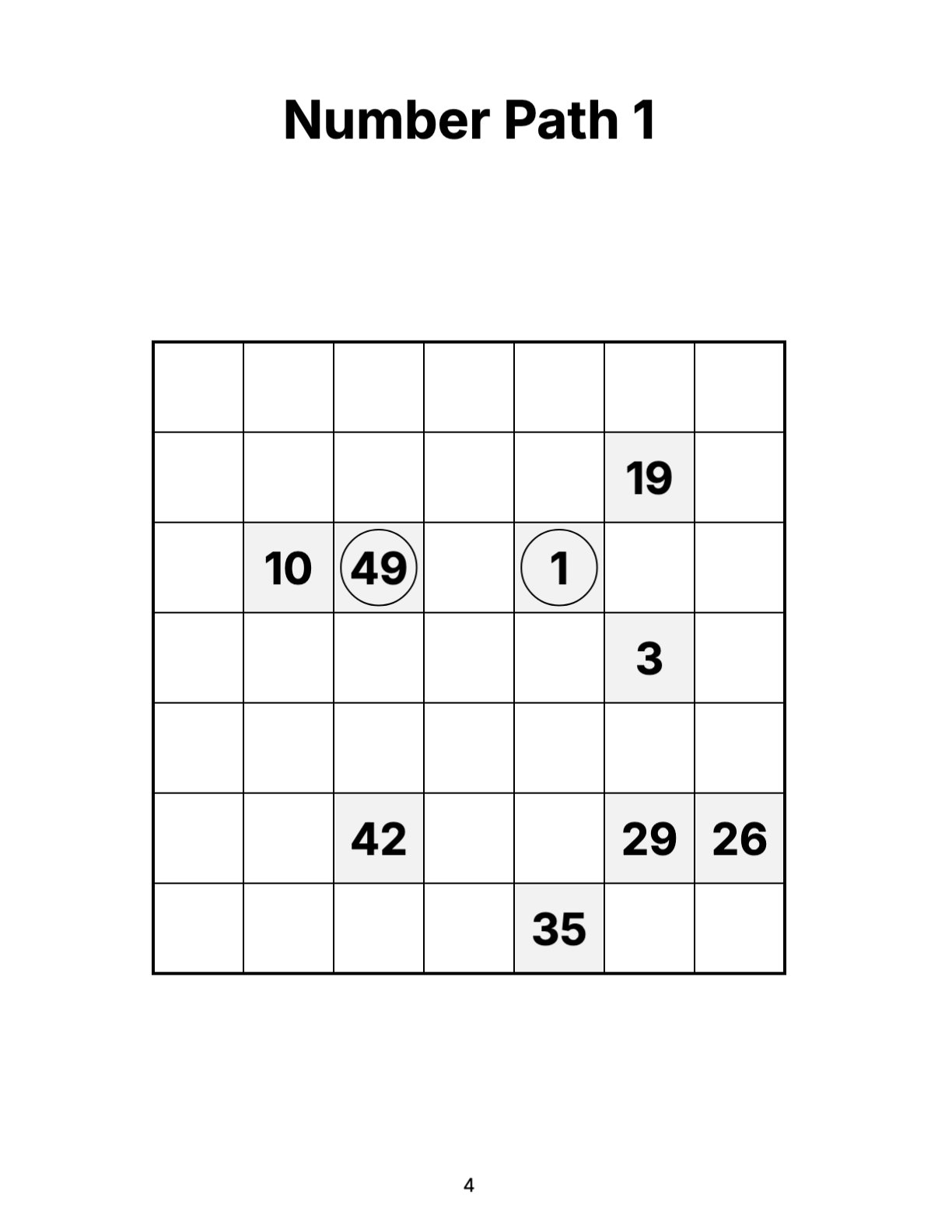
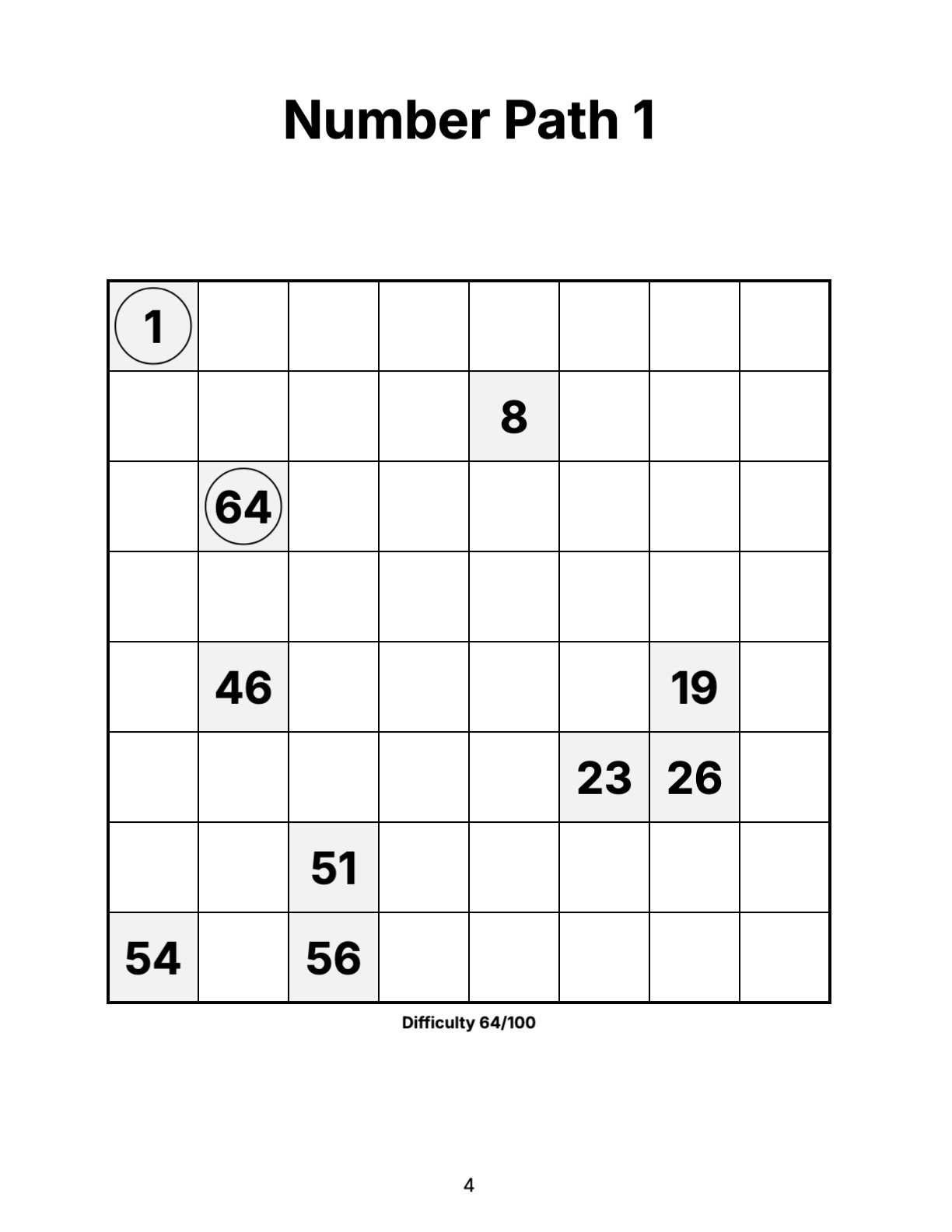
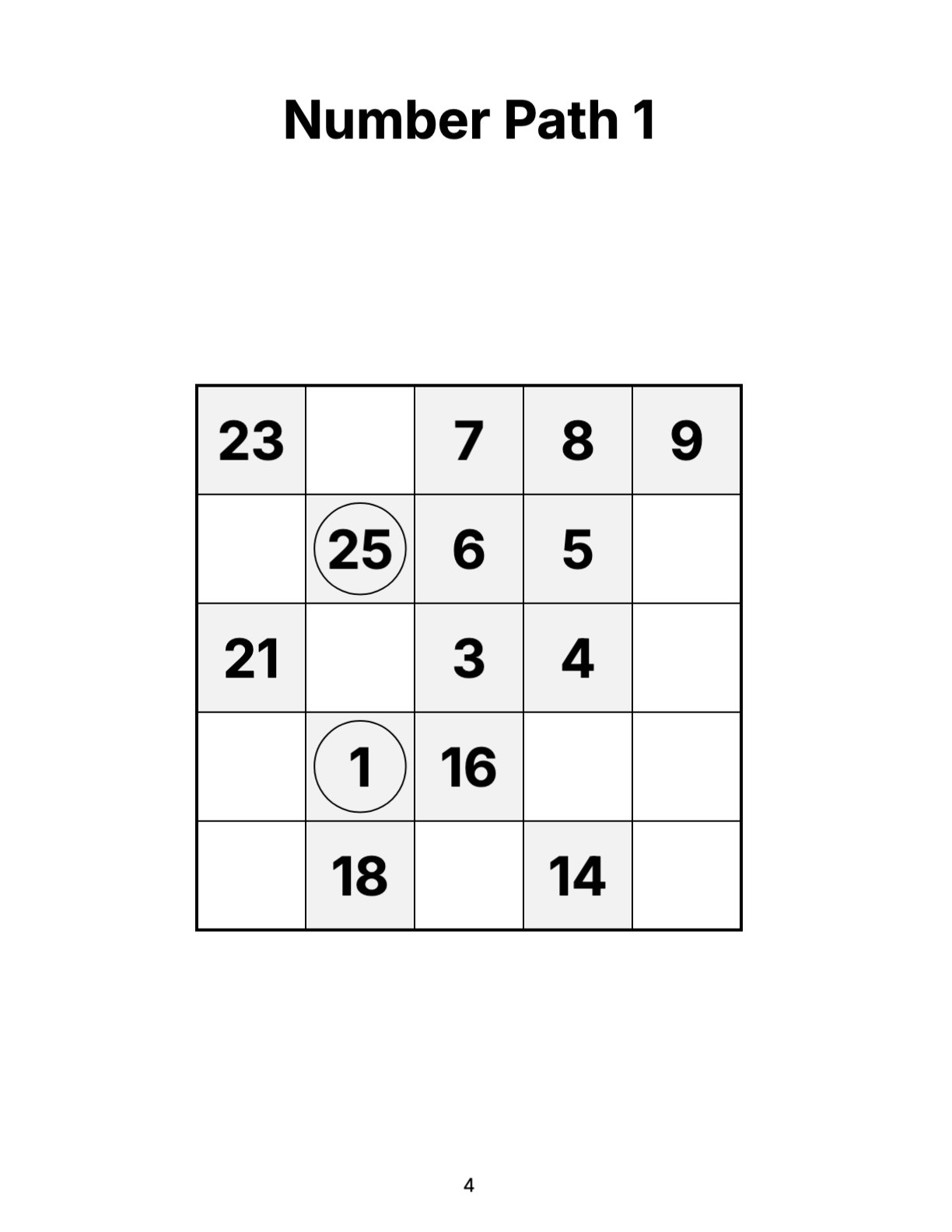
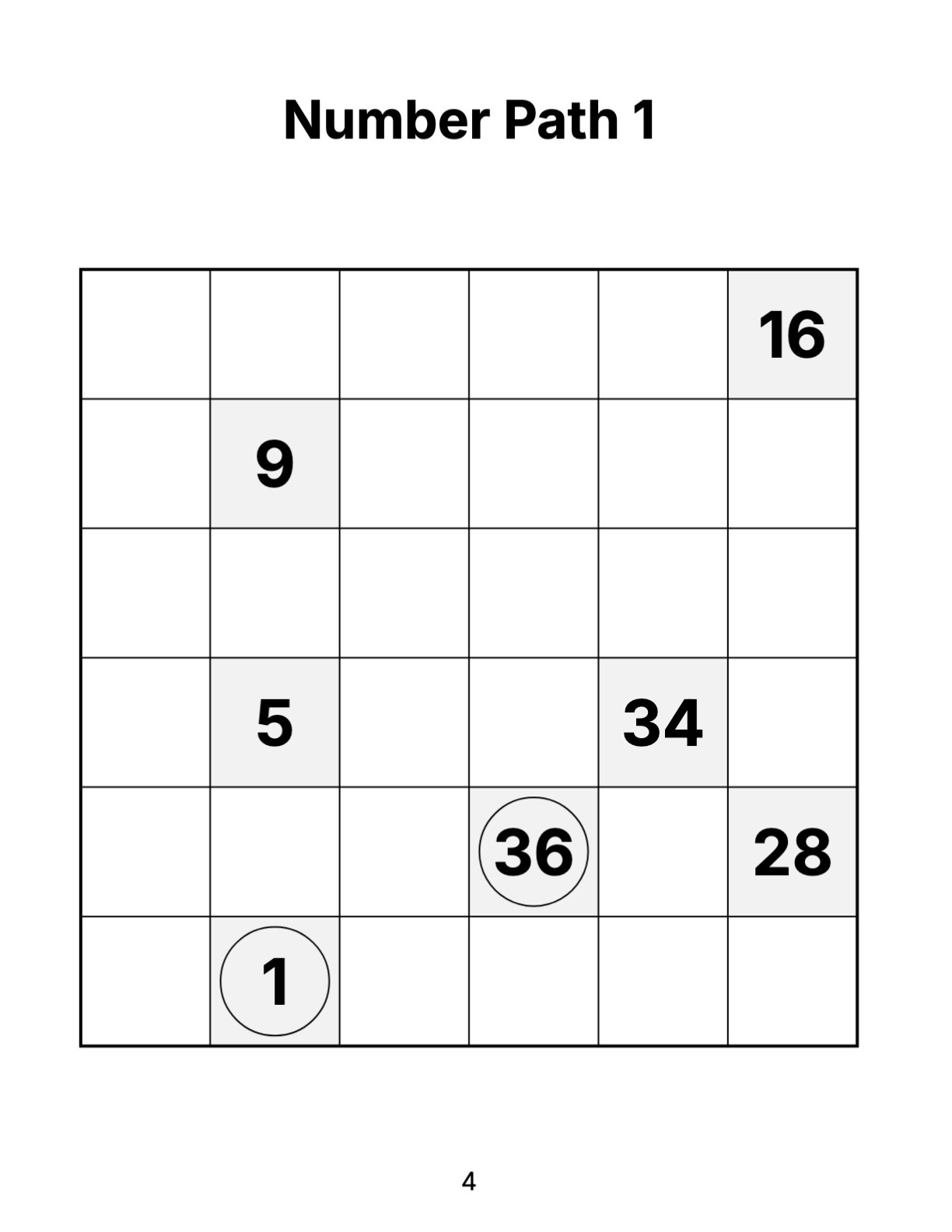
The grid of a Number Path has room for every number from 1 to its number of squares, 1 to 64 in an 8×8 grid. Write them all in and they trace a single path: each number sits directly above, below, left or right of the one after it, never diagonally. A few numbers are printed, among them the first and the last, which wear a ring; the solver restores the path in between.
Mathematicians would call the answer a Hamiltonian path, a route that visits every square exactly once, so the puzzle is also described as a Hamiltonian path puzzle or an orthogonal number chain. Marilyn vos Savant made it popular in her column in Parade magazine. It is the side-step relative of Hidoku, and that one difference in movement changes how it is solved.
The Checkerboard Rule
Imagine the grid colored like a chessboard. Every side step moves to the other color, so consecutive numbers always stand on different colors, all odd numbers share one color and all even numbers the other.
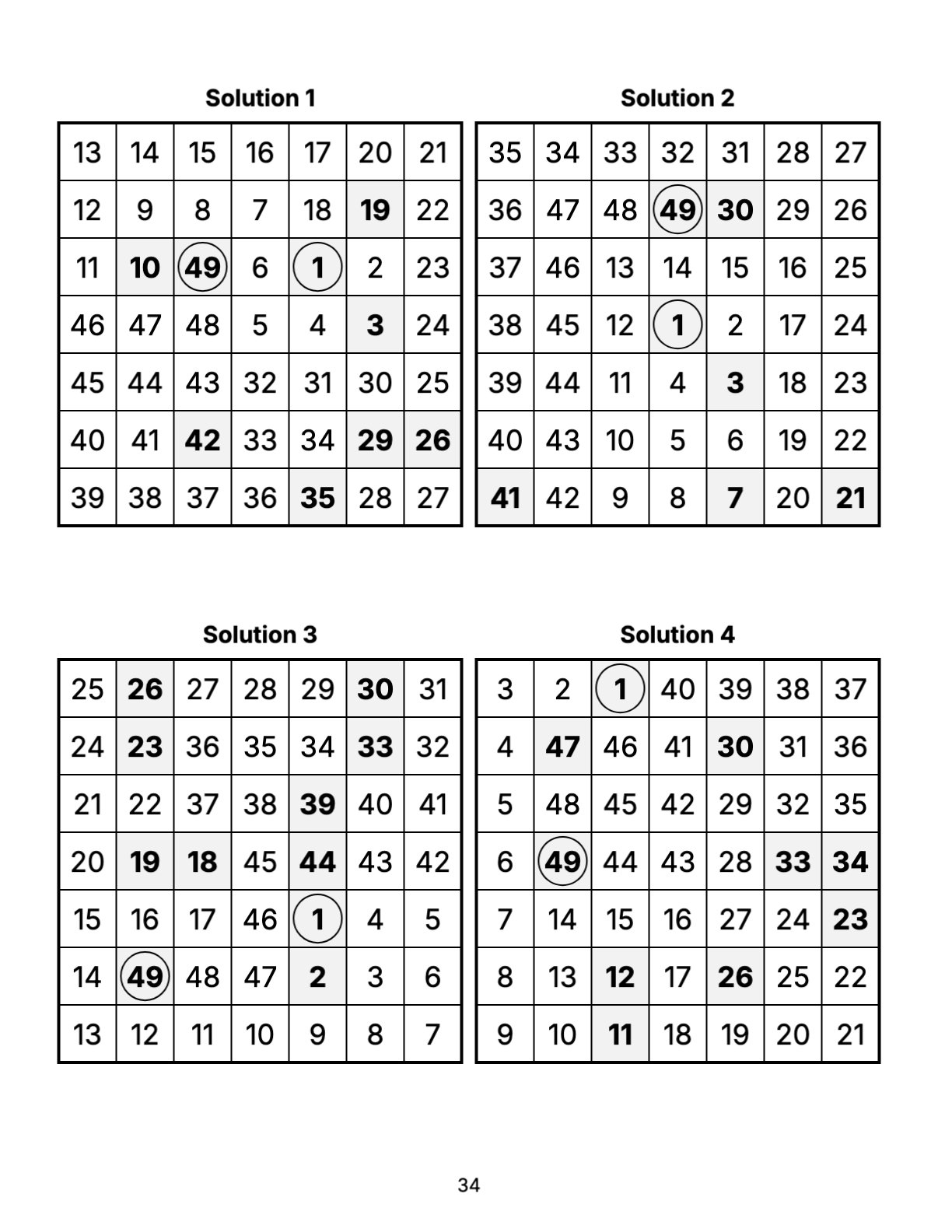
In a grid with an odd side the rule becomes very concrete. A 7×7 grid has 25 squares of the corner color and 24 of the other, and the numbers 1 to 49 include 25 odd ones. The odd numbers therefore fill exactly the corner-colored squares, and the 1 and the 49 both sit on that color. In a 6×6 grid the colors split 18 to 18, the 1 is odd and the 36 even, so the two ends always stand on different colors.
The rule also checks distances. Count the side steps between two printed numbers, ignoring walls: that count can never exceed the difference between the numbers, and it is always odd when the difference is odd and even when it is even. A printed 10 and 13 can be three steps apart, or one, but never two. Readers use this to rule out squares, and to spot their own mistakes early.
Corners, Straight Runs and Pockets
A corner square has only two neighbors. The 1 and the last number are always printed, so an empty corner holds some number with its predecessor on one neighbor and its successor on the other. If one neighbor shows 27 and the other is empty, the corner is 26 or 28. Edges are almost as useful, with three neighbors each.
When two printed numbers are exactly as many steps apart as their difference, the path between them must take a shortest route. A 31 and a 35 four squares apart in the same row leave no freedom at all: 32, 33 and 34 fill the squares between them. When the two numbers are not in a line, the run still has to take a shortest route, and printed numbers nearby usually leave only one or two of those open.
Harder puzzles add routes that bend around printed numbers, pairs of missing numbers that share the same two squares, and walled-off pockets of empty squares that the runs of missing numbers able to reach them must fill exactly. Expert puzzles need forcing chains: put a number on one of its two squares, follow the consequences, and if they collapse, it belongs on the other.
Why So Few Numbers Are Printed
With at most four neighbors per square and the checkerboard working against every wrong turn, a side-step path is far more constrained than a diagonal chain. A Number Path can therefore be cut back to very few printed numbers and still have only one answer. In the Wisdom Effect presets an Easy 6×6 grid shows 15 of its 36 numbers, but a Medium 7×7 grid only 6 to 11 of 49, a Hard 8×8 grid 7 to 12 of 64 and an Expert 9×9 grid 8 to 12 of 81.
The generator works backwards from a finished path. It draws a path of side steps through every square, then removes numbers in a seeded order, never the 1 or the last, and accepts each removal only if a solver restricted to the level can still restore the path. Easy keeps at least 40 % of the numbers; Medium and above go as low as their techniques permit. A path the solver restores has exactly one solution.
The score from 1 to 100 is calibrated on Number Path grids, so a Hard puzzle lands between 51 and 75 like a Hard puzzle of any other type, even though it prints fewer numbers than a Hidoku of the same size. The hardest technique picks the quarter; the amount of reasoning and the emptiness of the grid place it inside.
| Level | Reasoning required | Grid | Numbers printed |
|---|---|---|---|
| Easy | Next step; a number with one square left | 6×6 | 15 of 36 |
| Medium | Step counting on the checkerboard; a square only one number reaches | 7×7 | 6–11 of 49 |
| Hard | Routes, pairs, walled-off pockets | 8×8 | 7–12 of 64 |
| Expert | Forcing chains | 9×9 | 8–12 of 81 |
Editions for Children, Adults and Seniors
Children see a Number Path as connect-the-numbers with a twist: they have to find where the numbers go before they can join them. The Kids edition offers 4×4 to 6×6 grids at Easy and Medium and keeps extra numbers on Easy, so the Tiny 4×4 preset prints 9 of its 16 numbers and the Small 5×5 preset 14 of 25. The Big preset, for ages 9 and up, is a 6×6 grid at Medium. Asking a child to draw the finished path as a line is a nice extra.
Adults use the standard edition, grids from 5×5 to 10×10 at all four levels. Large print readers get the Senior edition: 5×5 to 8×8, Easy to Hard, one puzzle per page, with a Relaxed preset at 5×5, Classic at 6×6 and Challenging at 7×7.
| Edition | Sizes | Levels | Last number |
|---|---|---|---|
| Kids | 4×4–6×6 | Easy (extra numbers), Medium | 16, 25 or 36 |
| Standard | 5×5–10×10 | Easy, Medium, Hard, Expert | 25 up to 100 |
| Senior | 5×5–8×8 | Easy, Medium, Hard | 25 up to 64 |
Producing the Book
Open the create page, pick the edition and the Number Path card; the editor guide shows the general workflow. A preset sets level and grid at once. The Book Code makes every puzzle reproducible from the same code, and the Book Check generates the first eight puzzles and tells you how many came out easier than their level.
In the editor, the grid can be drawn as lines, tiles or dashed tiles, with the printed squares shaded or left white; the rings around the 1 and the last number use the inner line weight. At 10×10 the path ends at 100, so the numbers print a little smaller to fit three digits, and the configurator warns if any square would fall below about 7 mm. The answer key prints the full path with printed numbers in bold.
Number Path is on every plan, Starter included, and in the free trial. A puzzle costs one credit, an Expert puzzle or any grid above 8×8 two, so a book of 80 Hard 8×8 puzzles costs 80 credits.
Titles, Buyers and Companion Puzzles
Number Path is a plain, descriptive name, which makes titles easy to read: “Number Path Puzzles: 100 Logic Grids, Connect 1 to 64 Without Diagonals, with Solutions”. A kids edition can lead with the activity (“Connect the Numbers Logic Puzzles for Kids 6–9”), a senior edition with the print size. Keep other publishers’ trade-marked names for the same rules out of the title, subtitle and keywords; the FAQ names the one to avoid.
Because so few numbers are printed, a Hard or Expert Number Path looks almost empty, which some readers love and others find daunting. Say in the introduction that the bare look is intended, and for a new audience a Medium book is a safer start than an Expert one. Amazon KDP may remove a book that uses another company’s trade mark, so the plain name is also the safe one.
The natural companion is a Hidoku chapter: the same idea with diagonal moves. In a mixed activity book it also sits well beside Takuzu, Suko and Magic Squares.
Key rules
- Every step goes up, down, left or right, so odd and even numbers sit on opposite colors.
- Empty corners hold a number between their two neighbors; use them early.
- Number Path prints far fewer numbers than Hidoku and still has one solution.
- The kids Tiny and Small presets print more than half of the numbers.
Tools for This Guide
Number Path Puzzle Book Generator
The Number Path book generator: side-step paths from 4×4 to 10×10, on every plan.
OpenFree Number Path Puzzle Generator
A free printable Number Path page with its answer key.
OpenKids Puzzle Book Generator
Children’s puzzle books with small Number Path grids among other first puzzles.
OpenFrequently Asked Questions
How do you solve a Number Path puzzle?
Fill in the missing numbers so that 1 up to the last number form one path, each number directly above, below, left or right of the next. Start with short gaps and with empty corners: a corner has only two neighbors, so its number lies between theirs.
How is Number Path different from Hidoku?
In Hidoku the chain may also step diagonally; in Number Path it never does. That makes the path easy to follow by eye and lets very few printed numbers fix the answer. Parade magazine runs puzzles with Number Path rules as Numbrix®, so print Number Path on your cover. Numbrix® is a registered trade mark of Parade's publisher; Wisdom Effect is not connected with Parade.
Why do Number Path puzzles print so few numbers?
Each square has at most four neighbors and the checkerboard pattern rules out many routes, so fewer numbers are enough for one solution. A Hard 8×8 puzzle typically prints 7 to 12 of its 64 numbers.
Is a Number Path the same as a Hamiltonian path?
The answer to a Number Path is a Hamiltonian path on the grid: a route through every square exactly once, moving between side neighbors. The printed numbers fix where some of its steps fall.
Is Number Path good for kids?
Yes, from about six on a 4×4 grid with most numbers printed. It practices counting and the order of numbers, and the finished path can be drawn as a line. The Kids edition stops at 6×6.
Which plans include Number Path?
All of them: Starter, Pro and Publisher, plus the free trial. One credit per puzzle, two for Expert puzzles and grids bigger than 8×8.