In short
The same quote can be a gentle warm-up or a puzzle for experts, depending on the cipher. We printed one Benjamin Franklin quote as an Aristocrat, a Patristocrat, a shift code and a number code, and measured what really sets the difficulty: length and revealed letters.
On this page
Aristocrat: the Classic
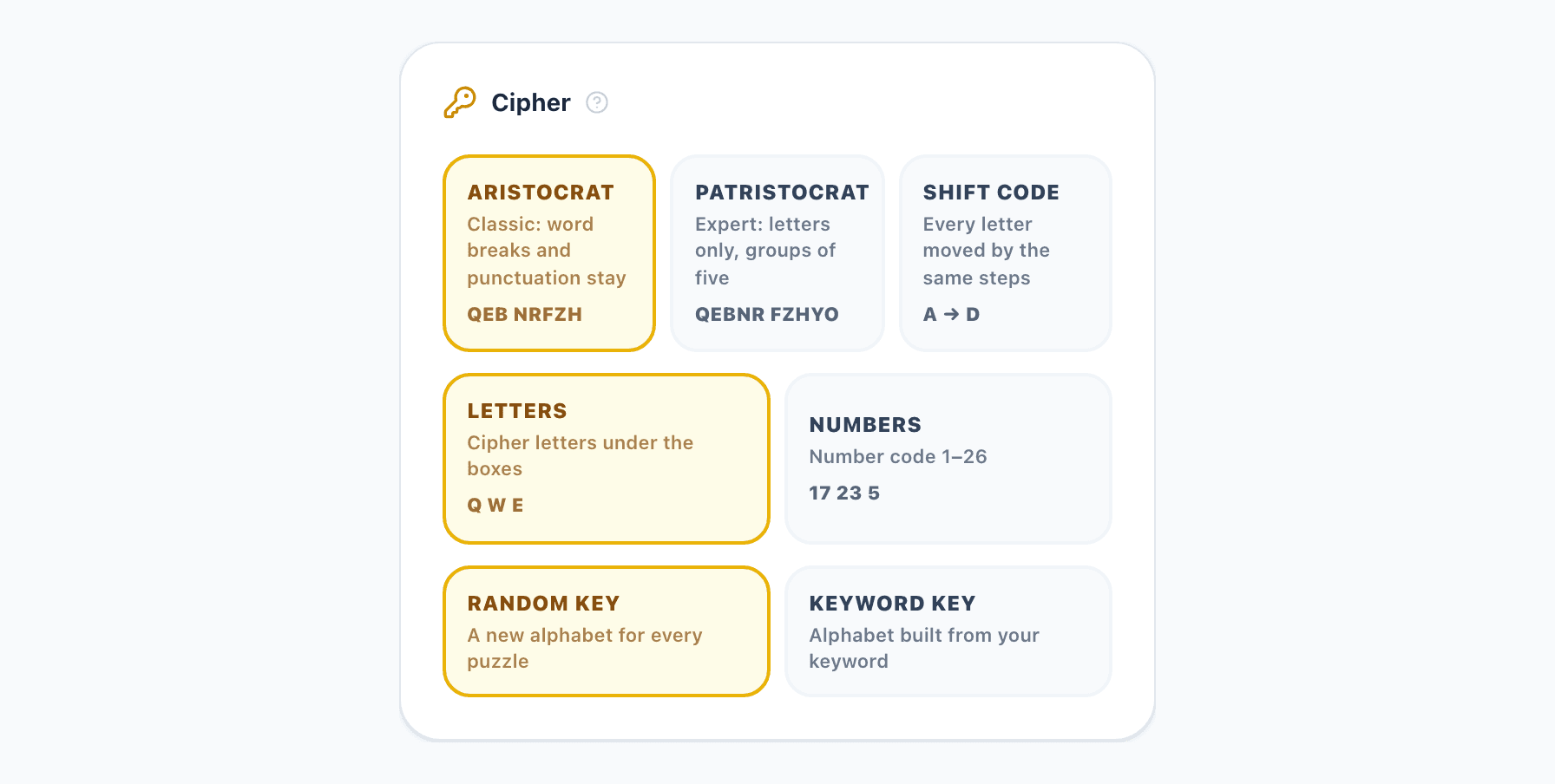
An Aristocrat is a simple substitution cipher with the word breaks and punctuation left in place. Every letter of the alphabet is swapped for another one, and the swap stays the same through the whole puzzle. This is the cryptogram most readers know from newspapers, and the right default for adult books.
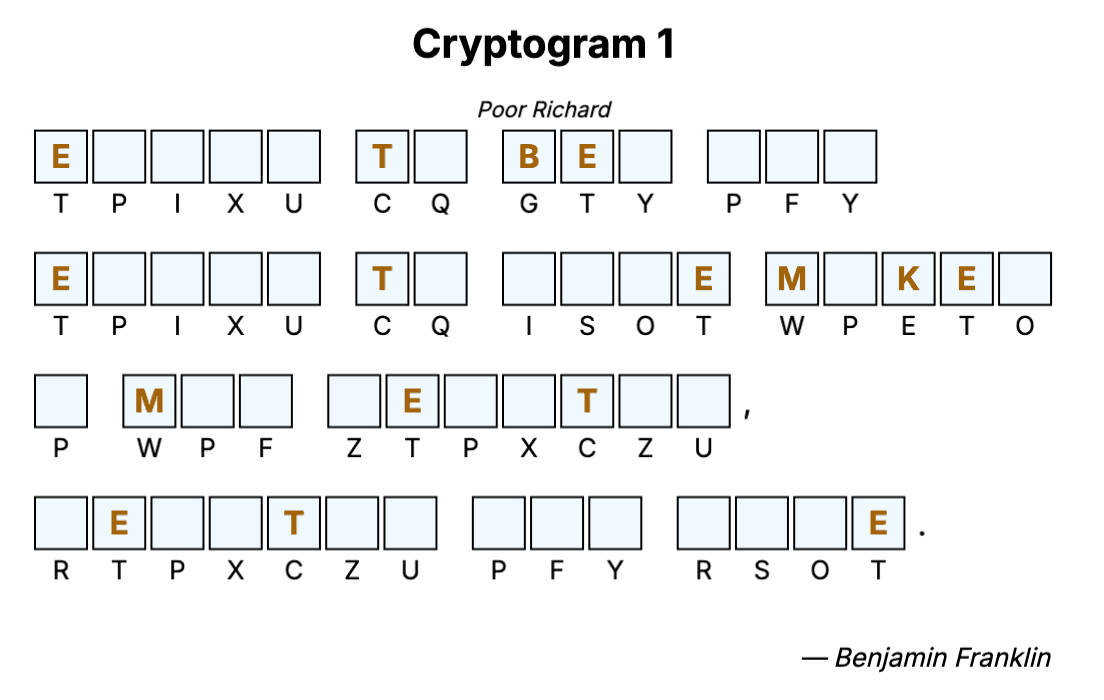
Solvers start with the shapes. In the Franklin quote below, the one-letter word P can only be A or I, the repeated pair TPIXU CQ shows that two words come back, and the comma and full stop mark where clauses end. Each solved letter then appears in other words, so the puzzle opens up step by step.
Tips about THE, AND or apostrophes (DON'T, IT'S) apply to quotes and sentences. The built-in themes of our generator are lists of themed words (animals, space, food…) under a title, so there the title and the topic are the solver's first clue. Quotes come from your own CSV, with the author printed under the puzzle.
Patristocrat: No Word Breaks
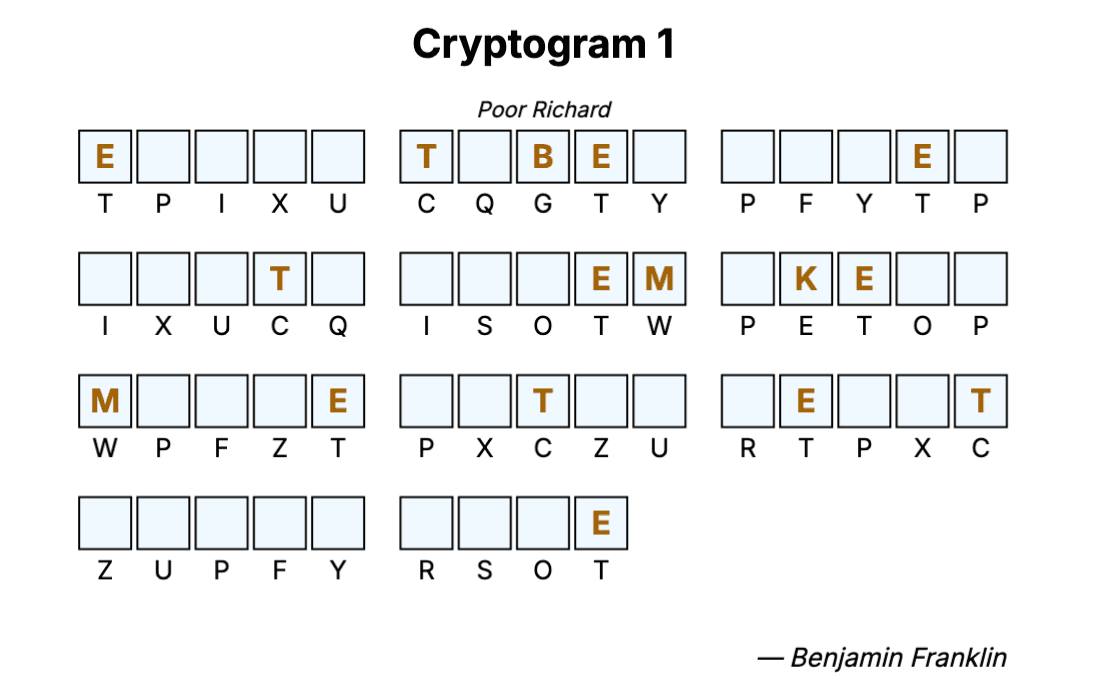
A Patristocrat uses the same kind of key, but prints only the letters: punctuation is removed and the text is cut into groups of five. Word shapes are gone, so solvers lean on letter frequency (E, T, A, O are the most common letters in English) and on common pairs such as TH, HE, IN and ER.
The two pictures use the same book code, so the key and the revealed letters are identical: E is always T, M is always W. Only the layout changed, and that alone turns a comfortable puzzle into a hard one.
Length matters more here than anywhere else. Frequencies only work with enough letters: our Expert preset uses 12 words, about 82 letters on average, while a typical short quote has 40–50 letters and leaves very little to count. One puzzle can hold up to 250 letters.
Shift Codes and Number Codes
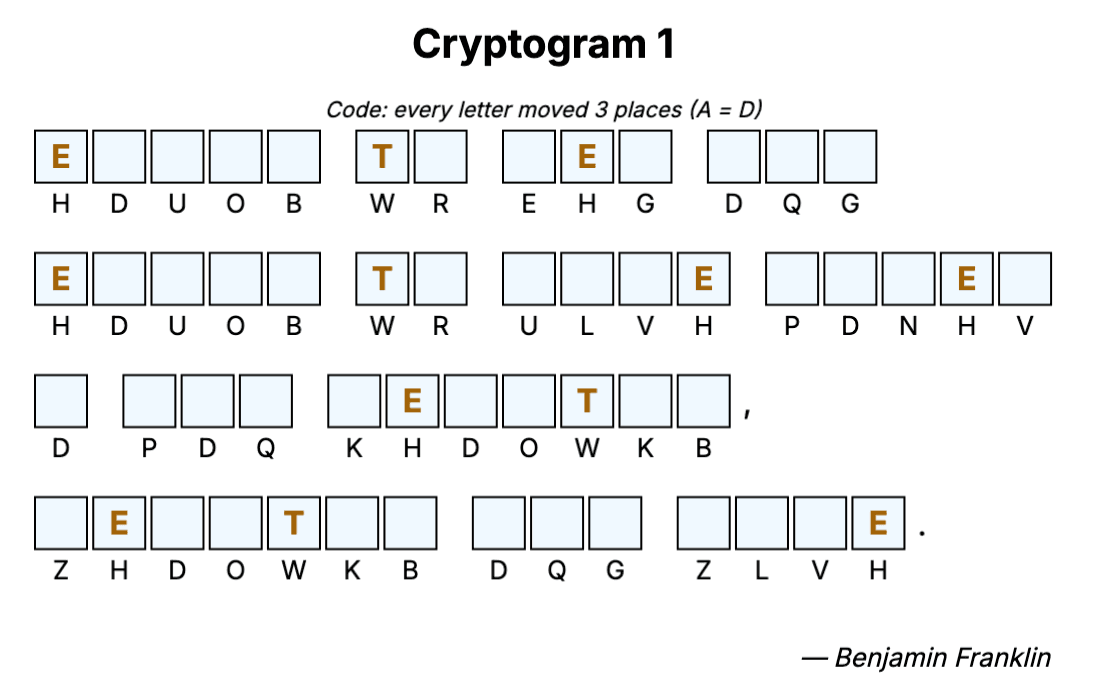
In a shift code (a Caesar cipher) every letter moves the same number of places: with a shift of 3, A becomes D and E becomes H. There are only 25 possible shifts, so once one letter is known the whole puzzle is solved. That makes it the ideal first code for children, especially when the shift is printed as a clue. Kids books print it by default; in standard books it is the "Print the shift" switch.
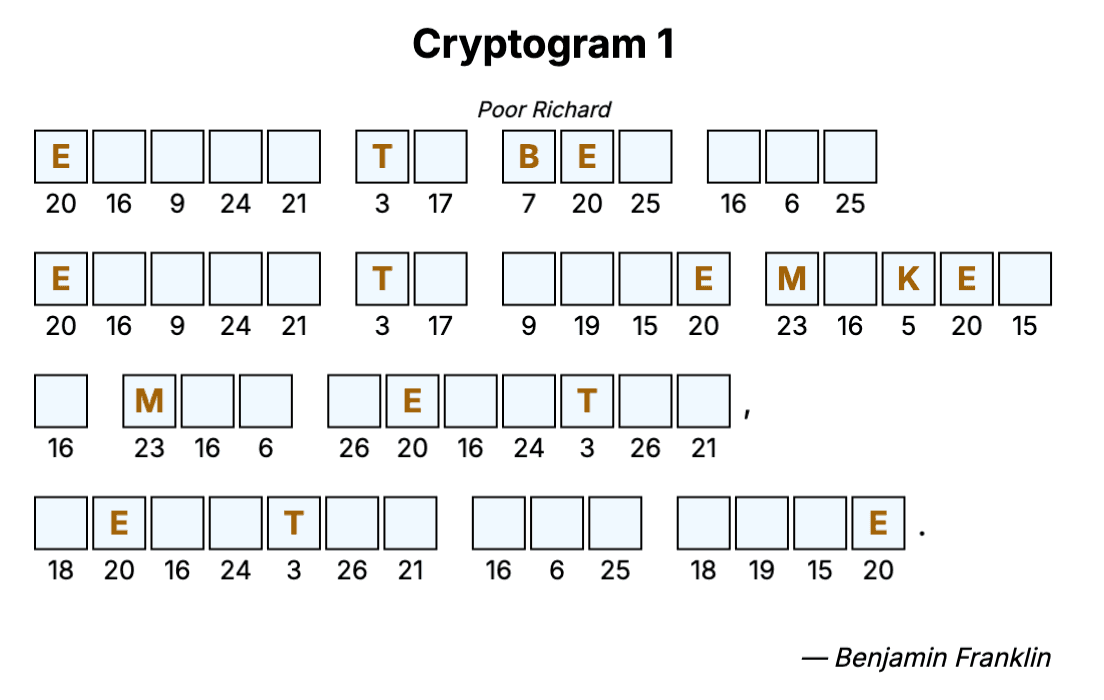
Number codes are often described as A = 1, B = 2. Ours are not: each number is the position of the scrambled cipher letter, so a number code is an Aristocrat dressed in numbers. Compare the two pictures with the Aristocrat above: E is T there and 20 here, because T is the 20th letter. No letter ever stands for itself, so 5 never means E.
The numbers make the page look like a secret message, which children love, but the cipher is as strong as an Aristocrat. Kids presets keep number codes easy by keeping the texts short and revealing 5–6 letters.
What Really Sets the Difficulty
The cipher type is one dial. The other two are the length of the text and the number of revealed letters, and they move the difficulty just as much. We generated 30 puzzles for each preset from the Animals theme and measured them.
Revealed letters in a preset are a minimum. When a text could still be read two ways, the generator reveals more letters until exactly one reading is left. In the Franklin quote the Medium preset asks for 2 revealed letters, and the check revealed 5. Short quotes are the most ambiguous: 26 of 30 needed some letters revealed even with the minimum set to 0.
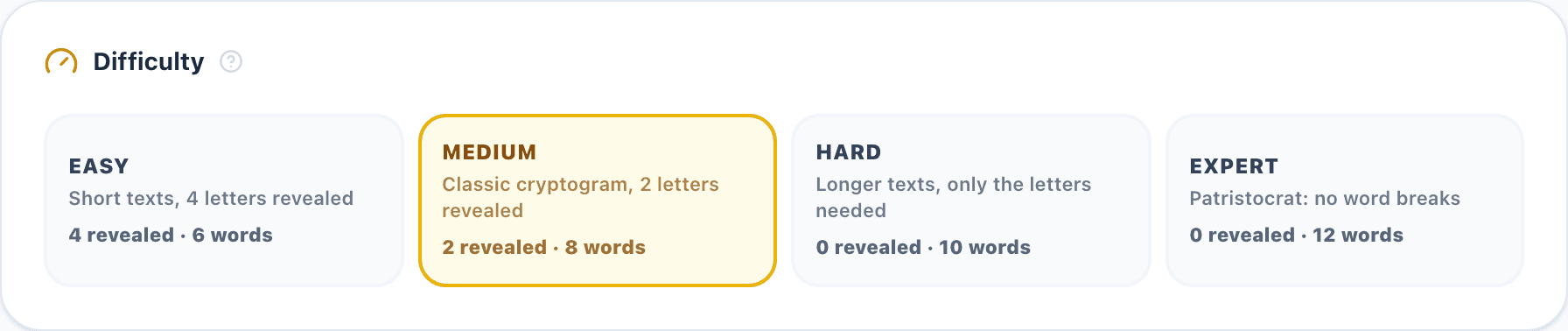
| Preset | Cipher | Words | Letters | Revealed | Puzzles with nothing revealed |
|---|---|---|---|---|---|
| Easy | Aristocrat | 6 | 43 | 4.7 (min. 4) | 0 of 30 |
| Medium | Aristocrat | 8 | 56 | 2.8 (min. 2) | 0 of 30 |
| Hard | Aristocrat | 10 | 69 | 0.9 | 19 of 30 |
| Expert | Patristocrat | 12 | 82 | 0.5 | 23 of 30 |
One Type per Book, a Ramp per Series
A cryptogram book uses one cipher and one preset for all its puzzles, and a mixed puzzle book has one cryptogram chapter. So a ramp from Aristocrats to Patristocrats inside one book is not possible. Build the ramp across a series instead: every volume has a clear promise on its cover, and readers who finish one move on to the next.
In an activity book for families, a chapter of shift codes sits naturally next to word searches, mazes and word scrambles: a kids mixed book gives the cryptogram chapter the kids rules automatically.
| Volume | Preset | Cipher | Revealed letters | For |
|---|---|---|---|---|
| 1 | Easy | Aristocrat | 4 or more | New solvers |
| 2 | Medium | Aristocrat | 2 or more | Regular solvers |
| 3 | Hard | Aristocrat | Only if needed | Experienced solvers |
| 4 | Expert | Patristocrat | Only if needed | Experts |
Key rules
- Aristocrat for most books, Patristocrat for experts, shift codes for young children.
- Number codes look playful but are Aristocrats underneath; keep them short and give a few letters.
- Length and revealed letters move the difficulty as much as the cipher type.
- One cipher per book: build a difficulty ramp as a series of volumes.
Tools for This Guide
Frequently Asked Questions
Which cryptogram type is the easiest?
A shift code with the shift printed as a clue: one known letter solves the whole puzzle. Next come short Aristocrats with a few revealed letters.
Are number codes easier than letter cryptograms?
Not by themselves. In our generator a number code is an Aristocrat with numbers instead of cipher letters, so the logic is the same. Kids presets make them easy with short texts and 5–6 revealed letters.
Does a Patristocrat have exactly one solution?
The generator checks the text with its word breaks and reveals letters until only one reading is left, then prints it without breaks with the same key and revealed letters.
Can I mix Aristocrats and Patristocrats in one book?
Not in our generator: a book uses one cipher. Publish them as a series, for example Medium Aristocrats in volume 2 and Expert Patristocrats in volume 4.
Why are Patristocrats printed in groups of five?
Grouping hides the word breaks while keeping the line readable; five letters is the traditional group size.