
Look along the edges
Every word crosses an edge, so its letters sit on both sides of a face border. Scan the squares next to each border first, not the middle of the faces.
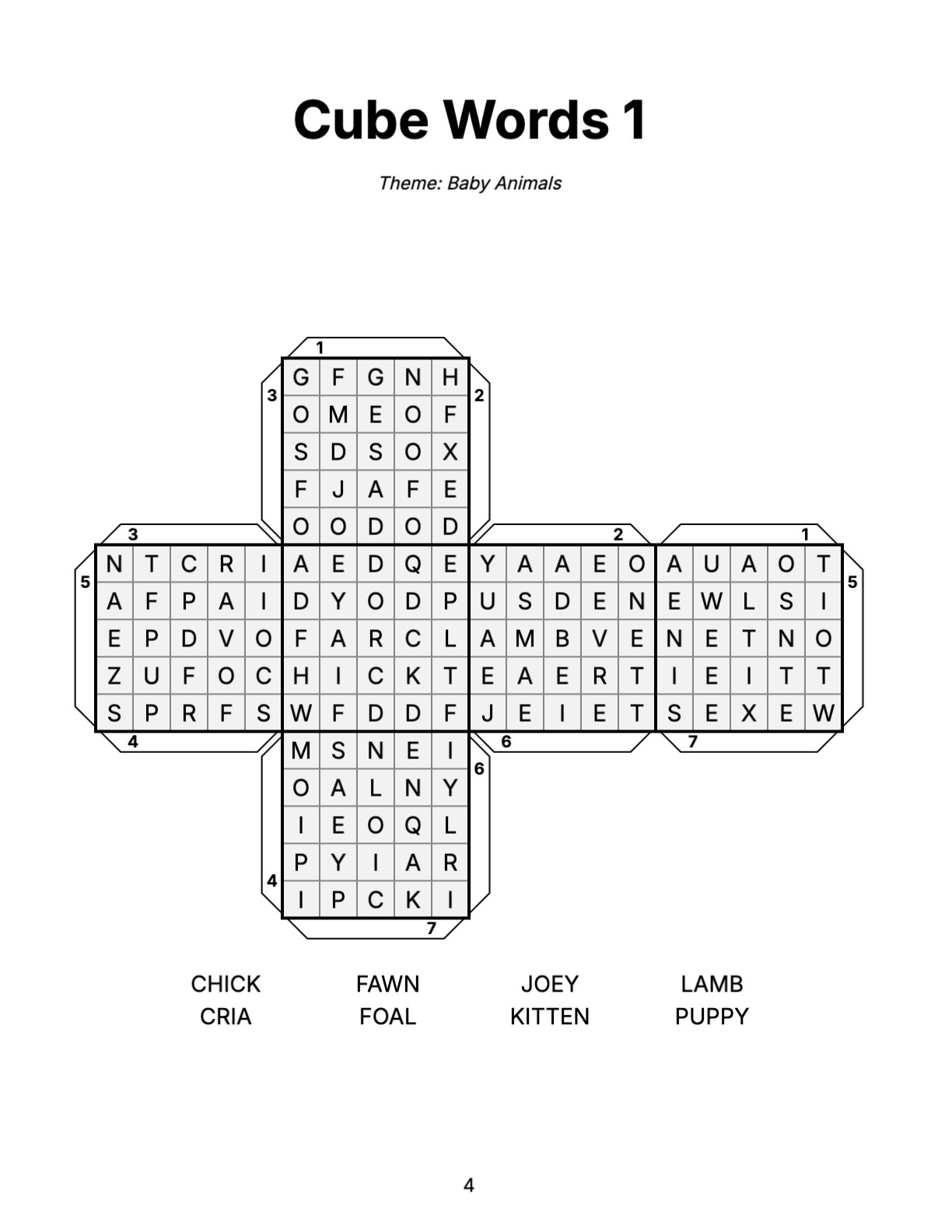
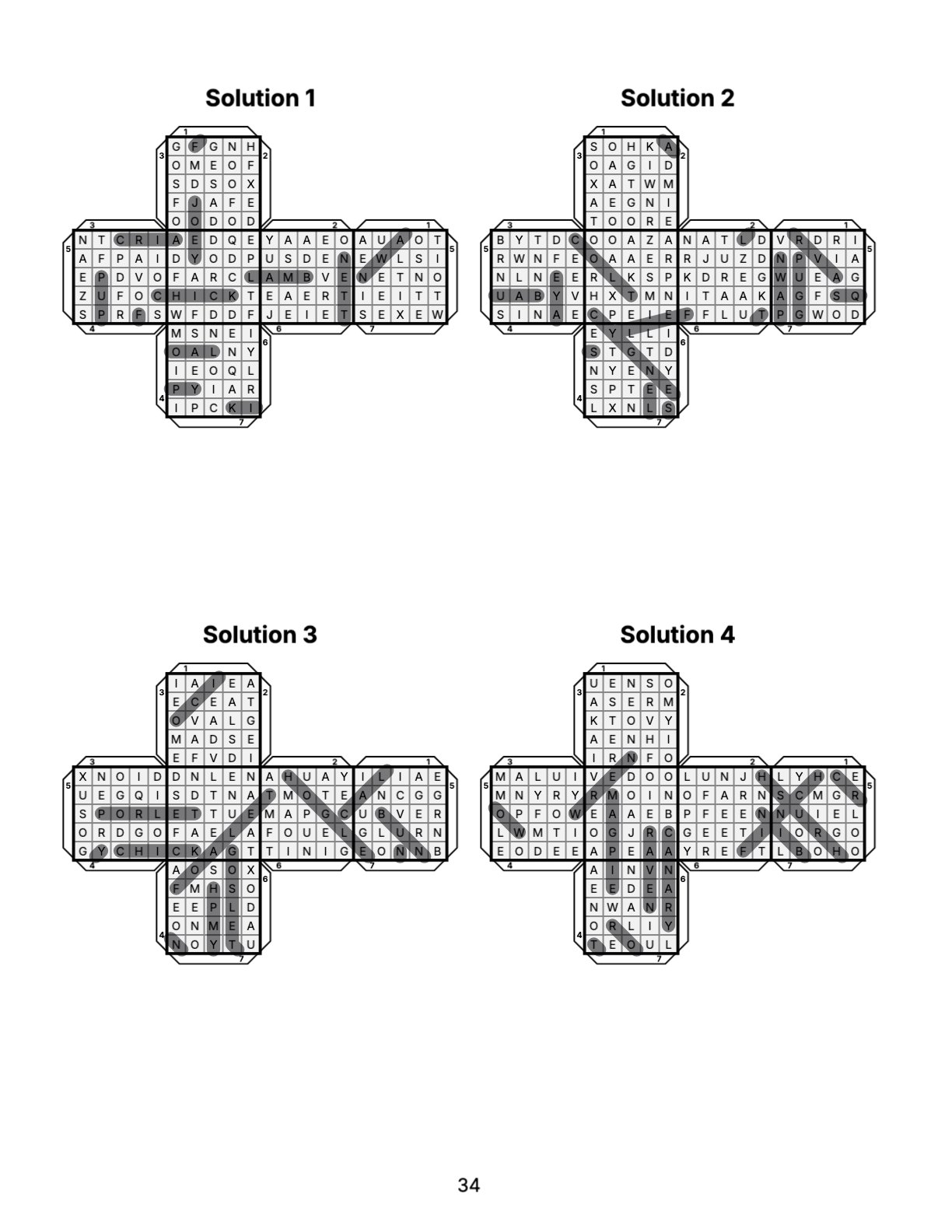
Find every word on the six faces of a cube laid flat as a net, each running in a straight line over an edge.
The page shows the six square faces of a cube as a net: top, four sides in a row, bottom.
Every word of the list runs in a straight line and crosses at least one edge of the cube onto the next face; no word passes through a corner.
Where two faces touch in the net, a word runs straight on. Where it reaches a numbered tab, it goes on at the other tab with the same number: the ends next to the numbers touch when the net is folded.
Words cross each other only on a shared letter, and every word reads in exactly one place; the other squares hold filler letters.
Start with the first way and move on when it gives nothing new.
Every word crosses an edge, so its letters sit on both sides of a face border. Scan the squares next to each border first, not the middle of the faces.
A word keeps its direction as it crosses: reading right on the front face, it reads right on the next face too. On a diagonal, both the row and the column keep moving.
At a numbered tab, find the tab with the same number and carry on from the matching square: count from the end of the edge next to the number on both sides.
If a cut edge is hard to picture, cut out a copy of the net and fold it. After a few puzzles the numbered edges are easy to follow on the flat page.
Who made Cube Word Search, when and where, and its other names: puzzle types.
Print-ready Cube Word Search books for Amazon KDP, every puzzle with its answer key.
Cube Word Search book generatorJust one page? Free Cube Word Search Generator